In Exercises 27–62, graph the solution set of each system of inequalities or indicate that the system has no solution. x2+y2<16, y≥2x
Verified step by step guidance
1
Step 1: Understand the inequalities given in the system. The first inequality is , which represents the interior of a circle centered at the origin (0,0) with radius 5, since 25 is 5 squared.
Step 2: The second inequality is , which means y is greater than or equal to the exponential function . This curve increases as x increases and passes through (0,1) because .
Step 3: To graph the solution set, first draw the circle with radius 5 centered at the origin. The solution for the first inequality is all points inside this circle, not including the boundary since the inequality is strict (<).
Step 4: Next, graph the curve . The solution for the second inequality includes the curve and all points above it.
Step 5: The solution set to the system is the region where the interior of the circle and the area above or on the curve overlap. Shade this overlapping region to represent the solution set.
Verified video answer for a similar problem:
This video solution was recommended by our tutors as helpful for the problem above
Video duration:
6m
Play a video:
Was this helpful?
Key Concepts
Here are the essential concepts you must grasp in order to answer the question correctly.
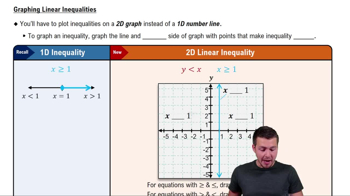
Graphing Inequalities
Graphing inequalities involves shading the region of the coordinate plane that satisfies the inequality. For example, the inequality x² + y² < 25 represents all points inside a circle of radius 5 centered at the origin, excluding the boundary. Understanding how to graph such regions is essential for visualizing solution sets.
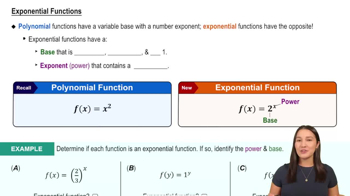
Exponential functions like y ≥ e^(x/2) grow rapidly and have a characteristic curve. When graphing inequalities involving exponentials, the region above or on the curve is shaded for 'greater than or equal to.' Recognizing the shape and behavior of exponential graphs helps in determining the solution set.
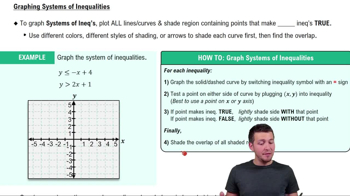
A system of inequalities requires finding the intersection of solution sets for all inequalities involved. The solution set is the region where all shaded areas overlap. Identifying this common region is crucial to solving and graphing systems accurately.