In Exercises 27–62, graph the solution set of each system of inequalities or indicate that the system has no solution. x≥0, y≥0, 2x+ 5y< 10, 3x + 4y ≤ 12
Verified step by step guidance
1
Step 1: Identify the inequalities in the system:
Step 2: Graph the boundary lines for each inequality by converting inequalities to equalities: , , , and . These lines will help define the regions for each inequality.
Step 3: Determine the shading direction for each inequality: For , shade to the right of the vertical line . For , shade above the horizontal line . For , shade below the line . For , shade below or on the line .
Step 4: Find the intersection of all shaded regions. This intersection represents the solution set that satisfies all inequalities simultaneously.
Step 5: Verify if the solution set is non-empty by checking if the feasible region exists where all inequalities overlap. If it exists, the graph of this region is the solution set; otherwise, the system has no solution.
Verified video answer for a similar problem:
This video solution was recommended by our tutors as helpful for the problem above
Video duration:
9m
Play a video:
Was this helpful?
Key Concepts
Here are the essential concepts you must grasp in order to answer the question correctly.
Graphing Linear Inequalities
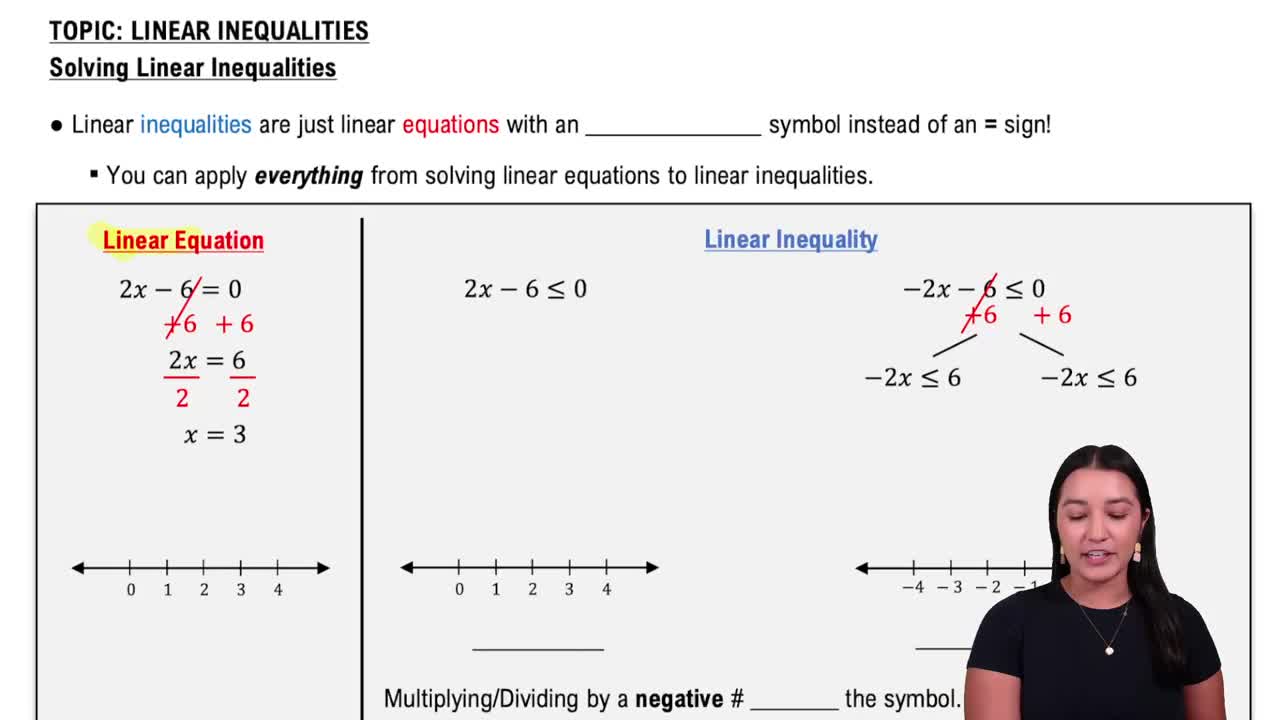
Graphing linear inequalities involves shading the region of the coordinate plane that satisfies the inequality. The boundary line is drawn using the corresponding equation, and it is solid if the inequality includes equality (≤ or ≥) and dashed if it does not (< or >). This helps visualize all possible solutions to the inequality.
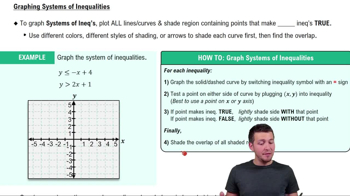
A system of inequalities consists of multiple inequalities that must be satisfied simultaneously. The solution set is the intersection of the individual solution regions, representing all points that satisfy every inequality in the system. Identifying this common region is key to solving the system.
Boundary lines separate the solution region from the non-solution region. To determine which side of the boundary line to shade, a test point (often the origin) is substituted into the inequality. If the test point satisfies the inequality, the region containing it is shaded; otherwise, the opposite side is shaded.