Ch. 1 - Equations and Inequalities
Blitzer - College Algebra 8th Edition
Blitzer8th EditionCollege AlgebraISBN: 9780136970514Not the one you use?Change textbook
Chapter 2, Problem 83a

Solve each absolute value inequality. - 4|1 - x| < - 16

Verified step by step guidance
1
Step 1: Start by isolating the absolute value expression. Divide both sides of the inequality by -4. Remember, dividing by a negative number reverses the inequality sign. The inequality becomes: |1 - x| > 4.
Step 2: Recall the definition of absolute value inequalities. For |A| > B, the inequality splits into two cases: A > B or A < -B. Apply this to the inequality: 1 - x > 4 or 1 - x < -4.
Step 3: Solve each case separately. For the first case, 1 - x > 4, subtract 1 from both sides to isolate -x: -x > 3. Then divide by -1 (reversing the inequality sign): x < -3.
Step 4: For the second case, 1 - x < -4, subtract 1 from both sides to isolate -x: -x < -5. Then divide by -1 (reversing the inequality sign): x > 5.
Step 5: Combine the solutions from both cases. The solution to the inequality is x < -3 or x > 5. This represents the values of x that satisfy the original inequality.

Verified video answer for a similar problem:

This video solution was recommended by our tutors as helpful for the problem above.
Video duration:
3m
Was this helpful?

Key Concepts

Here are the essential concepts you must grasp in order to answer the question correctly.

Absolute Value

Absolute value represents the distance of a number from zero on the number line, regardless of direction. It is denoted by vertical bars, such as |x|, and is always non-negative. For example, |3| = 3 and |-3| = 3. Understanding absolute value is crucial for solving inequalities that involve expressions within these bars.
Recommended video:
7:12
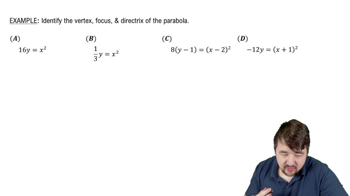
Parabolas as Conic Sections Example 1

Inequalities

Inequalities express a relationship where one side is not equal to the other, using symbols like <, >, ≤, or ≥. In the context of absolute value inequalities, they indicate the range of values that satisfy the condition. For instance, solving |x| < a means finding all x values that are within a distance a from zero.
Recommended video:
06:07
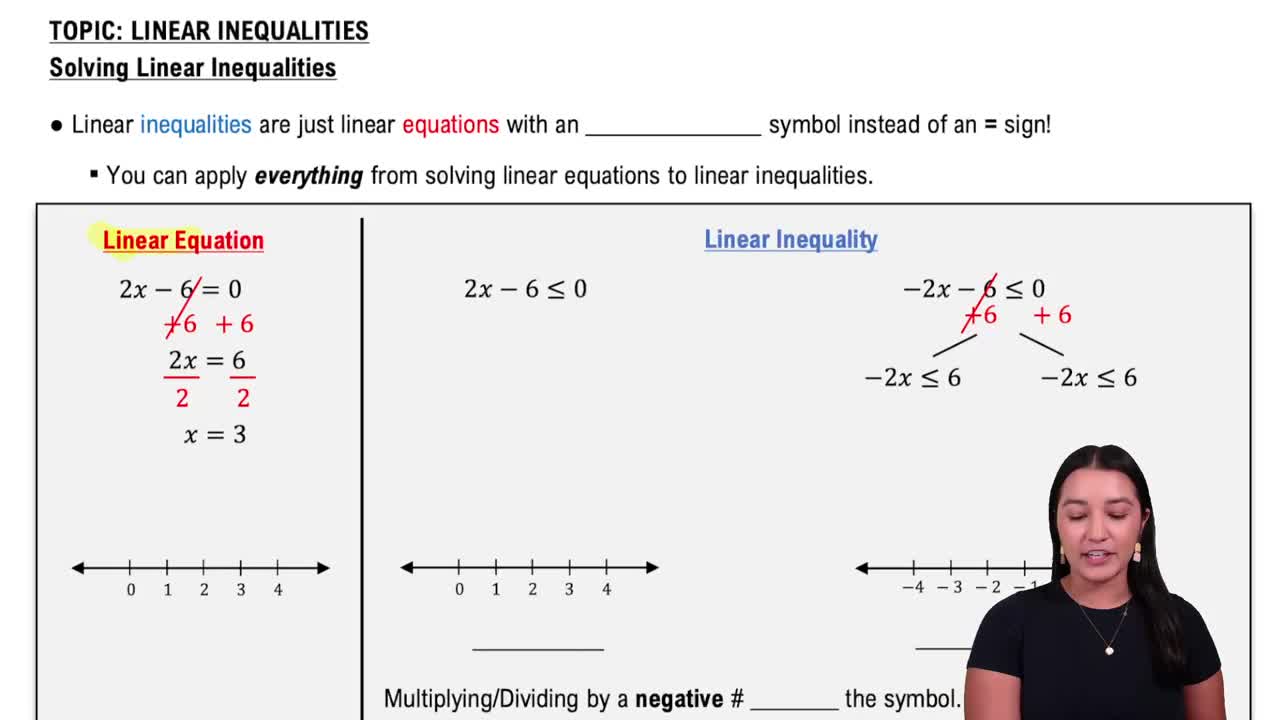
Linear Inequalities

Properties of Inequalities

When manipulating inequalities, certain properties must be observed, such as the fact that multiplying or dividing by a negative number reverses the inequality sign. This is essential when isolating variables in absolute value inequalities. Understanding these properties helps ensure that the solutions derived from the inequalities are valid.
Recommended video:
06:07
Linear Inequalities