In Exercises 59–94, solve each absolute value inequality. 3|x - 1| + 2 ≥ 8
Verified step by step guidance
1
Start by isolating the absolute value expression. Subtract 2 from both sides of the inequality: 3\|x - 1\| + 2 \geq 8 becomes 3\|x - 1\| \geq 6.
Next, divide both sides of the inequality by 3 to solve for the absolute value: \|x - 1\| \geq 2.
Recall that the inequality \|A\| \geq B (where B > 0) means A \leq -B or A \geq B. Apply this to \|x - 1\| \geq 2, giving two inequalities: x - 1 \leq -2 or x - 1 \geq 2.
Solve each inequality separately: For x - 1 \leq -2, add 1 to both sides to get x \leq -1. For x - 1 \geq 2, add 1 to both sides to get x \geq 3.
Combine the solutions to write the final solution set: x \leq -1 or x \geq 3.
Verified video answer for a similar problem:
This video solution was recommended by our tutors as helpful for the problem above
Video duration:
5m
Play a video:
Was this helpful?
Key Concepts
Here are the essential concepts you must grasp in order to answer the question correctly.
Absolute Value Inequalities
An absolute value inequality involves expressions with absolute value symbols, which represent the distance from zero on the number line. To solve these, you often split the inequality into two separate cases based on the definition |A| ≥ B meaning A ≤ -B or A ≥ B, provided B is non-negative.
Before solving an absolute value inequality, isolate the absolute value term on one side of the inequality. This often involves algebraic manipulation such as subtracting or dividing terms, which simplifies the problem and allows you to apply the definition of absolute value inequalities correctly.
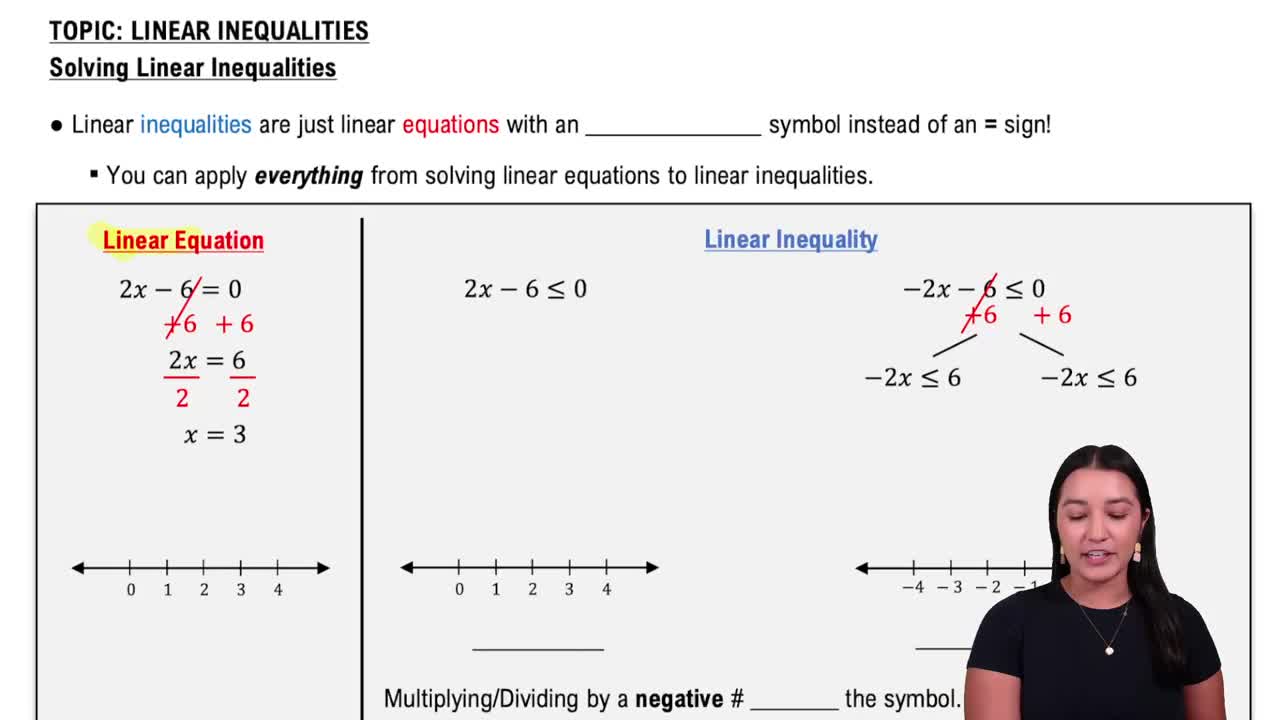
After splitting the absolute value inequality into two linear inequalities, solve each inequality separately using standard methods. This includes adding, subtracting, multiplying, or dividing both sides by constants, while remembering to reverse the inequality sign when multiplying or dividing by a negative number.