Identify the sum notation and the terms involved. The sum is given by \(\sum_{i=0}^{4} \frac{(-1)^i}{i!}\), which means you will add terms from \(i=0\) to \(i=4\) of the expression \(\frac{(-1)^i}{i!}\).
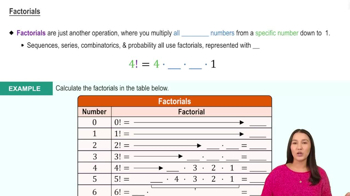
Recall the definition of factorial: for any non-negative integer \(n\), \(n! = n \times (n-1) \times \cdots \times 1\), with the special case \$0! = 1$.
Write out each term explicitly for \(i=0, 1, 2, 3, 4\):
- When \(i=0\), the term is \(\frac{(-1)^0}{0!}\)
- When \(i=1\), the term is \(\frac{(-1)^1}{1!}\)
- When \(i=2\), the term is \(\frac{(-1)^2}{2!}\)
- When \(i=3\), the term is \(\frac{(-1)^3}{3!}\)
- When \(i=4\), the term is \(\frac{(-1)^4}{4!}\)
Calculate each factorial value and the corresponding power of \(-1\) for each term, then write each term as a simplified fraction.
Add all the simplified terms together to find the sum \(\sum_{i=0}^{4} \frac{(-1)^i}{i!}\).
Verified video answer for a similar problem:
This video solution was recommended by our tutors as helpful for the problem above
Video duration:
4m
Play a video:
Was this helpful?
Key Concepts
Here are the essential concepts you must grasp in order to answer the question correctly.
Summation Notation (Sigma Notation)
Summation notation uses the Greek letter sigma (Σ) to represent the sum of a sequence of terms. The expression specifies the index of summation, its starting and ending values, and the general term to be summed. Understanding how to interpret and evaluate these sums is essential for solving problems involving series.
A factorial, denoted by n!, is the product of all positive integers from 1 up to n. For example, 4! = 4 × 3 × 2 × 1 = 24. Factorials are commonly used in permutations, combinations, and series expansions, and knowing how to compute and simplify factorial expressions is crucial.
An alternating series is a series whose terms alternate in sign, often indicated by factors like (−1)^i. This affects the sum by adding and subtracting terms in turn. Recognizing alternating series helps in understanding convergence behavior and calculating partial sums accurately.