Identify the summation notation: \(\sum_{i=1}^{4} 2i^2\) means you will sum the values of the expression \$2i^2\( as \)i$ goes from 1 to 4.
Write out each term in the sum by substituting \(i\) with each integer from 1 to 4: \$2(1)^2\(, \)2(2)^2\(, \)2(3)^2\(, and \)2(4)^2$.
Calculate each term separately: square the value of \(i\) first, then multiply by 2 for each term.
Add all the calculated terms together to find the total sum: \$2(1)^2 + 2(2)^2 + 2(3)^2 + 2(4)^2$.
Express the final sum as the result of the addition, which completes the evaluation of the summation.
Verified video answer for a similar problem:
This video solution was recommended by our tutors as helpful for the problem above
Video duration:
4m
Play a video:
Was this helpful?
Key Concepts
Here are the essential concepts you must grasp in order to answer the question correctly.
Summation Notation (Sigma Notation)
Summation notation uses the Greek letter sigma (Σ) to represent the sum of a sequence of terms. It specifies the index of summation, the lower and upper limits, and the expression to be summed. For example, 4Σi=1 2i^2 means summing 2i² as i goes from 1 to 4.
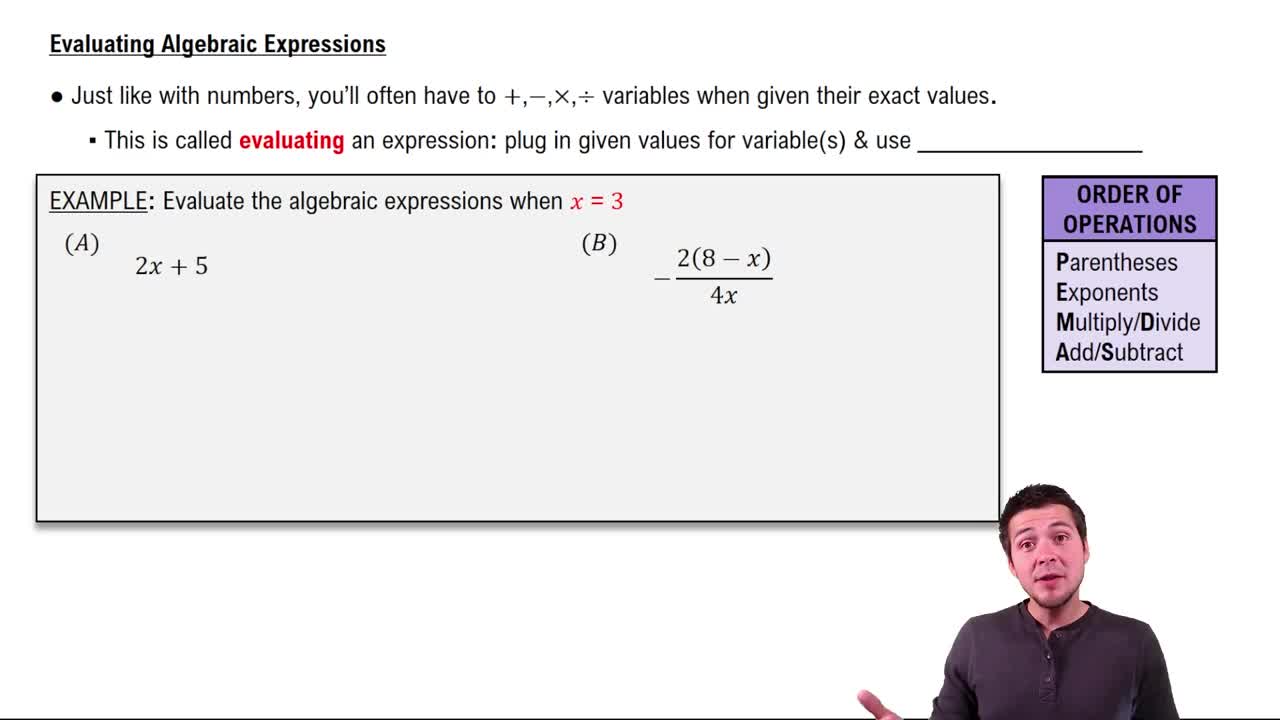
Evaluating polynomial expressions involves substituting values for the variable and simplifying. In this problem, for each integer i from 1 to 4, you calculate 2 times i squared (2i²) before summing all results. This step is essential to find each term in the summation.
Properties of summations allow breaking down or simplifying sums, such as distributing constants or separating sums of sums. For example, constants can be factored out of the summation, making calculations easier. Understanding these properties helps efficiently compute the total sum.