Find the inverse of each function that is one-to-one. {(3,-1), (5,0), (0,5), (4, 2/3)}
Table of contents
- 0. Review of Algebra4h 18m
- 1. Equations & Inequalities3h 18m
- 2. Graphs of Equations1h 43m
- 3. Functions2h 17m
- 4. Polynomial Functions1h 44m
- 5. Rational Functions1h 23m
- 6. Exponential & Logarithmic Functions2h 28m
- 7. Systems of Equations & Matrices4h 5m
- 8. Conic Sections2h 23m
- 9. Sequences, Series, & Induction1h 22m
- 10. Combinatorics & Probability1h 45m
3. Functions
Function Composition
Problem 57
Textbook Question
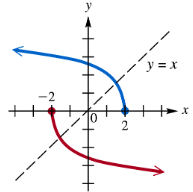
Determine whether each pair of functions graphed are inverses.

Verified step by step guidance1
Step 1: Understand the concept of inverse functions. Two functions are inverses if their graphs are reflections of each other across the line \(y = x\). This means that every point \((a, b)\) on one function corresponds to a point \((b, a)\) on the other function.
Step 2: Identify the two functions on the graph. The orange curve represents one function, and the blue curve represents the other function. The green dashed line is the line \(y = x\), which acts as the mirror line for checking inverses.
Step 3: Check if the two functions are symmetric with respect to the line \(y = x\). Visually inspect if the orange and blue curves are mirror images of each other across the green dashed line.
Step 4: Look for corresponding points on the two functions. For example, if the orange function passes through \((4, 2)\), then the blue function should pass through \((2, 4)\) for them to be inverses.
Step 5: Conclude whether the two functions are inverses based on the symmetry and corresponding points. If the graphs are reflections across \(y = x\), then the functions are inverses; otherwise, they are not.
Verified video answer for a similar problem:This video solution was recommended by our tutors as helpful for the problem above
Video duration:
1mPlay a video:
Was this helpful?
Key Concepts
Here are the essential concepts you must grasp in order to answer the question correctly.
Inverse Functions
Inverse functions reverse the effect of each other, meaning if f(x) maps x to y, then its inverse f⁻¹(x) maps y back to x. Graphically, two functions are inverses if reflecting one function's graph over the line y = x produces the other function's graph.
Recommended video:
Graphing Logarithmic Functions
Line of Symmetry y = x
The line y = x acts as a mirror line for inverse functions. If two functions are inverses, their graphs are symmetric with respect to this line. Checking if one graph is the reflection of the other across y = x helps determine if they are inverses.
Recommended video:
Guided course
The Slope of a Line
Graphical Verification of Inverses
To verify if two functions are inverses using their graphs, reflect one graph over the line y = x and see if it coincides with the other graph. This visual method provides an intuitive way to confirm inverse relationships without algebraic calculations.
Recommended video:
Graphing Logarithmic Functions
Watch next
Master Function Composition with a bite sized video explanation from Patrick
Start learningRelated Videos
Related Practice
Textbook Question
463
views