Table of contents
- 0. Review of Algebra4h 18m
- 1. Equations & Inequalities3h 18m
- 2. Graphs of Equations1h 43m
- 3. Functions2h 17m
- 4. Polynomial Functions1h 44m
- 5. Rational Functions1h 23m
- 6. Exponential & Logarithmic Functions2h 28m
- 7. Systems of Equations & Matrices4h 5m
- 8. Conic Sections2h 23m
- 9. Sequences, Series, & Induction1h 22m
- 10. Combinatorics & Probability1h 45m
3. Functions
Function Composition
Problem 33
Textbook Question
Which graphs in Exercises 29–34 represent functions that have inverse functions?
Verified step by step guidance1
Understand the concept of a function having an inverse: A function has an inverse if it is one-to-one. This means that each input corresponds to exactly one output, and each output corresponds to exactly one input.
Apply the Horizontal Line Test: To determine if a function is one-to-one, use the horizontal line test. If any horizontal line intersects the graph of the function at more than one point, the function is not one-to-one and does not have an inverse.
Examine the graphs provided in Exercises 29–34: For each graph, visually inspect whether any horizontal line would intersect the graph at more than one point. If it does, the function does not have an inverse. If it does not, the function has an inverse.
Identify the graphs that pass the Horizontal Line Test: List the graphs that meet the criteria of being one-to-one based on your inspection.
Conclude which graphs represent functions with inverses: Summarize your findings by stating which graphs represent functions that have inverse functions, based on the Horizontal Line Test.
Verified video answer for a similar problem:This video solution was recommended by our tutors as helpful for the problem above
Video duration:
7mPlay a video:
Was this helpful?
Key Concepts
Here are the essential concepts you must grasp in order to answer the question correctly.
Function Definition
A function is a relation that assigns exactly one output for each input from its domain. This means that for every x-value, there is a unique y-value. Understanding the definition of a function is crucial for determining whether a graph represents a function and whether it can have an inverse.
Recommended video:
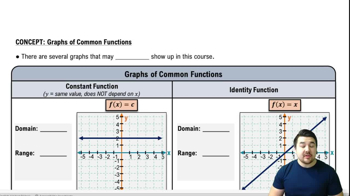
Graphs of Common Functions
Horizontal Line Test
The horizontal line test is a method used to determine if a function has an inverse that is also a function. If any horizontal line intersects the graph of the function more than once, the function does not have an inverse that is a function. This test is essential for analyzing the graphs in the given exercises.
Recommended video:
Guided course
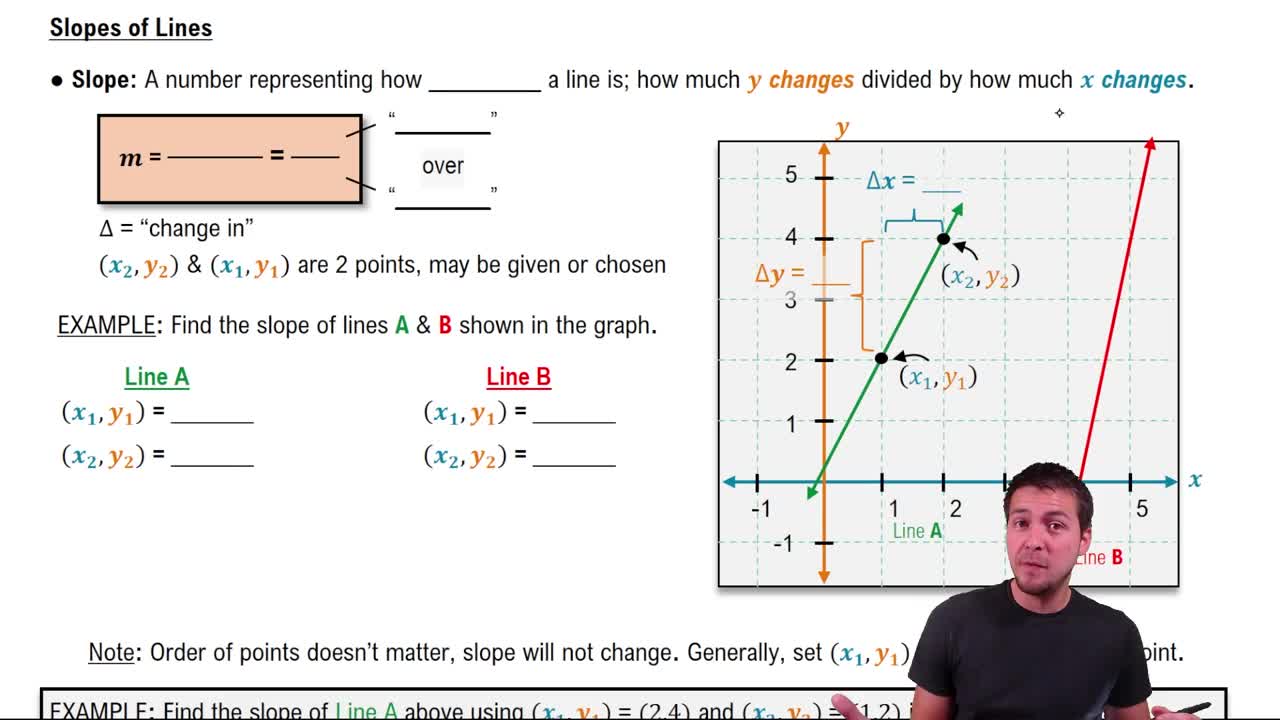
The Slope of a Line
Inverse Functions
An inverse function essentially reverses the effect of the original function. If a function f takes an input x to an output y, then its inverse f⁻¹ takes y back to x. For a function to have an inverse, it must be one-to-one, meaning it passes the horizontal line test, ensuring that each output corresponds to a unique input.
Recommended video:
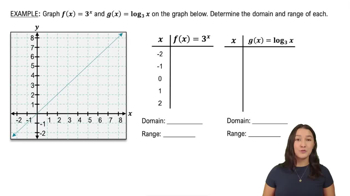
Graphing Logarithmic Functions
Watch next
Master Function Composition with a bite sized video explanation from Patrick
Start learningRelated Videos
Related Practice
Textbook Question
In Exercises 1-10, find f(g(x)) and g (f(x)) and determine whether each pair of functions ƒ and g are inverses of each other. f(x)=3x+8 and g(x) = (x-8)/3
424
views