In Exercises 25–34, use the zero-exponent rule to simplify each expression.
6⁰
Verified step by step guidance
1
Identify the zero-exponent rule, which states that any non-zero number raised to the power of zero is equal to 1.
Recognize that the base in the expression is 6, which is a non-zero number.
Apply the zero-exponent rule to the expression 6^0.
Simplify the expression using the rule: 6^0 = 1.
Conclude that the simplified form of the expression is 1.
Verified video answer for a similar problem:
This video solution was recommended by our tutors as helpful for the problem above.
Video duration:
1m
Play a video:
0 Comments
Key Concepts
Here are the essential concepts you must grasp in order to answer the question correctly.
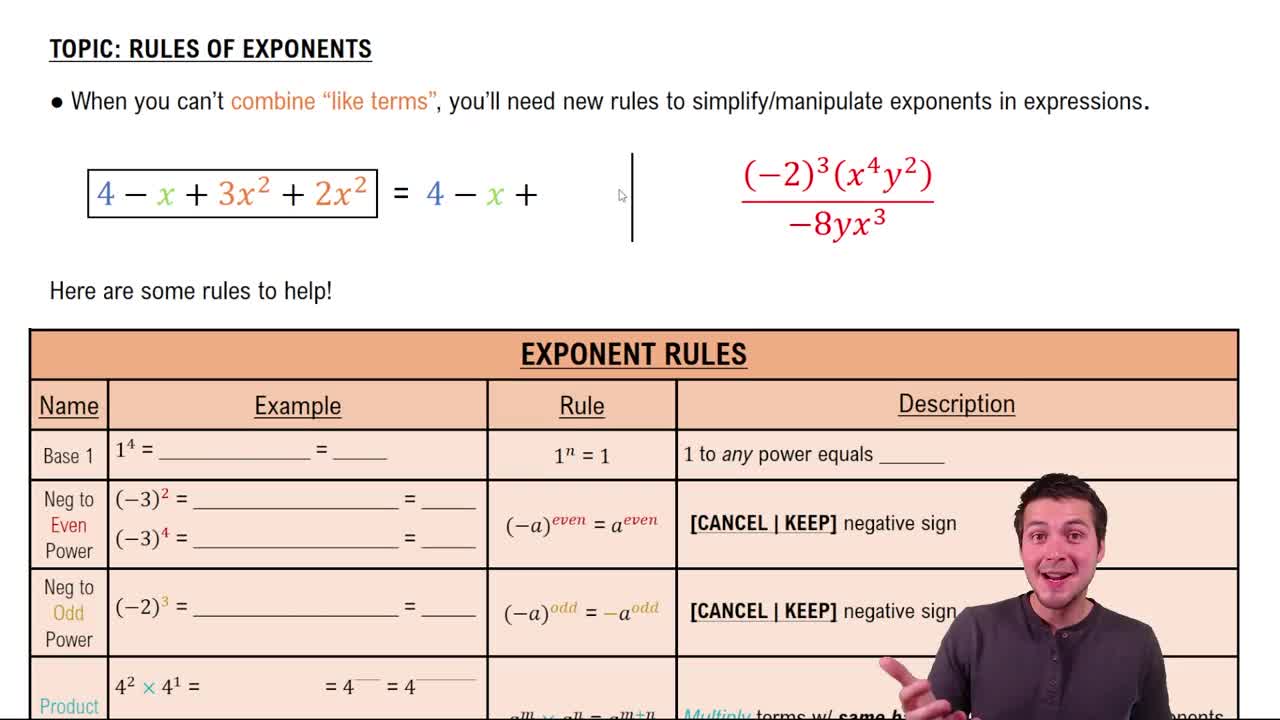
Zero Exponent Rule
The zero exponent rule states that any non-zero base raised to the power of zero equals one. This rule is fundamental in algebra as it simplifies expressions and helps in solving equations. For example, 6⁰ simplifies to 1, regardless of the base, as long as the base is not zero.
Exponential notation is a way to express repeated multiplication of a number by itself. It consists of a base and an exponent, where the exponent indicates how many times the base is multiplied. Understanding this notation is crucial for applying rules like the zero exponent rule effectively.
Properties of exponents are a set of rules that govern how to manipulate expressions involving exponents. These include rules for multiplication, division, and powers of powers. Familiarity with these properties allows for the simplification of complex expressions and is essential for solving algebraic problems.

 1:42 minutes
 Verified step by step guidance
 7:39
7:39