In Exercises 1–38, solve each radical equation.
____
2√x - 3 + 4 = x + 1
Verified step by step guidance
1
Step 1: Start by isolating the radical expression on one side of the equation. Subtract 4 from both sides to get: \( 2\sqrt{x} - 3 = x - 3 \).
Step 2: Add 3 to both sides to further isolate the radical: \( 2\sqrt{x} = x \).
Step 3: Divide both sides by 2 to solve for \( \sqrt{x} \): \( \sqrt{x} = \frac{x}{2} \).
Step 4: Square both sides to eliminate the square root: \( x = \left(\frac{x}{2}\right)^2 \).
Step 5: Expand and simplify the equation: \( x = \frac{x^2}{4} \).
Verified video answer for a similar problem:
This video solution was recommended by our tutors as helpful for the problem above.
Video duration:
10m
Play a video:
0 Comments
Key Concepts
Here are the essential concepts you must grasp in order to answer the question correctly.
Radical Equations
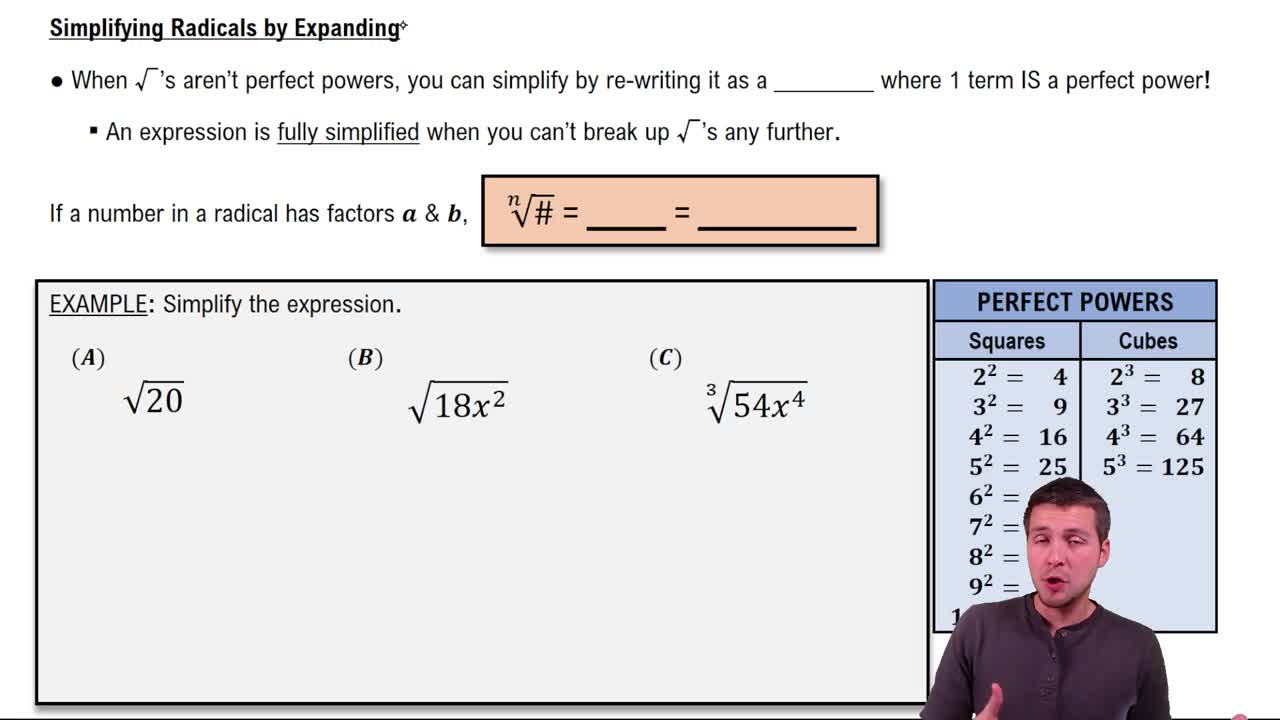
Radical equations are equations that involve a variable within a radical (square root, cube root, etc.). To solve these equations, one typically isolates the radical on one side and then squares both sides to eliminate the radical. This process may introduce extraneous solutions, so it's essential to check all potential solutions in the original equation.
Isolating variables is a fundamental algebraic technique used to solve equations. It involves rearranging the equation to get the variable of interest on one side by itself. This often requires performing inverse operations, such as adding, subtracting, multiplying, or dividing both sides of the equation to simplify it and make the solution clearer.
Extraneous solutions are solutions that emerge from the process of solving an equation but do not satisfy the original equation. This is particularly common in radical equations, where squaring both sides can introduce solutions that are not valid. Therefore, it is crucial to substitute any found solutions back into the original equation to verify their validity.

 10:05 minutes
 Verified step by step guidance
 05:20
05:20