Step 1: Recognize that the expression involves a square root, specifically \( \sqrt{40x} \).
Step 2: Factor the number 40 into its prime factors: \( 40 = 2^3 \times 5 \).
Step 3: Rewrite the expression under the square root using the prime factors: \( \sqrt{40x} = \sqrt{2^3 \times 5 \times x} \).
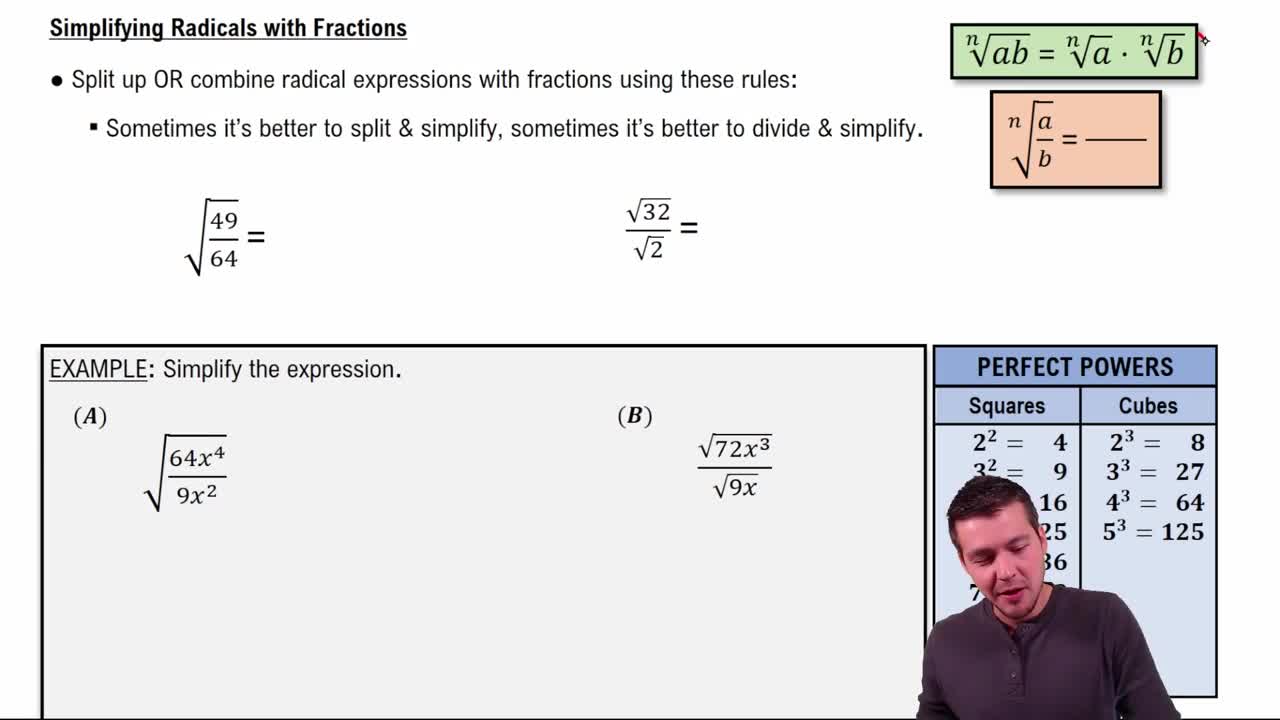
Step 4: Apply the property of square roots that \( \sqrt{a \times b} = \sqrt{a} \times \sqrt{b} \) to separate the factors: \( \sqrt{2^3 \times 5 \times x} = \sqrt{2^2 \times 2 \times 5 \times x} \).
Step 5: Simplify by taking the square root of the perfect square \( 2^2 \), which is 2, and leave the remaining factors under the square root: \( 2\sqrt{10x} \).
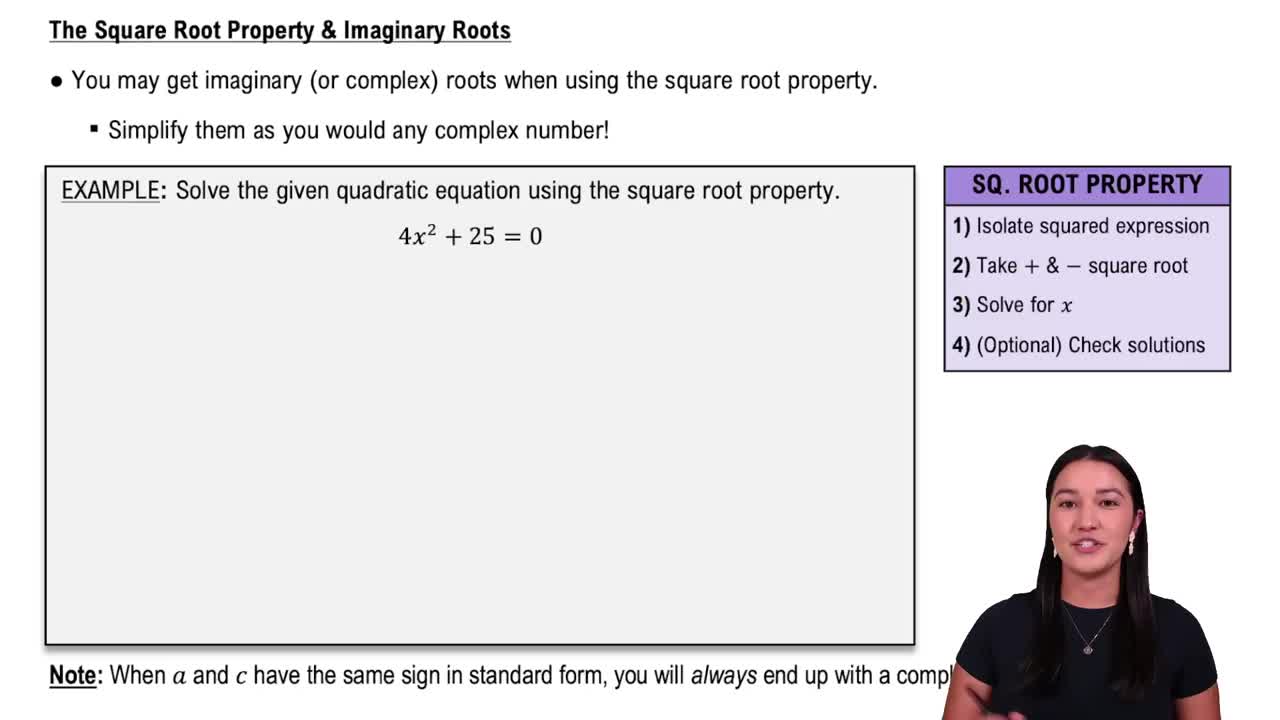
Verified video answer for a similar problem:
This video solution was recommended by our tutors as helpful for the problem above
Video duration:
1m
Play a video:
Was this helpful?
Key Concepts
Here are the essential concepts you must grasp in order to answer the question correctly.
Factoring
Factoring is the process of breaking down an expression into simpler components, or factors, that when multiplied together yield the original expression. In algebra, this often involves identifying common factors or applying special product formulas, such as the difference of squares or perfect square trinomials. Understanding how to factor is essential for simplifying expressions and solving equations.
A square root of a number is a value that, when multiplied by itself, gives the original number. For example, the square root of 40 can be expressed as √(4 × 10), which simplifies to 2√10. Recognizing how to simplify square roots is crucial in algebra, especially when dealing with expressions that involve radical signs.
Radical expressions involve roots, such as square roots, cube roots, etc. Simplifying radical expressions often requires factoring the radicand (the number under the root) into its prime factors and identifying perfect squares or cubes. Mastery of radical expressions is important for performing operations like addition, subtraction, and multiplication involving roots.