Rewrite each expression using the distributive property and simplify, if possible. 15x-10x
Verified step by step guidance
1
Identify the common factor in the terms 15x and -10x. Both terms have the variable \( x \) and numerical coefficients 15 and 10.
Use the distributive property, which states \( a(b + c) = ab + ac \), in reverse to factor out the common term \( x \) from both terms.
Write the expression as \( x(15 - 10) \), factoring out \( x \) from both terms.
Simplify the expression inside the parentheses by subtracting 10 from 15, resulting in \( x(5) \).
Rewrite the expression as \( 5x \), which is the simplified form after applying the distributive property.
Verified video answer for a similar problem:
This video solution was recommended by our tutors as helpful for the problem above
Video duration:
53s
Play a video:
Was this helpful?
Key Concepts
Here are the essential concepts you must grasp in order to answer the question correctly.
Distributive Property
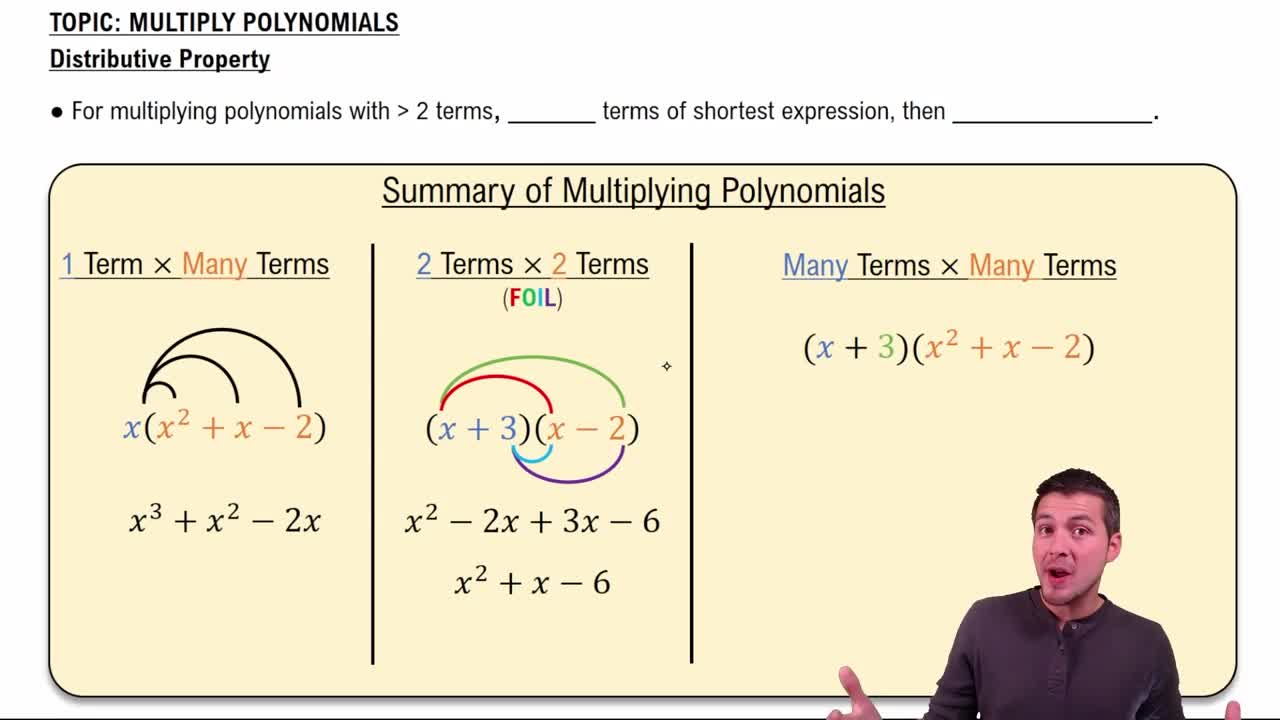
The distributive property states that multiplying a sum or difference by a number is the same as multiplying each term inside the parentheses by that number separately. For example, a(b + c) = ab + ac. This property helps in rewriting expressions by factoring or expanding.
Multiply Polynomials Using the Distributive Property
Combining Like Terms
Combining like terms involves adding or subtracting terms that have the same variable raised to the same power. For example, 15x and -10x are like terms because both contain x. Simplifying expressions often requires combining these terms to write a simpler equivalent expression.
Simplification means rewriting an expression in its simplest form by performing operations like addition, subtraction, multiplication, or division. After applying the distributive property and combining like terms, the expression should be simplified to a single term or a simpler expression.