In Exercises 1–34, solve each rational equation. If an equation has no solution, so state.
1 − 4/(x+7) = 5/(x+7)
Verified step by step guidance
1
Identify the common denominator, which is \(x+7\).
Multiply every term in the equation by \(x+7\) to eliminate the denominators.
This results in: \((x+7)(1) - 4 = 5\).
Simplify the equation: \(x + 7 - 4 = 5\).
Solve for \(x\) by isolating it on one side of the equation.
Verified video answer for a similar problem:
This video solution was recommended by our tutors as helpful for the problem above.
Video duration:
3m
Play a video:
0 Comments
Key Concepts
Here are the essential concepts you must grasp in order to answer the question correctly.
Rational Equations
Rational equations are equations that involve fractions with polynomials in the numerator and denominator. To solve these equations, one typically seeks a common denominator to eliminate the fractions, allowing for easier manipulation and simplification. Understanding how to handle rational expressions is crucial for solving these types of equations.
Finding a common denominator is the process of identifying a shared multiple of the denominators in a set of fractions. This step is essential in rational equations, as it allows for the elimination of fractions, making the equation easier to solve. In the given equation, the common denominator is (x + 7), which simplifies the equation significantly.
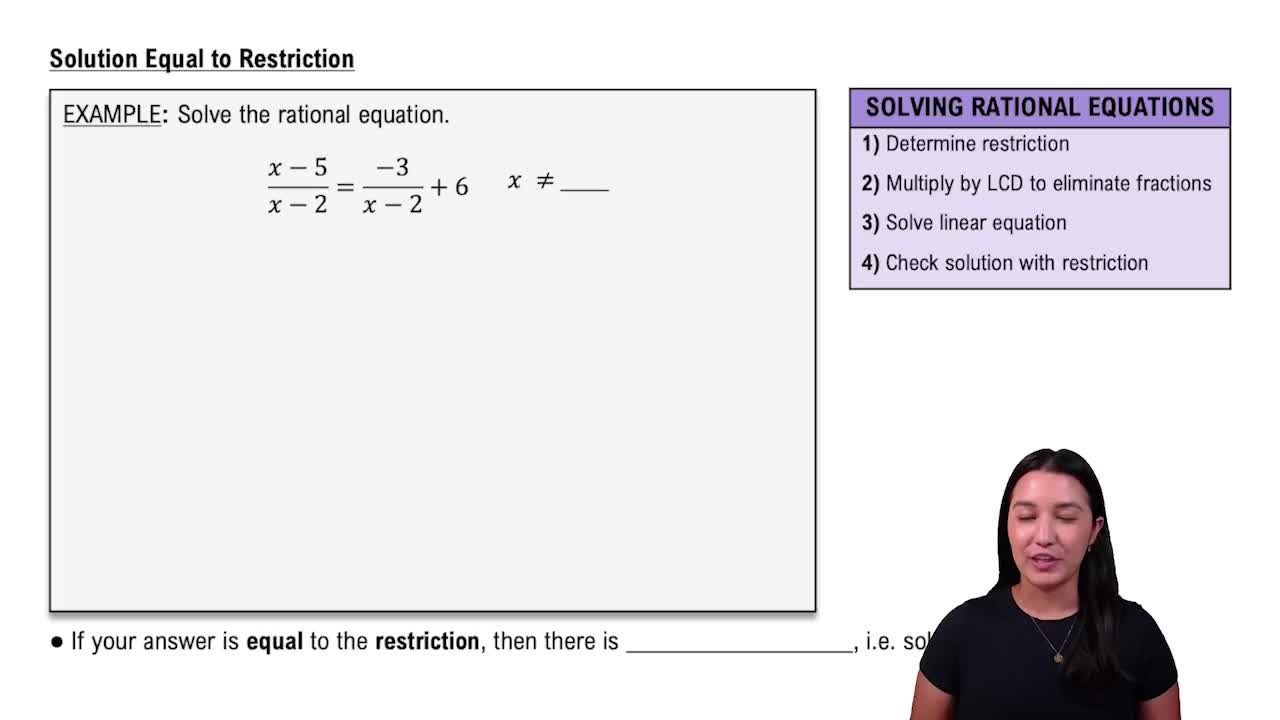
When solving rational equations, it is important to check for extraneous solutions, which are solutions that do not satisfy the original equation. This often occurs when the process of eliminating fractions introduces solutions that make the original denominators zero. In this case, one must ensure that any solution found does not lead to division by zero in the original equation.

 3:22 minutes
 Verified step by step guidance
 05:56
05:56