Start by isolating the square root expressions on each side of the equation: \(\sqrt{\!x+2} = 1 - \sqrt{3x+7}\).
To eliminate the square roots, first move one of the square root terms to the other side to have all radicals separated: \(\sqrt{\!x+2} + \sqrt{3x+7} = 1\).
Square both sides of the equation to remove the square roots. Remember to apply the formula for squaring a binomial: \((a + b)^2 = a^2 + 2ab + b^2\). So, square the left side and the right side accordingly.
After squaring, simplify the resulting equation by combining like terms and isolating the remaining square root term if any. Then, square both sides again if necessary to completely eliminate the radicals.
Solve the resulting polynomial equation for \(x\). Finally, check all solutions in the original equation to discard any extraneous solutions introduced by the squaring steps.
Verified video answer for a similar problem:
This video solution was recommended by our tutors as helpful for the problem above
Video duration:
9m
Play a video:
Was this helpful?
Key Concepts
Here are the essential concepts you must grasp in order to answer the question correctly.
Square Root Equations
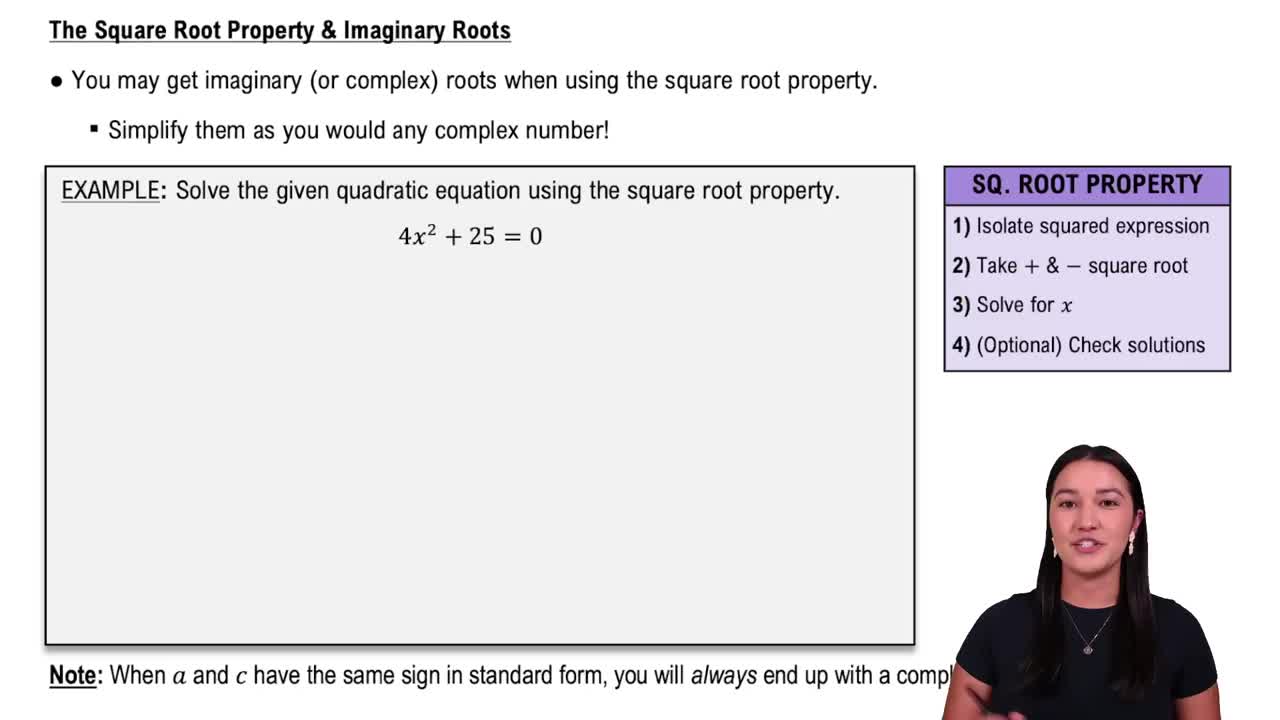
Square root equations involve variables inside a radical sign. To solve them, isolate the square root on one side and then square both sides to eliminate the radical. This process may introduce extraneous solutions, so checking all solutions in the original equation is essential.
The domain of a square root function includes only values that make the radicand (expression inside the root) non-negative. For example, in √(x+2), x+2 must be ≥ 0. Identifying domain restrictions helps avoid invalid solutions and ensures the equation is defined.
When an equation has more than one square root term, isolate one radical and square both sides carefully. This may require repeating the process to eliminate all radicals. After solving, verify solutions to exclude any extraneous roots introduced by squaring.