Solve each quadratic inequality. Give the solution set in interval notation. See Exam-ples 5 and 6. x(x-1)≤6
Table of contents
- 0. Review of Algebra4h 18m
- 1. Equations & Inequalities3h 18m
- 2. Graphs of Equations1h 43m
- 3. Functions2h 17m
- 4. Polynomial Functions1h 44m
- 5. Rational Functions1h 23m
- 6. Exponential & Logarithmic Functions2h 28m
- 7. Systems of Equations & Matrices4h 5m
- 8. Conic Sections2h 23m
- 9. Sequences, Series, & Induction1h 22m
- 10. Combinatorics & Probability1h 45m
1. Equations & Inequalities
Linear Inequalities
Problem 55
Textbook Question
Which inequality has solution set (-∞, ∞)? A. (x-3)2≥0 B. (5x-6)2≤0 C. (6x+4)2>0 D. (8x+7)2<0
Verified step by step guidance1
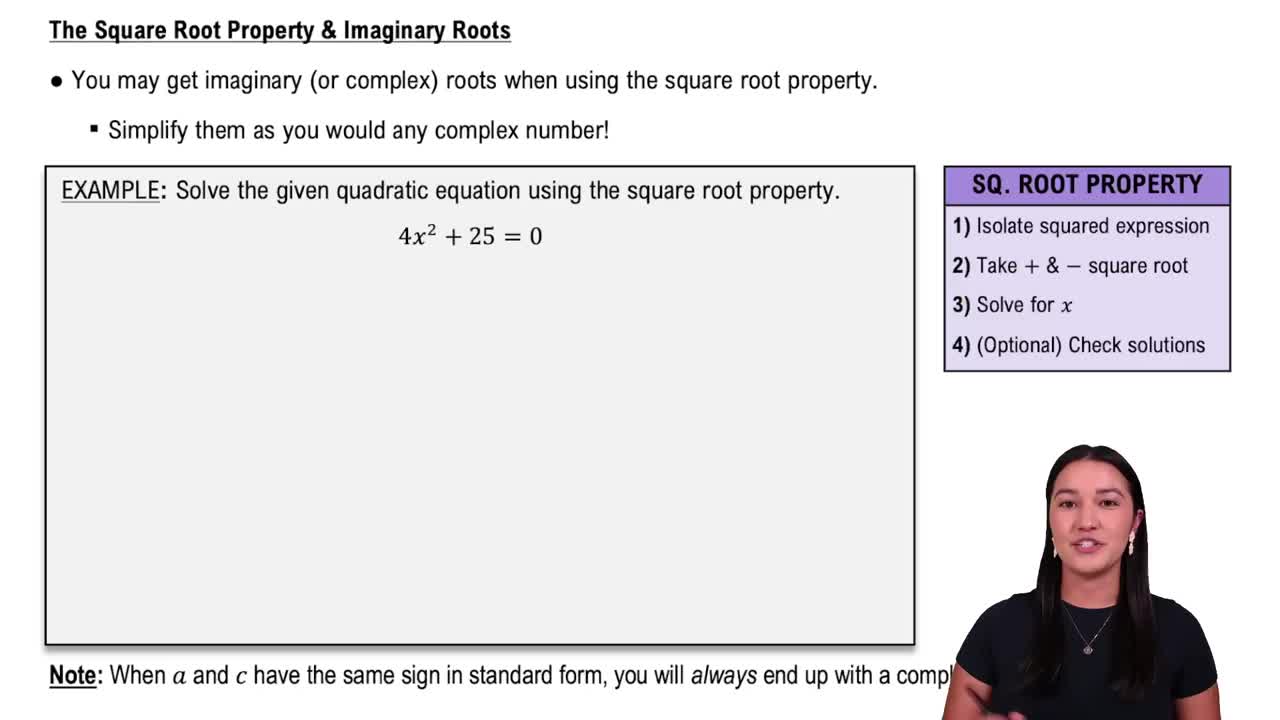
Recall that for any real number expression, a square of that expression, such as \( (expression)^2 \), is always greater than or equal to zero because squaring any real number cannot produce a negative result.
Analyze option A: \( (x-3)^2 \geq 0 \). Since squares are always non-negative, this inequality holds for all real values of \(x\), so its solution set is \((-\infty, \infty)\).
Analyze option B: \( (5x-6)^2 \leq 0 \). Since squares are always non-negative, the only way this inequality holds is when \( (5x-6)^2 = 0 \), which happens at a single value of \(x\). So the solution set is not all real numbers.
Analyze option C: \( (6x+4)^2 > 0 \). This inequality is true for all \(x\) except where \( (6x+4)^2 = 0 \), which is at one specific \(x\) value. So the solution set excludes one point, not all real numbers.
Analyze option D: \( (8x+7)^2 < 0 \). Since squares cannot be negative, this inequality has no solution, so the solution set is empty.
Verified video answer for a similar problem:This video solution was recommended by our tutors as helpful for the problem above
Video duration:
3mPlay a video:
Was this helpful?
Key Concepts
Here are the essential concepts you must grasp in order to answer the question correctly.
Properties of Squares and Non-negativity
The square of any real number is always non-negative, meaning it is either zero or positive. This property helps determine the possible values of expressions like (x - 3)^2, which can never be negative.
Recommended video:
Imaginary Roots with the Square Root Property
Solving Inequalities Involving Squares
Inequalities with squared expressions require understanding when the expression equals zero or is positive/negative. For example, (expression)^2 ≥ 0 is always true, while (expression)^2 < 0 has no real solutions since squares can't be negative.
Recommended video:
Solving Quadratic Equations by Completing the Square
Interpreting Solution Sets of Inequalities
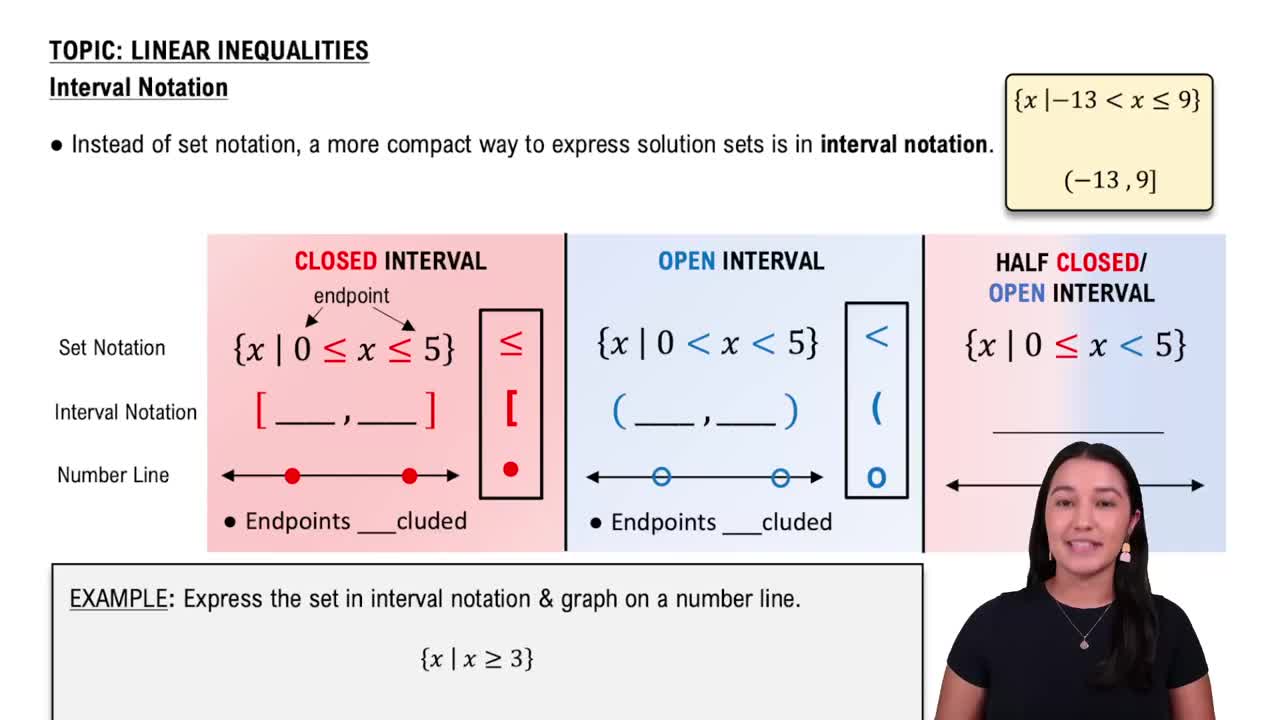
The solution set (-∞, ∞) means all real numbers satisfy the inequality. Recognizing which inequalities hold for all x involves analyzing the inequality's nature, such as whether it can ever be false or has restrictions.
Recommended video:
Linear Inequalities
Related Videos
Related Practice
Textbook Question
388
views