Solve each rational inequality. Give the solution set in interval notation. 5/(x+1)>12/(x+1)
Verified step by step guidance
1
Start by writing down the inequality: \(\frac{5}{x+1} > \frac{12}{x+1}\).
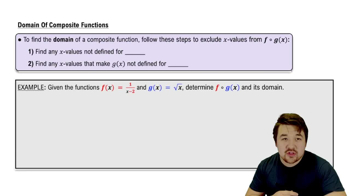
Identify the domain restrictions: since the denominators are \(x+1\), we must have \(x + 1 \neq 0\), so \(x \neq -1\).
Because the denominators are the same and not zero, multiply both sides of the inequality by \((x+1)^2\) (which is always positive) to eliminate the denominators without changing the inequality direction. This gives: \$5(x+1) > 12(x+1)$.
Solve the resulting linear inequality for \(x\): subtract \$5x\( and \)12\( from both sides to isolate \)x\(, then express the solution set in interval notation, remembering to exclude \)x = -1$ from the domain.
Verified video answer for a similar problem:
This video solution was recommended by our tutors as helpful for the problem above
Video duration:
5m
Play a video:
0 Comments
Key Concepts
Here are the essential concepts you must grasp in order to answer the question correctly.
Rational Inequalities
Rational inequalities involve expressions where variables appear in the denominator. Solving them requires finding values of the variable that make the inequality true, while considering restrictions where the denominator is zero to avoid undefined expressions.
When solving rational inequalities, it is crucial to identify values that make denominators zero, as these values are excluded from the solution set. These restrictions define the domain and help avoid invalid solutions.
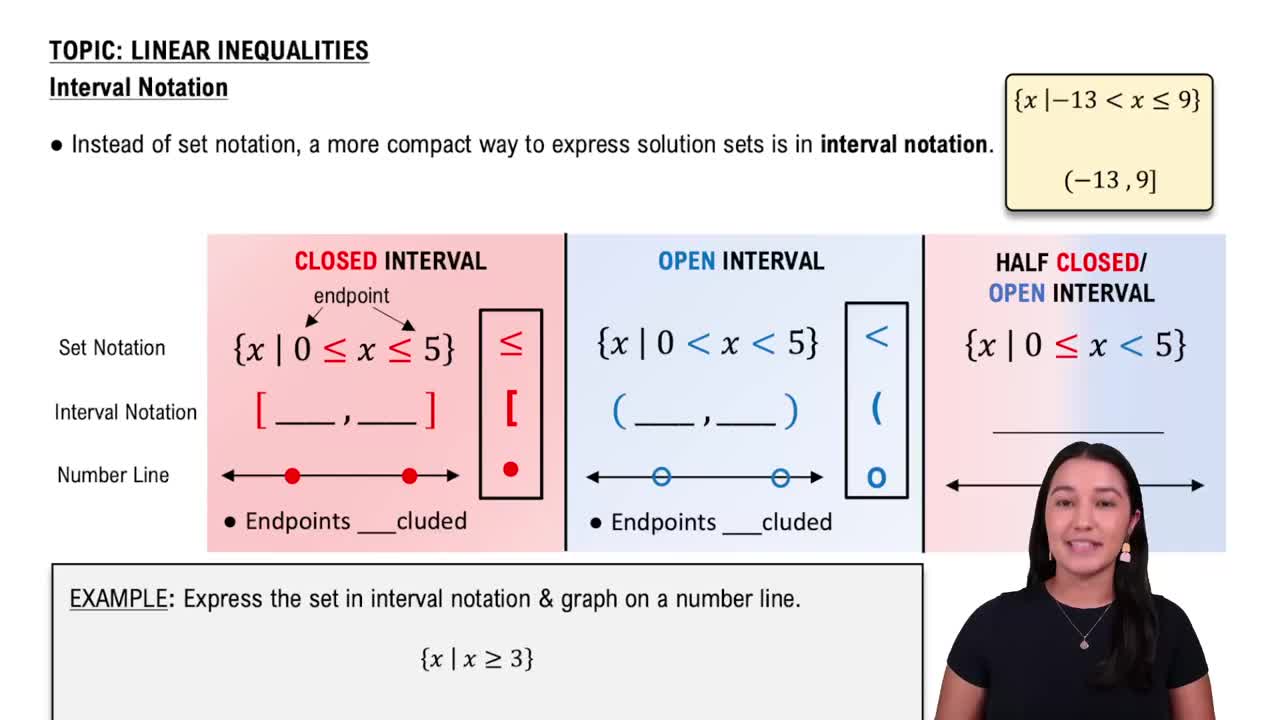
After solving the inequality, the solution set is expressed in interval notation, which concisely represents all values satisfying the inequality. Understanding how to write and interpret intervals, including open and closed endpoints, is essential.


 5:53 minutes
 Verified step by step guidance
 3:21
3:21