Concept Check: By what number should the numerator and denominator of be multiplied in order to rationalize the denominator? Write this fraction with a rationalized denominator.
Verified step by step guidance
1
Identify the denominator as \(\sqrt[3]{3} - \sqrt[3]{5}\). To rationalize a denominator involving cube roots, we use the fact that \(a^3 - b^3 = (a - b)(a^2 + ab + b^2)\), where \(a = \sqrt[3]{3}\) and \(b = \sqrt[3]{5}\).
To eliminate the cube roots in the denominator, multiply both numerator and denominator by the conjugate expression \(\sqrt[3]{3^2} + \sqrt[3]{3} \cdot \sqrt[3]{5} + \sqrt[3]{5^2}\), which is \(\sqrt[3]{9} + \sqrt[3]{15} + \sqrt[3]{25}\).
Write the new fraction as \(\frac{1}{\sqrt[3]{3} - \sqrt[3]{5}} \times \frac{\sqrt[3]{9} + \sqrt[3]{15} + \sqrt[3]{25}}{\sqrt[3]{9} + \sqrt[3]{15} + \sqrt[3]{25}}\).
Use the difference of cubes formula in the denominator: \((\sqrt[3]{3} - \sqrt[3]{5})(\sqrt[3]{9} + \sqrt[3]{15} + \sqrt[3]{25}) = 3 - 5 = -2\), which is a rational number.
Express the fraction with the rationalized denominator as \(\frac{\sqrt[3]{9} + \sqrt[3]{15} + \sqrt[3]{25}}{-2}\).
Verified video answer for a similar problem:
This video solution was recommended by our tutors as helpful for the problem above
Video duration:
4m
Play a video:
Was this helpful?
Key Concepts
Here are the essential concepts you must grasp in order to answer the question correctly.
Rationalizing the Denominator
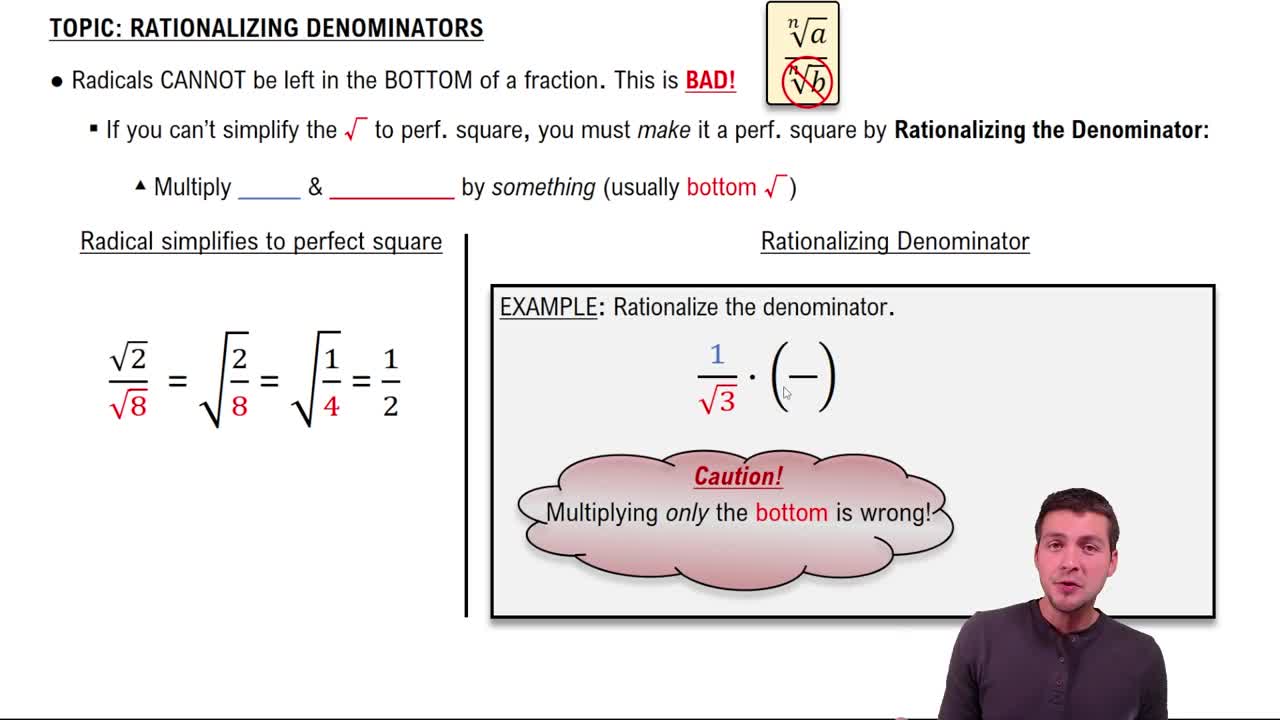
Rationalizing the denominator involves eliminating any roots or irrational numbers from the denominator of a fraction. This is done by multiplying the numerator and denominator by a suitable expression that makes the denominator a rational number, simplifying the expression.
When dealing with expressions like ∛a - ∛b, the conjugate used to rationalize is based on the sum and product of cube roots, similar to the difference of cubes formula. Multiplying by the expression ∛a² + ∛a∛b + ∛b² helps eliminate cube roots in the denominator.
Understanding how cube roots and exponents interact is essential. For example, (∛x)³ = x, and multiplying cube roots follows the rule ∛a * ∛b = ∛(ab). These properties allow simplification when multiplying expressions involving cube roots.