Rationalize each denominator. Assume all variables represent nonnegative numbers and that no denominators are 0. 2+m+n3m
Verified step by step guidance
1
Identify the expression to rationalize: \(\frac{3m}{2 + (\sqrt{m} + n)}\). Notice that the denominator is a sum involving a square root term \(\sqrt{m}\) and another variable \(n\).
Rewrite the denominator to clarify its structure: \$2 + \sqrt{m} + n$. Since the denominator is a sum of three terms, consider grouping the radical term with one of the constants to apply rationalization techniques.
To rationalize the denominator, multiply both numerator and denominator by the conjugate of the denominator. The conjugate changes the sign of the radical term. Here, the conjugate of \$2 + \sqrt{m} + n\( can be considered as \)2 + n - \sqrt{m}$.
Multiply numerator and denominator by the conjugate: \(\frac{3m}{2 + \sqrt{m} + n} \times \frac{2 + n - \sqrt{m}}{2 + n - \sqrt{m}}\). This will eliminate the square root in the denominator when you expand the product in the denominator.
Expand the denominator using the difference of squares formula: \((a + b)(a - b) = a^2 - b^2\), where \(a = 2 + n\) and \(b = \sqrt{m}\). Then simplify the numerator by distributing \$3m$ over the conjugate terms.
Verified video answer for a similar problem:
This video solution was recommended by our tutors as helpful for the problem above
Video duration:
3m
Play a video:
Was this helpful?
Key Concepts
Here are the essential concepts you must grasp in order to answer the question correctly.
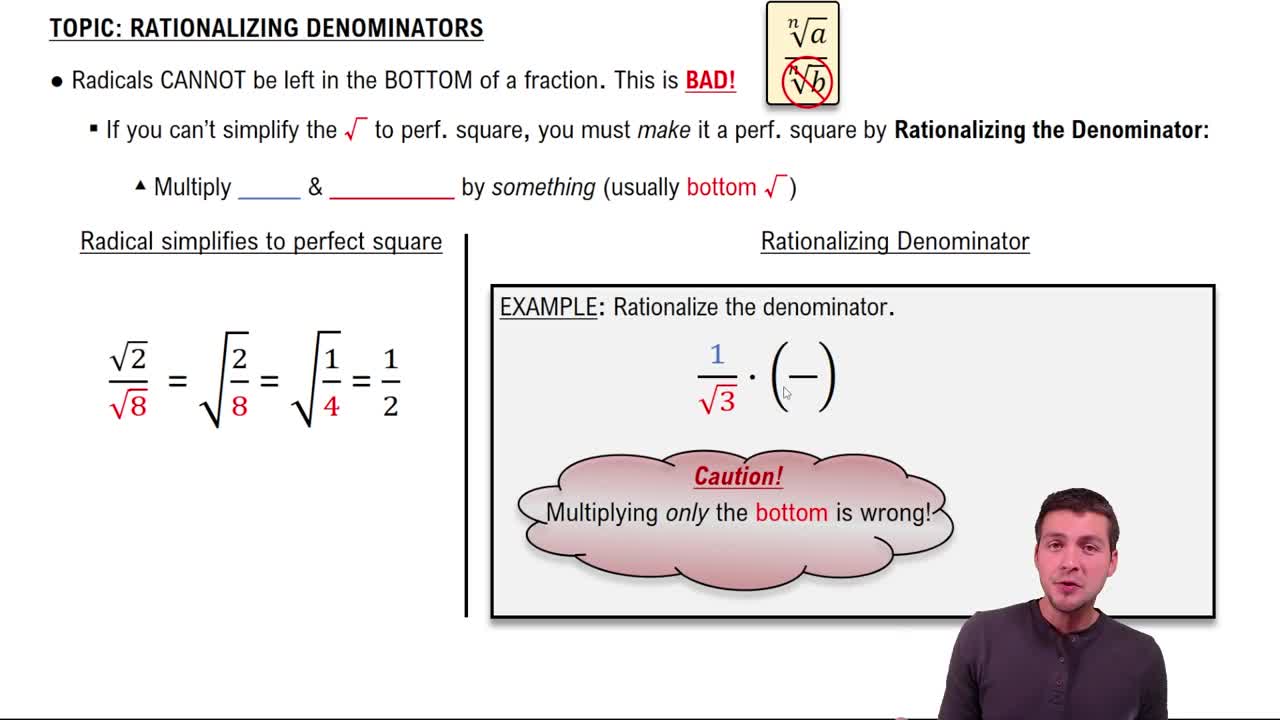
Rationalizing the Denominator
Rationalizing the denominator involves eliminating any radicals (such as square roots) from the denominator of a fraction. This is done by multiplying the numerator and denominator by a suitable expression that removes the radical, often the conjugate if the denominator is a binomial involving roots.
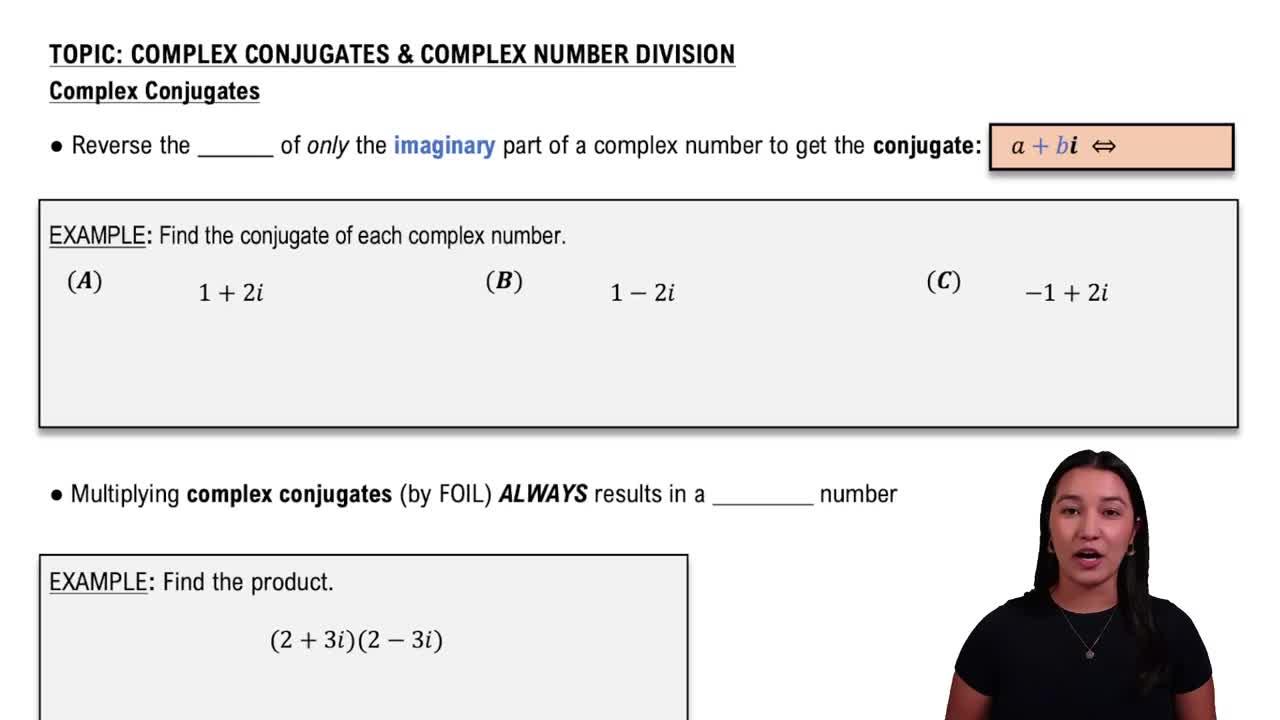
The conjugate of a binomial expression a + b is a - b, and vice versa. Multiplying a binomial by its conjugate results in a difference of squares, which eliminates the square root terms. This technique is essential when rationalizing denominators with sums or differences involving radicals.
Properties of Square Roots and Nonnegative Variables
Square roots represent the principal (nonnegative) root of a number. Assuming variables are nonnegative ensures the expressions under the root are valid and simplifies manipulation. This assumption allows direct application of root properties without considering absolute values.