In Exercises 25–34, use the zero-exponent rule to simplify each expression.
(13y)⁰
Verified step by step guidance
1
Identify the zero-exponent rule, which states that any non-zero number raised to the power of zero is equal to 1.
Recognize that the expression \((13y)^0\) involves raising the entire term \(13y\) to the power of zero.
Apply the zero-exponent rule to the expression \((13y)^0\).
Conclude that the expression simplifies to 1, as any non-zero base raised to the zero power is 1.
Verified video answer for a similar problem:
This video solution was recommended by our tutors as helpful for the problem above.
Video duration:
1m
Play a video:
0 Comments
Key Concepts
Here are the essential concepts you must grasp in order to answer the question correctly.
Zero Exponent Rule
The zero exponent rule states that any non-zero base raised to the power of zero equals one. This rule is fundamental in algebra as it simplifies expressions significantly. For example, (13y)⁰ simplifies to 1, regardless of the values of 13 and y, as long as they are not zero.
Exponential notation is a way to express repeated multiplication of a number by itself. In the expression (13y)⁰, the base is 13y, and the exponent indicates how many times the base is multiplied. Understanding this notation is crucial for applying the zero exponent rule correctly.
In the context of the zero exponent rule, it is important to note that the base must be non-zero. If the base is zero, the expression 0⁰ is considered indeterminate in mathematics. Therefore, when applying the zero exponent rule, ensuring the base is not zero is essential for valid simplification.

 1:57 minutes
 Verified step by step guidance
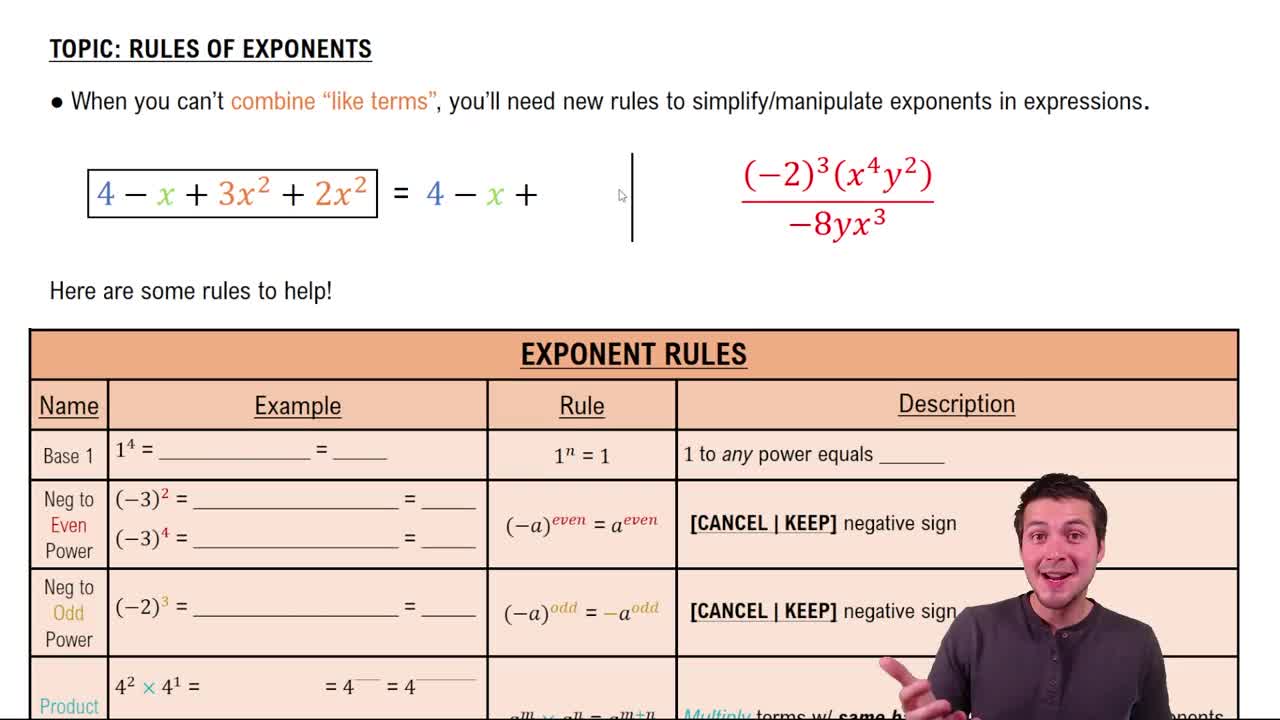
 7:39
7:39