In all exercises, other than exercises with no solution, use interval notation to express solution sets and graph each solution set on a number line. In Exercises 27–50, solve each linear inequality. 1 - (x + 3) ≥ 4 - 2x
Table of contents
- 0. Review of Algebra4h 18m
- 1. Equations & Inequalities3h 18m
- 2. Graphs of Equations1h 43m
- 3. Functions2h 17m
- 4. Polynomial Functions1h 44m
- 5. Rational Functions1h 23m
- 6. Exponential & Logarithmic Functions2h 28m
- 7. Systems of Equations & Matrices4h 5m
- 8. Conic Sections2h 23m
- 9. Sequences, Series, & Induction1h 22m
- 10. Combinatorics & Probability1h 45m
1. Equations & Inequalities
Linear Inequalities
Problem 42
Textbook Question
Explain why the equation | x | = √x² has infinitely many solutions.
Verified step by step guidance1
Recall the definition of absolute value: for any real number \(x\), \(|x|\) represents the distance of \(x\) from zero on the number line, which is always non-negative.
Understand that the square root of \(x^2\) is defined as \(\sqrt{x^2} = |x|\) because squaring \(x\) makes it non-negative, and the square root returns the principal (non-negative) root.
Since \(|x|\) and \(\sqrt{x^2}\) are equivalent expressions for all real numbers \(x\), the equation \(|x| = \sqrt{x^2}\) holds true for every real number.
Because every real number satisfies this equation, there are infinitely many solutions, as the set of real numbers is infinite.
Thus, the equation \(|x| = \sqrt{x^2}\) is true for all \(x \in \mathbb{R}\), explaining why it has infinitely many solutions.
Verified video answer for a similar problem:This video solution was recommended by our tutors as helpful for the problem above
Video duration:
3mPlay a video:
Was this helpful?
Key Concepts
Here are the essential concepts you must grasp in order to answer the question correctly.
Absolute Value Definition
The absolute value of a number x, denoted |x|, is the non-negative value of x without regard to its sign. It is defined as |x| = x if x ≥ 0, and |x| = -x if x < 0. This means |x| is always zero or positive.
Recommended video:
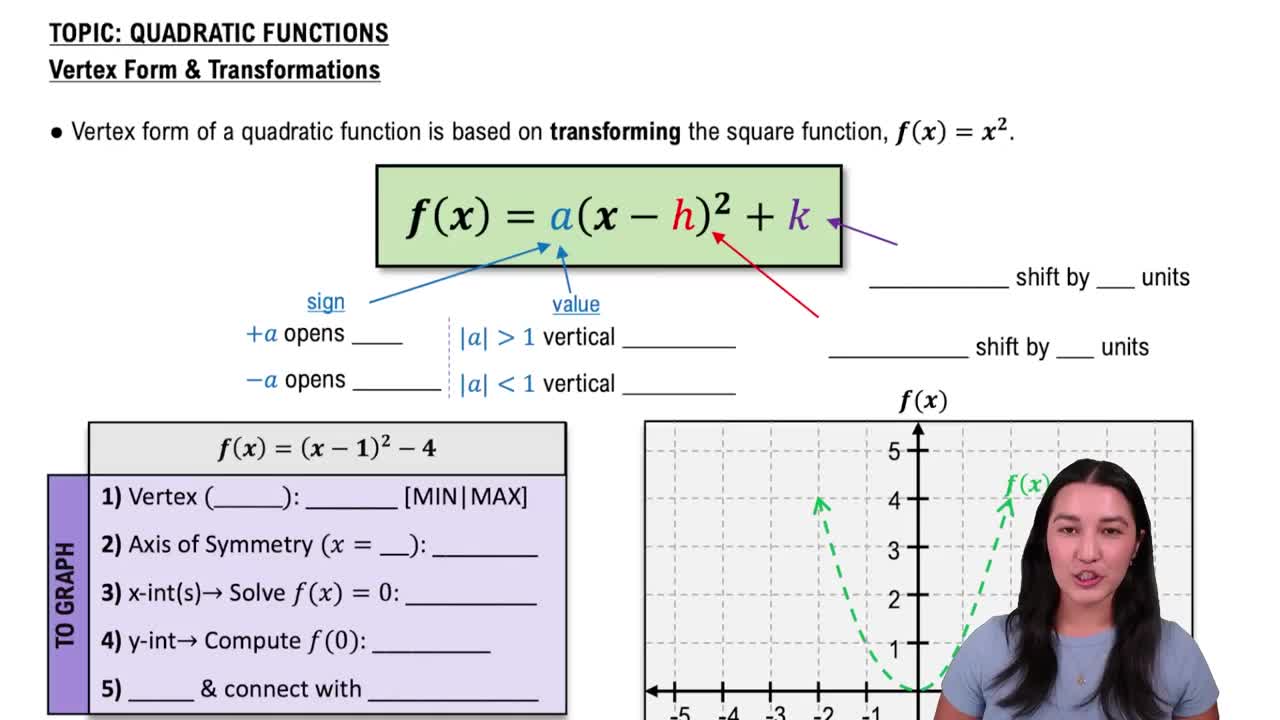
Vertex Form
Square Root and Squaring Relationship
The square root of x², written as √(x²), equals the non-negative value of x because squaring any real number makes it non-negative. Thus, √(x²) = |x|, which shows the two expressions are equivalent for all real x.
Recommended video:
Imaginary Roots with the Square Root Property
Infinite Solutions in Real Numbers
Since |x| = √(x²) holds true for every real number x, the equation has infinitely many solutions. This is because both sides represent the same value for all x in the real number set, not just specific points.
Recommended video:
Dividing Complex Numbers
Related Videos
Related Practice
Textbook Question
746
views