For the pair of functions defined, find (ƒ+g)(x), (ƒ-g)(x), (ƒg)(x), and (f/g)(x).Give the domain of each. ƒ(x)=√(5x-4), g(x)=-(1/x)
Verified step by step guidance
1
First, write down the given functions clearly: \(f(x) = \sqrt{5x - 4}\) and \(g(x) = -\frac{1}{x}\).
To find \((f+g)(x)\), add the two functions: \((f+g)(x) = \sqrt{5x - 4} - \frac{1}{x}\).
To find \((f-g)(x)\), subtract \(g(x)\) from \(f(x)\): \((f-g)(x) = \sqrt{5x - 4} + \frac{1}{x}\) (note the minus sign in \(g(x)\)).
To find \((fg)(x)\), multiply the two functions: \((fg)(x) = \sqrt{5x - 4} \times \left(-\frac{1}{x}\right) = -\frac{\sqrt{5x - 4}}{x}\).
To find \((f/g)(x)\), divide \(f(x)\) by \(g(x)\): \((f/g)(x) = \frac{\sqrt{5x - 4}}{-\frac{1}{x}} = -x \sqrt{5x - 4}\). Then, determine the domain for each by considering the restrictions: for \(f(x)\), the expression inside the square root must be non-negative (\$5x - 4 \geq 0\(), and for \)g(x)\(, \)x \neq 0\( because of the denominator. Also, for \)(f/g)(x)\(, ensure \)g(x) \neq 0$.
Verified video answer for a similar problem:
This video solution was recommended by our tutors as helpful for the problem above
Video duration:
4m
Play a video:
Was this helpful?
Key Concepts
Here are the essential concepts you must grasp in order to answer the question correctly.
Function Operations
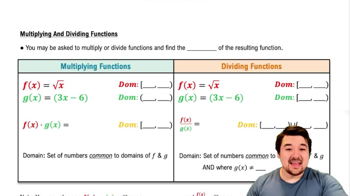
Function operations involve combining two functions through addition, subtraction, multiplication, or division to create new functions. For example, (ƒ+g)(x) = ƒ(x) + g(x) and (f/g)(x) = ƒ(x) divided by g(x), provided g(x) ≠ 0. Understanding these operations is essential to manipulate and analyze combined functions.
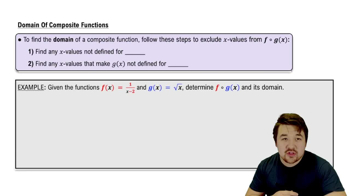
The domain of a function is the set of all input values (x) for which the function is defined. When combining functions, the domain of the resulting function is the intersection of the individual domains, considering restrictions like division by zero or square roots of negative numbers.
Square root functions require the radicand to be non-negative, so for ƒ(x) = √(5x-4), 5x-4 ≥ 0. Rational functions like g(x) = -1/x are undefined when the denominator is zero, so x ≠ 0. These restrictions must be considered when determining the domain of combined functions.