The rule for rewriting an absolute value equation without absolute value bars can be extended to equations with two sets of absolute value bars: If u and v represent algebraic expressions, then |u| = |v| is equivalent to u = v or u = - v. Use this to solve the equations in Exercises 77–84.
Table of contents
- 0. Review of Algebra4h 18m
- 1. Equations & Inequalities3h 18m
- 2. Graphs of Equations1h 43m
- 3. Functions2h 17m
- 4. Polynomial Functions1h 44m
- 5. Rational Functions1h 23m
- 6. Exponential & Logarithmic Functions2h 28m
- 7. Systems of Equations & Matrices4h 5m
- 8. Conic Sections2h 23m
- 9. Sequences, Series, & Induction1h 22m
- 10. Combinatorics & Probability1h 45m
1. Equations & Inequalities
The Quadratic Formula
Problem 89
Textbook Question
Use the method described in Exercises 83–86, if applicable, and properties ofabsolute value to solve each equation or inequality. (Hint: Exercises 99 and 100 canbe solved by inspection.) | 3x^2 - 14x | = 5
Verified step by step guidance1
Identify the absolute value equation: \(|3x^2 - 14x| = 5\).
Recognize that the absolute value equation \(|A| = B\) implies two separate equations: \(A = B\) and \(A = -B\).
Set up the first equation: \(3x^2 - 14x = 5\).
Set up the second equation: \(3x^2 - 14x = -5\).
Solve each quadratic equation separately to find the values of \(x\).
Verified video answer for a similar problem:This video solution was recommended by our tutors as helpful for the problem above
Video duration:
5mPlay a video:
Was this helpful?
Key Concepts
Here are the essential concepts you must grasp in order to answer the question correctly.
Absolute Value
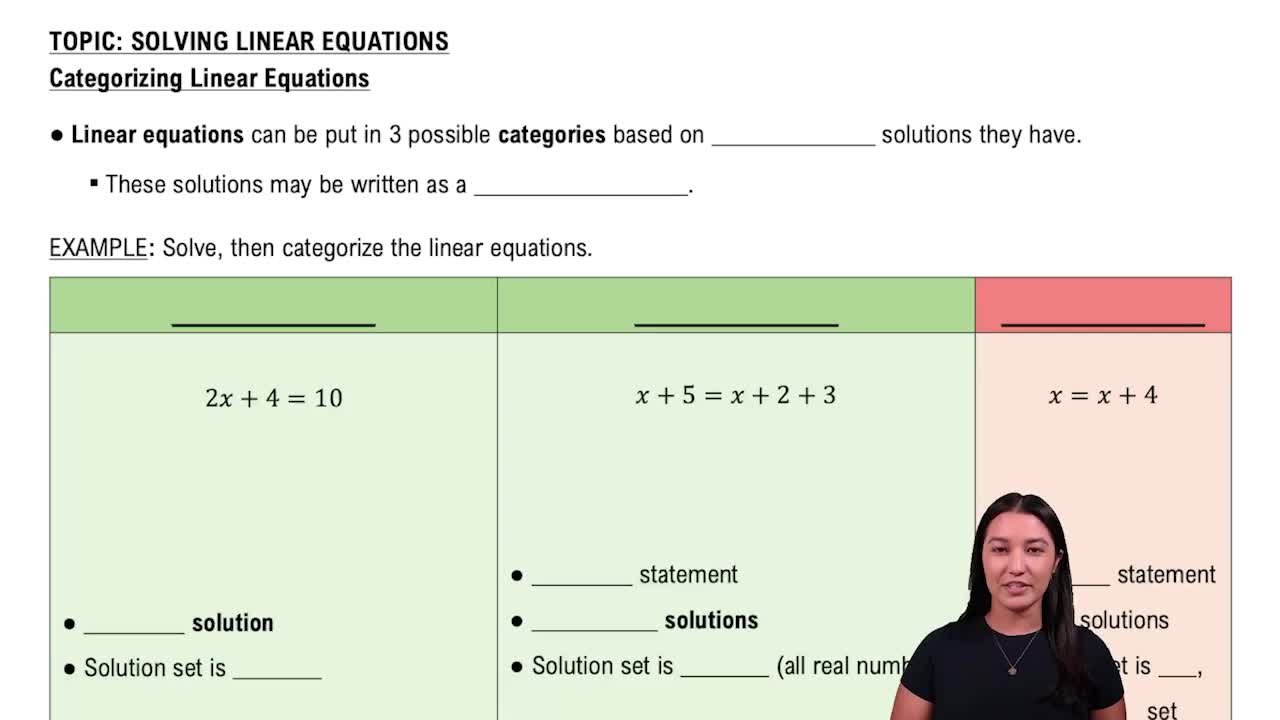
Absolute value measures the distance of a number from zero on the number line, regardless of direction. For any real number x, the absolute value is denoted as |x| and is defined as |x| = x if x ≥ 0, and |x| = -x if x < 0. In equations, this means that |A| = B implies A = B or A = -B, which is crucial for solving equations involving absolute values.
Recommended video:
Parabolas as Conic Sections Example 1
Quadratic Equations
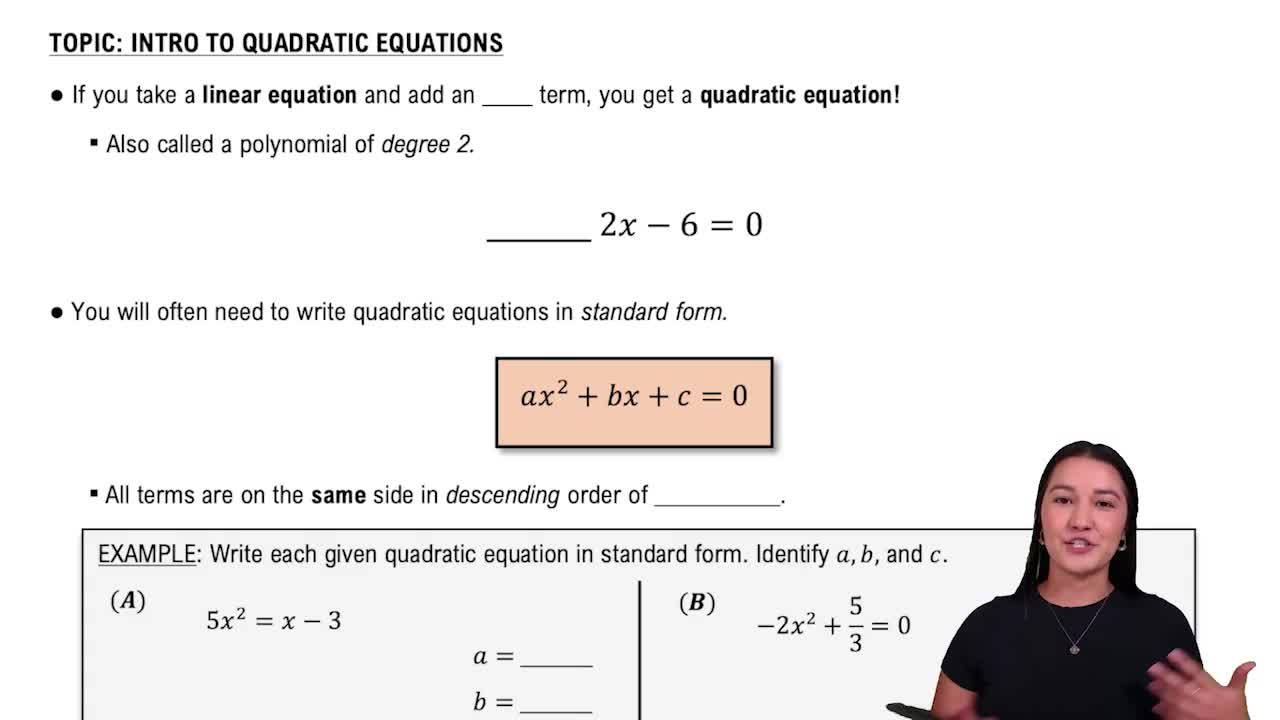
A quadratic equation is a polynomial equation of the form ax^2 + bx + c = 0, where a, b, and c are constants and a ≠ 0. The solutions to quadratic equations can be found using factoring, completing the square, or the quadratic formula. In the context of the given problem, the expression inside the absolute value is a quadratic, which will need to be solved for its roots to find the values of x.
Recommended video:
Introduction to Quadratic Equations
Properties of Inequalities
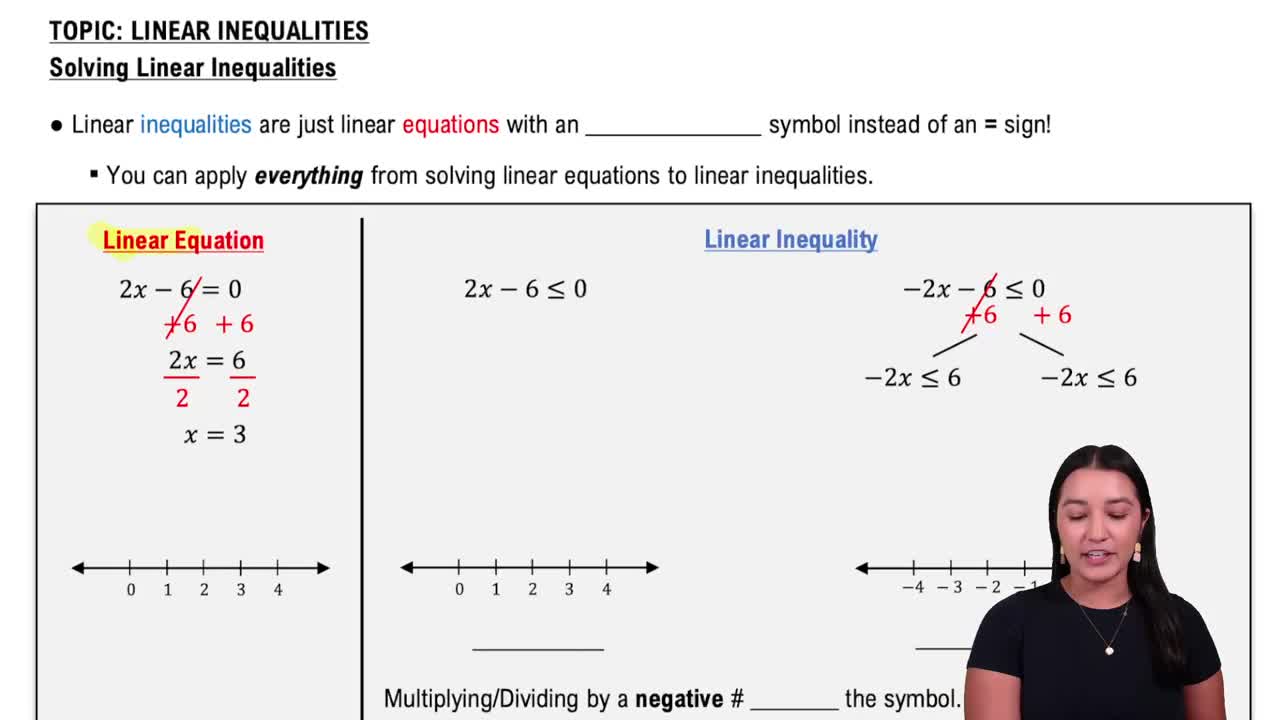
When solving inequalities, certain properties must be considered, such as the fact that multiplying or dividing both sides of an inequality by a negative number reverses the inequality sign. Additionally, when dealing with absolute values, the resulting equations can lead to multiple cases that must be analyzed separately. Understanding these properties is essential for correctly interpreting and solving the given equation.
Recommended video:
Linear Inequalities
Watch next
Master Solving Quadratic Equations Using The Quadratic Formula with a bite sized video explanation from Patrick
Start learningRelated Videos
Related Practice
Textbook Question
634
views