Find a common denominator for the fractions on both sides of the inequality. The common denominator is \((4 - x)(1 - x)\).
Multiply both sides of the inequality by the common denominator \((4 - x)(1 - x)\) to eliminate the fractions.
Simplify the resulting inequality and solve for \(x\).
Determine the critical points by setting the denominators equal to zero: \(4 - x = 0\) and \(1 - x = 0\). These points are \(x = 4\) and \(x = 1\). Use these points to test intervals and determine where the inequality holds true.
Verified video answer for a similar problem:
This video solution was recommended by our tutors as helpful for the problem above
Video duration:
4m
Play a video:
Was this helpful?
Key Concepts
Here are the essential concepts you must grasp in order to answer the question correctly.
Rational Inequalities
Rational inequalities involve expressions that are ratios of polynomials set in an inequality format. To solve them, one must determine where the rational expression is greater than or less than zero. This often requires finding critical points where the expression is undefined or equals zero, and then testing intervals to see where the inequality holds true.
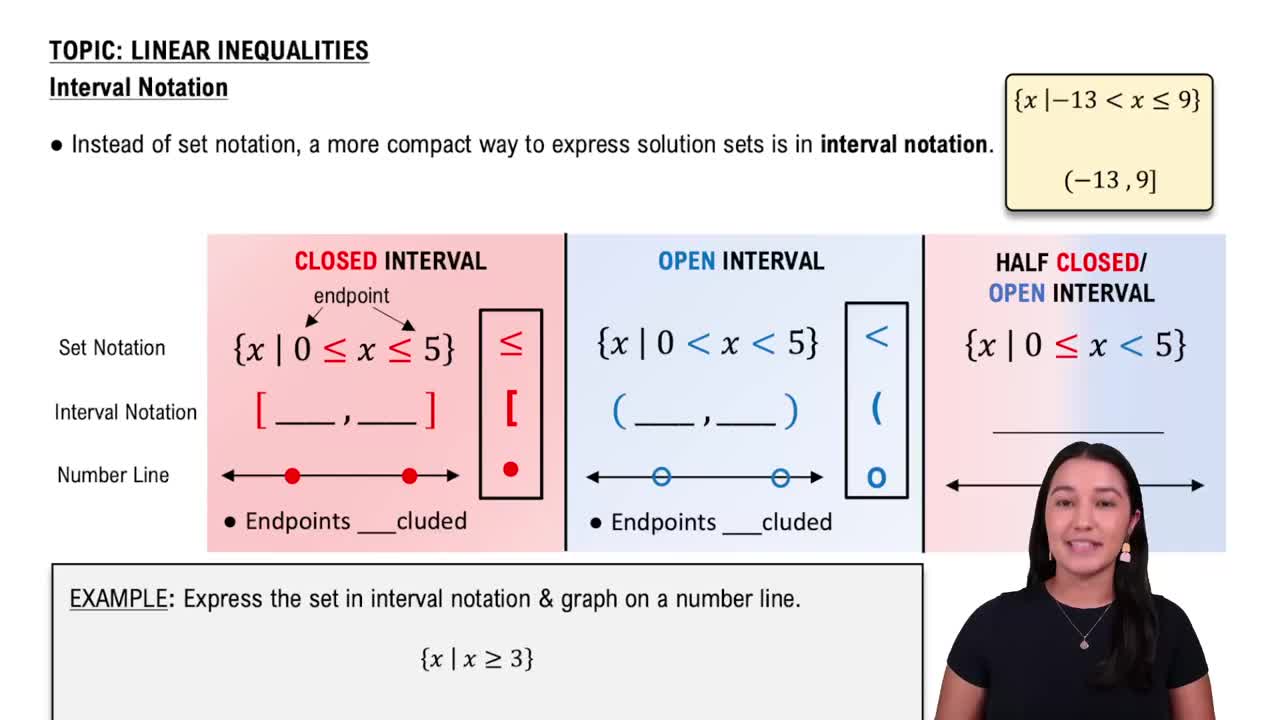
Interval notation is a mathematical notation used to represent a range of values. It uses parentheses and brackets to indicate whether endpoints are included (closed interval) or excluded (open interval). For example, (a, b) means all numbers between a and b, not including a and b, while [a, b] includes both endpoints.
Critical points are values of the variable where the rational expression is either zero or undefined. These points are essential in solving rational inequalities as they divide the number line into intervals. By testing these intervals, one can determine where the inequality is satisfied, leading to the solution set.