Solve each inequality. Give the solution set in interval notation. (2x-1)(x+5)<0
Verified step by step guidance
1
Identify the critical points by setting each factor equal to zero: \(2x - 1 = 0\) and \(x + 5 = 0\).
Solve these equations to find the critical points: \(x = \frac{1}{2}\) and \(x = -5\).
Use these critical points to divide the number line into intervals: \((-\infty, -5)\), \((-5, \frac{1}{2})\), and \((\frac{1}{2}, \infty)\).
Test a point from each interval in the inequality \((2x-1)(x+5)<0\) to determine where the inequality holds true.
Based on the test results, determine which intervals satisfy the inequality and express the solution set in interval notation.
Verified video answer for a similar problem:
This video solution was recommended by our tutors as helpful for the problem above
Video duration:
3m
Play a video:
Was this helpful?
Key Concepts
Here are the essential concepts you must grasp in order to answer the question correctly.
Inequalities
Inequalities express a relationship where one quantity is less than, greater than, less than or equal to, or greater than or equal to another. In this case, the inequality (2x-1)(x+5)<0 indicates that the product of the two expressions must be negative. Understanding how to manipulate and solve inequalities is crucial for finding the solution set.
Factoring involves breaking down an expression into simpler components, which can help in solving equations and inequalities. For the given inequality, factoring the expression (2x-1)(x+5) allows us to identify critical points where the expression changes sign. These points are essential for determining the intervals to test for the solution.
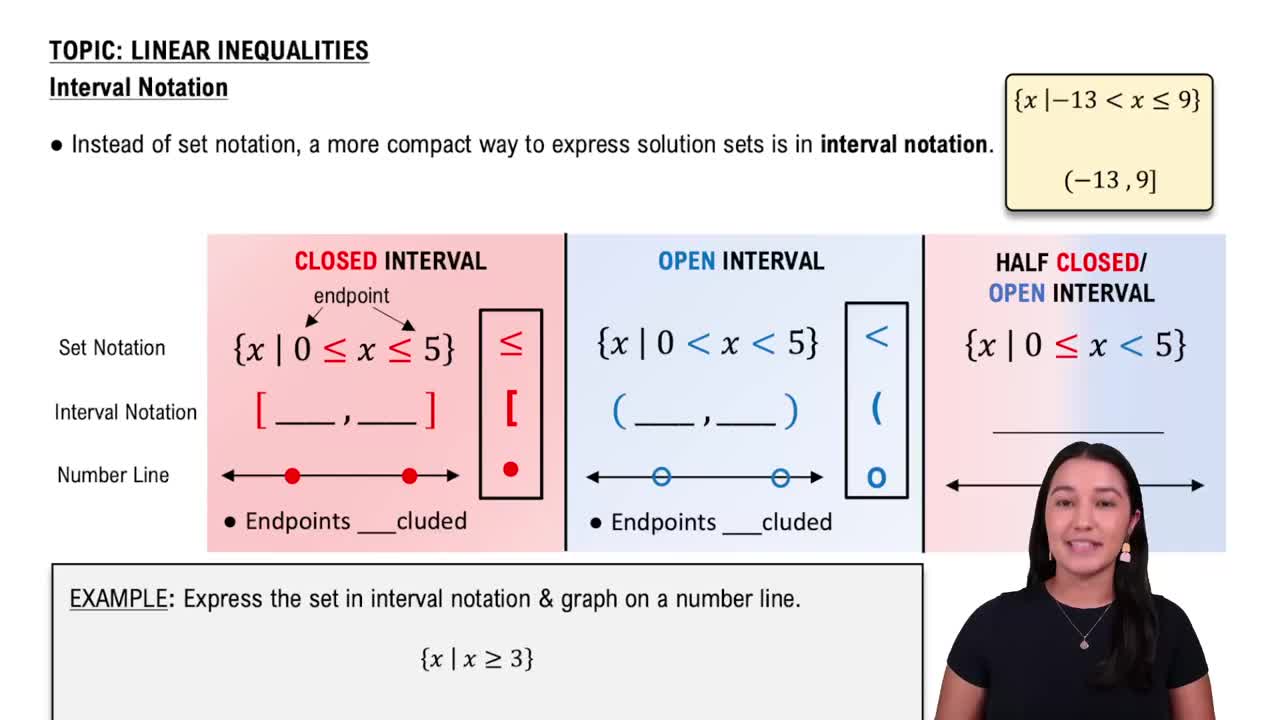
Interval notation is a mathematical notation used to represent a range of values. It uses parentheses and brackets to indicate whether endpoints are included or excluded. In the context of the inequality solution, expressing the solution set in interval notation provides a clear and concise way to communicate the values of x that satisfy the inequality.