Graph each quadratic function. Give the vertex, axis, x-intercepts, y-intercept, domain, range, and largest open intervals of the domain over which each function is increasing or decreasing. ƒ(x)=-3x2-12x-1
Table of contents
- 0. Review of Algebra4h 18m
- 1. Equations & Inequalities3h 18m
- 2. Graphs of Equations1h 43m
- 3. Functions2h 17m
- 4. Polynomial Functions1h 44m
- 5. Rational Functions1h 23m
- 6. Exponential & Logarithmic Functions2h 28m
- 7. Systems of Equations & Matrices4h 5m
- 8. Conic Sections2h 23m
- 9. Sequences, Series, & Induction1h 22m
- 10. Combinatorics & Probability1h 45m
4. Polynomial Functions
Quadratic Functions
Problem 5
Textbook Question
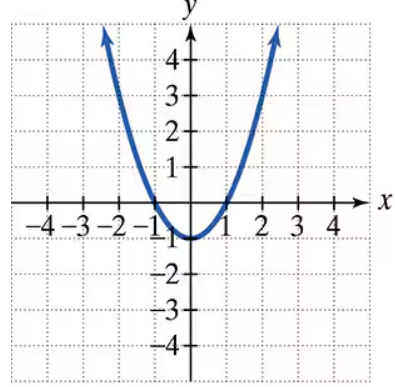
The graph of a quadratic function is given. Write the function's equation, selecting from the following options.
Verified step by step guidance1
Identify the general form of a quadratic function, which is \(y = ax^2 + bx + c\).
Use the point where the graph crosses the y-axis, which is \((0, 9)\), to find the value of \(c\). Since \(x=0\), the equation simplifies to \(y = c\), so \(c = 9\).
Substitute the other given point \((-3, 18)\) into the equation \(y = ax^2 + bx + 9\) to create an equation involving \(a\) and \(b\): \$18 = a(-3)^2 + b(-3) + 9$.
Simplify the equation from the previous step to get \$18 = 9a - 3b + 9\(, then rearrange it to \)9 = 9a - 3b$.
Use the vertex or symmetry of the parabola (if known) or another point to create a second equation to solve for \(a\) and \(b\). Alternatively, analyze the shape and direction of the parabola to determine the signs and values of \(a\) and \(b\).
Verified video answer for a similar problem:This video solution was recommended by our tutors as helpful for the problem above
Video duration:
2mPlay a video:
Was this helpful?
Key Concepts
Here are the essential concepts you must grasp in order to answer the question correctly.
Quadratic Function and Its Standard Form
A quadratic function is a polynomial of degree two, typically written as f(x) = ax^2 + bx + c. The graph of a quadratic function is a parabola, which can open upwards or downwards depending on the sign of 'a'. Understanding the standard form helps in identifying the coefficients that define the shape and position of the parabola.
Recommended video:
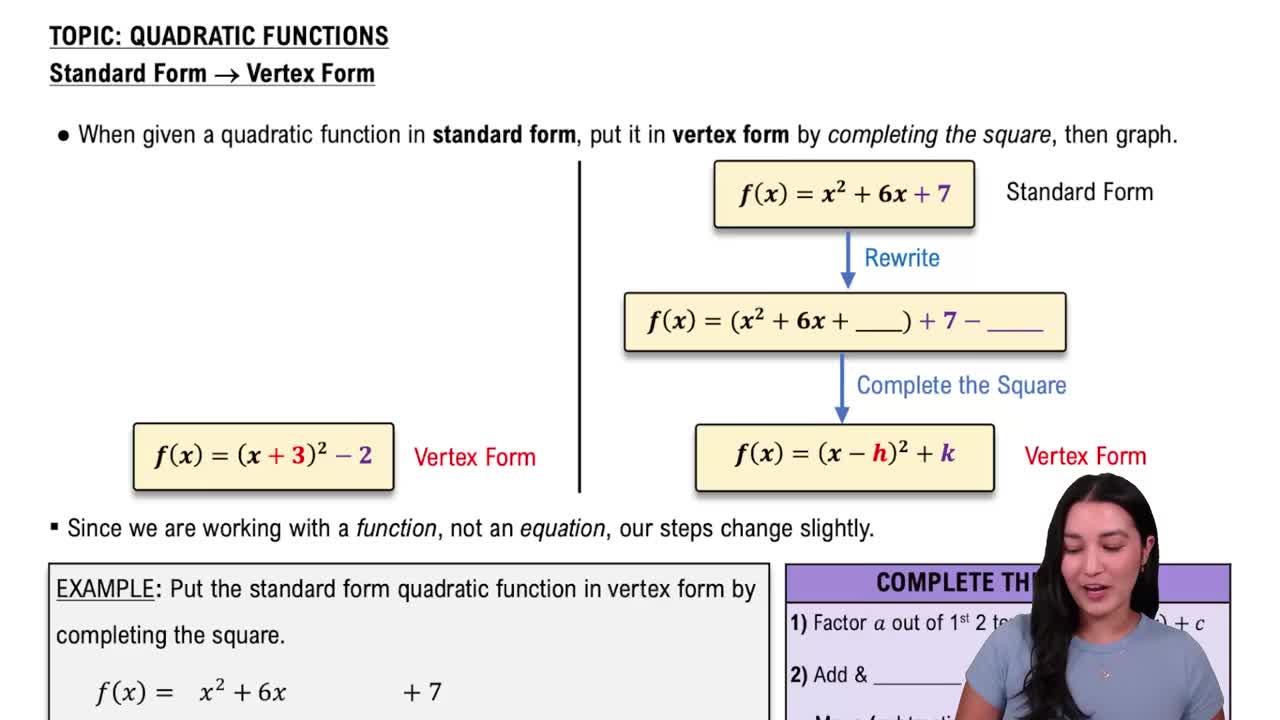
Converting Standard Form to Vertex Form
Using Points to Determine the Equation
Given points on the graph, such as (-3, 18) and (0, 9), you can substitute these coordinates into the quadratic equation to form a system of equations. Solving this system allows you to find the values of a, b, and c, which define the specific quadratic function that fits the graph.
Recommended video:
Guided course
Determinants of 2×2 Matrices
Interpreting the Vertex and Y-Intercept
The vertex of the parabola is its highest or lowest point, and the y-intercept is where the graph crosses the y-axis (x=0). In this graph, the point (0, 9) is the y-intercept, giving the value of c directly. Recognizing these points simplifies finding the quadratic equation.
Recommended video:
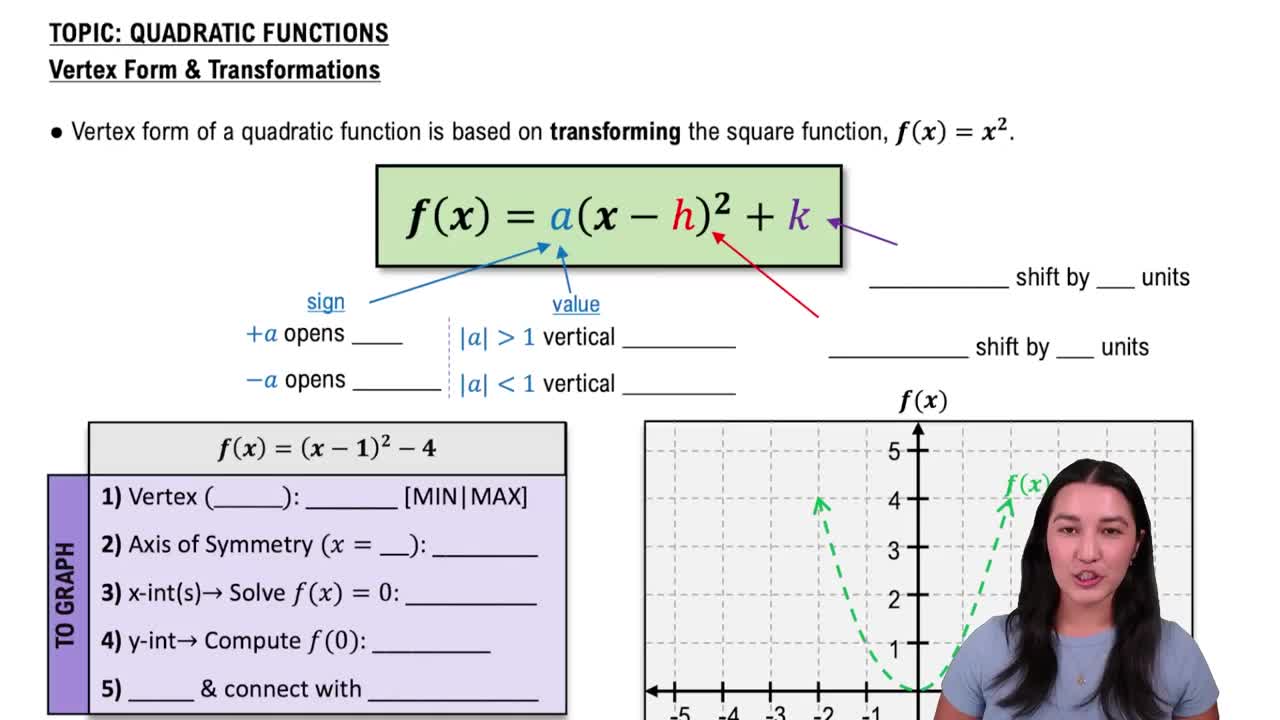
Vertex Form
Watch next
Master Properties of Parabolas with a bite sized video explanation from Patrick
Start learningRelated Videos
Related Practice
Textbook Question
1286
views