Table of contents
- 0. Review of Algebra4h 18m
- 1. Equations & Inequalities3h 18m
- 2. Graphs of Equations1h 43m
- 3. Functions2h 17m
- 4. Polynomial Functions1h 44m
- 5. Rational Functions1h 23m
- 6. Exponential & Logarithmic Functions2h 28m
- 7. Systems of Equations & Matrices4h 5m
- 8. Conic Sections2h 23m
- 9. Sequences, Series, & Induction1h 22m
- 10. Combinatorics & Probability1h 45m
4. Polynomial Functions
Quadratic Functions
Problem 5
Textbook Question
In Exercises 5–6, use the function's equation, and not its graph, to find (a) the minimum or maximum value and where it occurs. (b) the function's domain and its range.
Verified step by step guidance1
Identify the type of function given. Since the function is \(f(x) = -x^2 + 14x - 106\), it is a quadratic function with a negative leading coefficient, which means its graph is a parabola opening downward and it has a maximum value.
Find the vertex of the parabola, since the vertex gives the maximum or minimum value of a quadratic function. Use the vertex formula for the x-coordinate: \(x = \frac{-b}{2a}\), where \(a = -1\) and \(b = 14\) from the function \(f(x) = ax^2 + bx + c\).
Calculate the y-coordinate of the vertex by substituting the x-value found into the original function: \(f(x) = -x^2 + 14x - 106\). This y-value is the maximum value of the function.
Determine the domain of the function. Since it is a quadratic function, the domain is all real numbers, which can be written as \((-\infty, \infty)\).
Determine the range of the function. Because the parabola opens downward and the vertex represents the maximum value, the range is all real numbers less than or equal to the maximum y-value found at the vertex. Express the range as \((-\infty, \text{maximum value}]\).
Verified video answer for a similar problem:This video solution was recommended by our tutors as helpful for the problem above
Video duration:
5mPlay a video:
Was this helpful?
Key Concepts
Here are the essential concepts you must grasp in order to answer the question correctly.
Quadratic Functions and Their Graphs
A quadratic function is a polynomial of degree two, typically written as f(x) = ax^2 + bx + c. Its graph is a parabola that opens upward if a > 0 and downward if a < 0. Understanding the shape helps identify whether the function has a maximum or minimum value.
Recommended video:
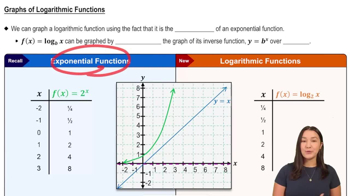
Graphs of Logarithmic Functions
Vertex of a Parabola
The vertex of a parabola given by f(x) = ax^2 + bx + c is the point where the function attains its maximum or minimum value. It can be found using the formula x = -b/(2a). Substituting this x-value back into the function gives the corresponding y-value, which is the max or min.
Recommended video:
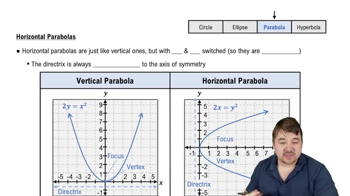
Horizontal Parabolas
Domain and Range of Quadratic Functions
The domain of any quadratic function is all real numbers since x can take any value. The range depends on the vertex and the parabola's direction: if it opens downward, the range is all values less than or equal to the vertex's y-value; if upward, all values greater than or equal to it.
Recommended video:
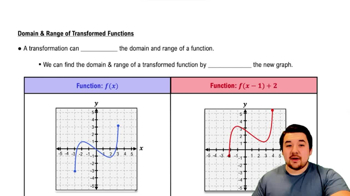
Domain & Range of Transformed Functions
Watch next
Master Properties of Parabolas with a bite sized video explanation from Patrick
Start learningRelated Videos
Related Practice
Textbook Question
In Exercises 1–4, the graph of a quadratic function is given. Write the function's equation, selecting from the following options.
1323
views