Solve each rational inequality. Give the solution set in interval notation. See Examples 4 and 5. (x - 1)/(x - 4) > 0
Verified step by step guidance
1
Step 1: Identify the critical points of the inequality. These are the values of x that make the numerator or the denominator equal to zero. In this case, the critical points are x = 1 and x = 4.
Step 2: Use the critical points to divide the number line into intervals. The intervals are (-∞, 1), (1, 4), and (4, ∞).
Step 3: Test a number from each interval in the inequality to determine if the interval is part of the solution set. For example, you could test x = 0 in the first interval, x = 2 in the second interval, and x = 5 in the third interval.
Step 4: If the inequality is true for the test value, then the entire interval is part of the solution set. If the inequality is false for the test value, then the interval is not part of the solution set.
Step 5: Write the solution set in interval notation. Include the intervals where the inequality is true, and exclude the intervals where the inequality is false. Remember to use parentheses or brackets appropriately: use parentheses to exclude an endpoint, and use brackets to include an endpoint.
Verified video answer for a similar problem:
This video solution was recommended by our tutors as helpful for the problem above
Video duration:
7m
Play a video:
Was this helpful?
Key Concepts
Here are the essential concepts you must grasp in order to answer the question correctly.
Rational Inequalities
Rational inequalities involve expressions that are ratios of polynomials set in relation to an inequality (e.g., >, <). To solve them, one must determine where the rational expression is positive or negative, which often requires finding critical points where the numerator or denominator equals zero.
Critical points are values of the variable that make the numerator or denominator of a rational expression zero. These points divide the number line into intervals, which can be tested to determine where the inequality holds true. For the inequality (x - 1)/(x - 4) > 0, the critical points are x = 1 and x = 4.
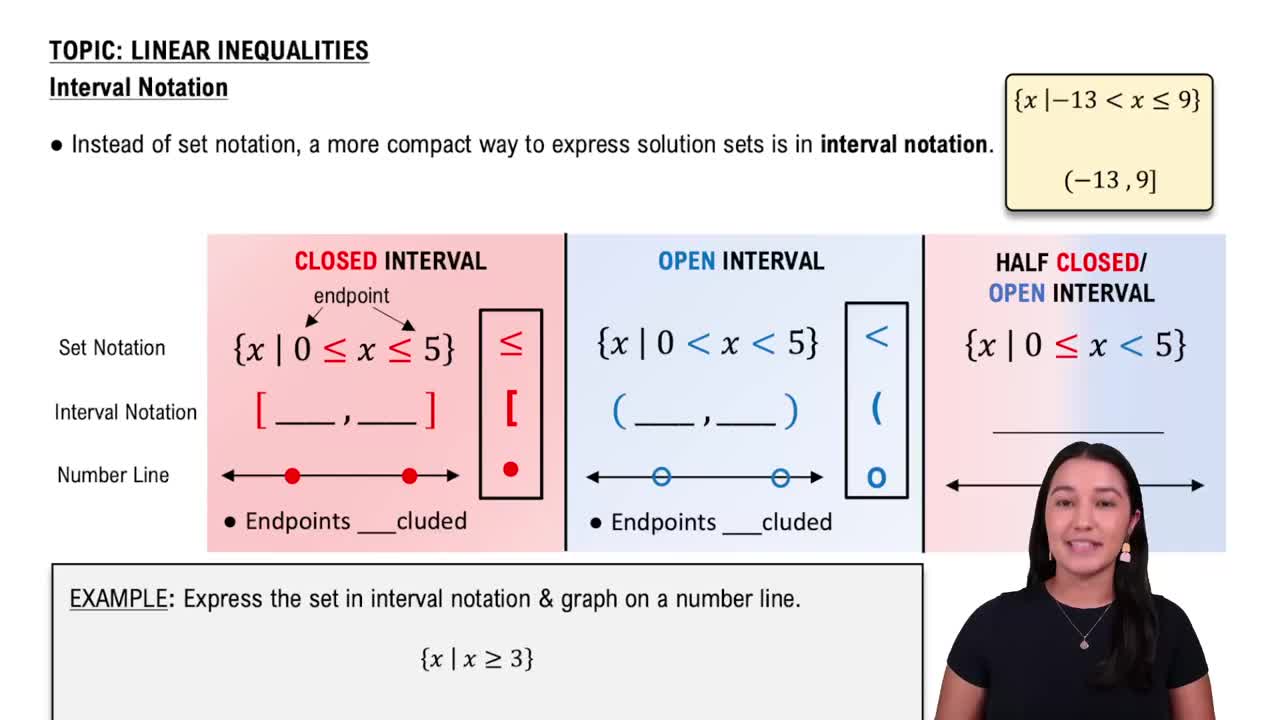
Interval notation is a way of representing the solution set of inequalities using intervals. It uses brackets [ ] for inclusive endpoints and parentheses ( ) for exclusive endpoints. For example, the solution set for the inequality can be expressed as intervals that indicate where the rational expression is greater than zero.