Determine the different possibilities for the numbers of positive, negative, and nonreal complex zeros of each function. See Example 7. ƒ(x)=9x6-7x4+8x2+x+6
Table of contents
- 0. Review of Algebra4h 18m
- 1. Equations & Inequalities3h 18m
- 2. Graphs of Equations1h 43m
- 3. Functions2h 17m
- 4. Polynomial Functions1h 44m
- 5. Rational Functions1h 23m
- 6. Exponential & Logarithmic Functions2h 28m
- 7. Systems of Equations & Matrices4h 5m
- 8. Conic Sections2h 23m
- 9. Sequences, Series, & Induction1h 22m
- 10. Combinatorics & Probability1h 45m
4. Polynomial Functions
Zeros of Polynomial Functions
Problem 3
Textbook Question
Use the Rational Zero Theorem to list all possible rational zeros for each given function. f(x)=3x4−11x3−x2+19x+6
Verified step by step guidance1
Identify the polynomial function: \(f(x) = 3x^{4} - 11x^{3} - x^{2} + 19x + 6\).
Recall the Rational Zero Theorem: any rational zero, expressed as \(\frac{p}{q}\), must have \(p\) as a factor of the constant term and \(q\) as a factor of the leading coefficient.
List the factors of the constant term (6): \(\pm1, \pm2, \pm3, \pm6\).
List the factors of the leading coefficient (3): \(\pm1, \pm3\).
Form all possible rational zeros by taking each factor of 6 over each factor of 3, simplifying if possible, to get the complete list of candidates.
Verified video answer for a similar problem:This video solution was recommended by our tutors as helpful for the problem above
Video duration:
2mPlay a video:
Was this helpful?
Key Concepts
Here are the essential concepts you must grasp in order to answer the question correctly.
Rational Zero Theorem
The Rational Zero Theorem provides a method to list all possible rational zeros of a polynomial function. It states that any rational zero, expressed as a fraction p/q in lowest terms, must have p as a factor of the constant term and q as a factor of the leading coefficient.
Recommended video:
Guided course
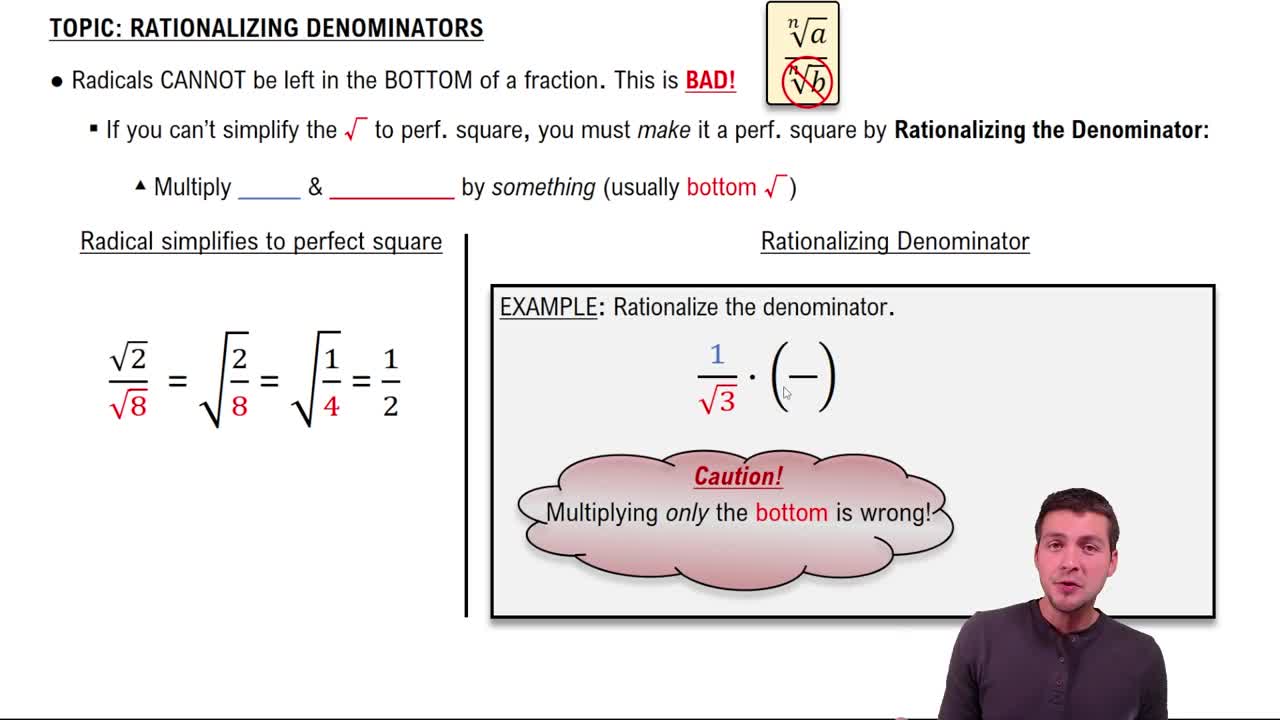
Rationalizing Denominators
Factors of Integers
To apply the Rational Zero Theorem, you need to find all factors of the constant term and the leading coefficient. Factors are integers that divide the number exactly without leaving a remainder, and identifying these helps generate all possible rational zeros.
Recommended video:
Guided course
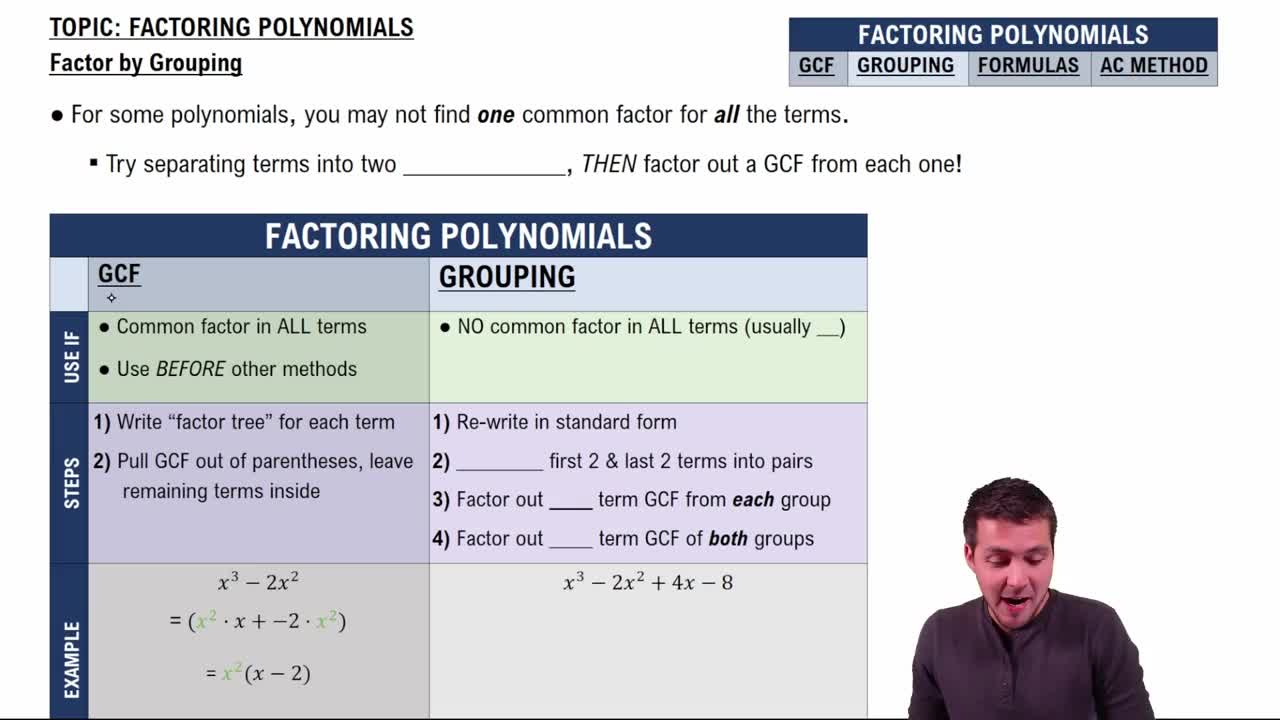
Factor by Grouping
Polynomial Functions and Zeros
A zero of a polynomial function is a value of x that makes the function equal to zero. Understanding how zeros relate to the graph and behavior of polynomials is essential for solving equations and analyzing functions.
Recommended video:
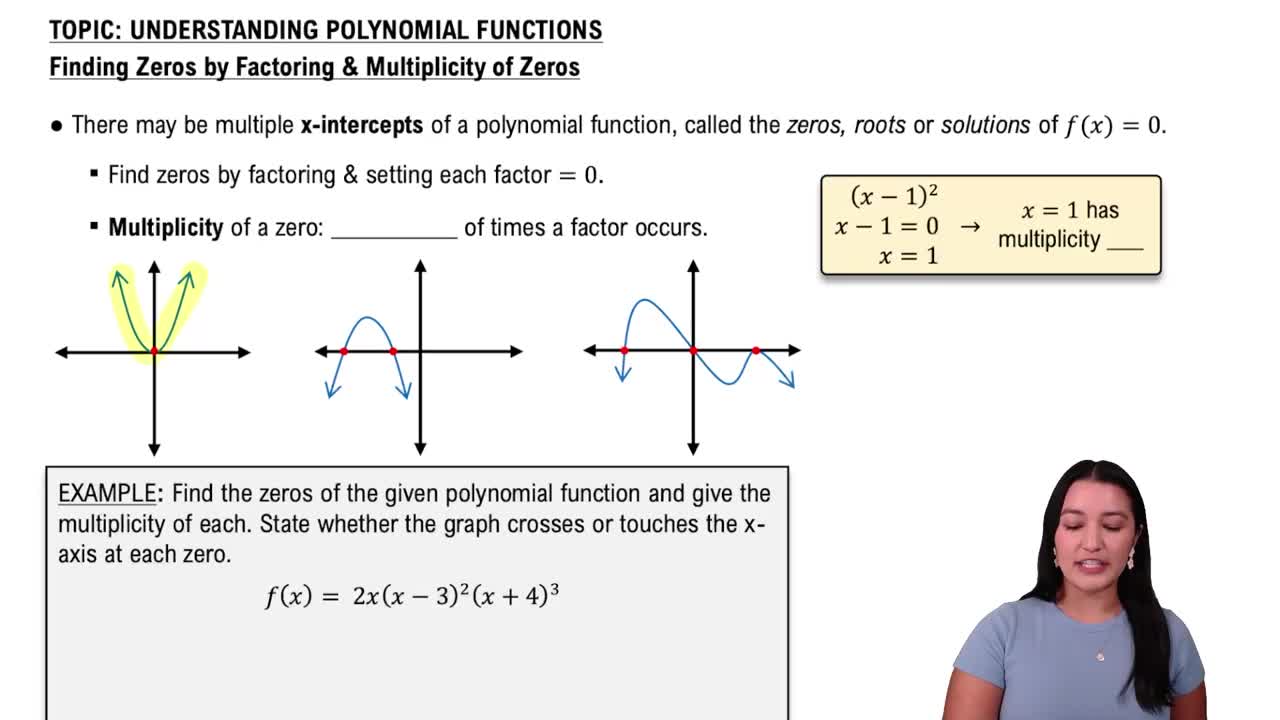
Finding Zeros & Their Multiplicity
Related Videos
Related Practice
Textbook Question
230
views