Let U = {0, 1, 2, 3, 4, 5, 6, 7, 8, 9, 10, 11, 12, 13}, M = {0, 2, 4, 6, 8}, N = {1, 3, 5, 7, 9, 11, 13}, Q = {0, 2, 4, 6, 8, 10, 12}, and R = {0, 1, 2, 3, 4}.Use these sets to find each of the following. Identify any disjoint sets. M ∩ N
Verified step by step guidance
1
Recall that the intersection of two sets, denoted by \(M \cap N\), consists of all elements that are common to both sets \(M\) and \(N\).
List the elements of set \(M\): \(\{0, 2, 4, 6, 8\}\) and set \(N\): \(\{1, 3, 5, 7, 9, 11, 13\}\).
Compare the elements of \(M\) and \(N\) to find any common elements. Since \(M\) contains only even numbers and \(N\) contains only odd numbers, check if any number appears in both sets.
If no elements are common between \(M\) and \(N\), then their intersection \(M \cap N\) is the empty set \(\emptyset\).
Since \(M \cap N = \emptyset\), this means sets \(M\) and \(N\) are disjoint, which means they have no elements in common.
Verified video answer for a similar problem:
This video solution was recommended by our tutors as helpful for the problem above
Video duration:
1m
Play a video:
Was this helpful?
Key Concepts
Here are the essential concepts you must grasp in order to answer the question correctly.
Set Intersection
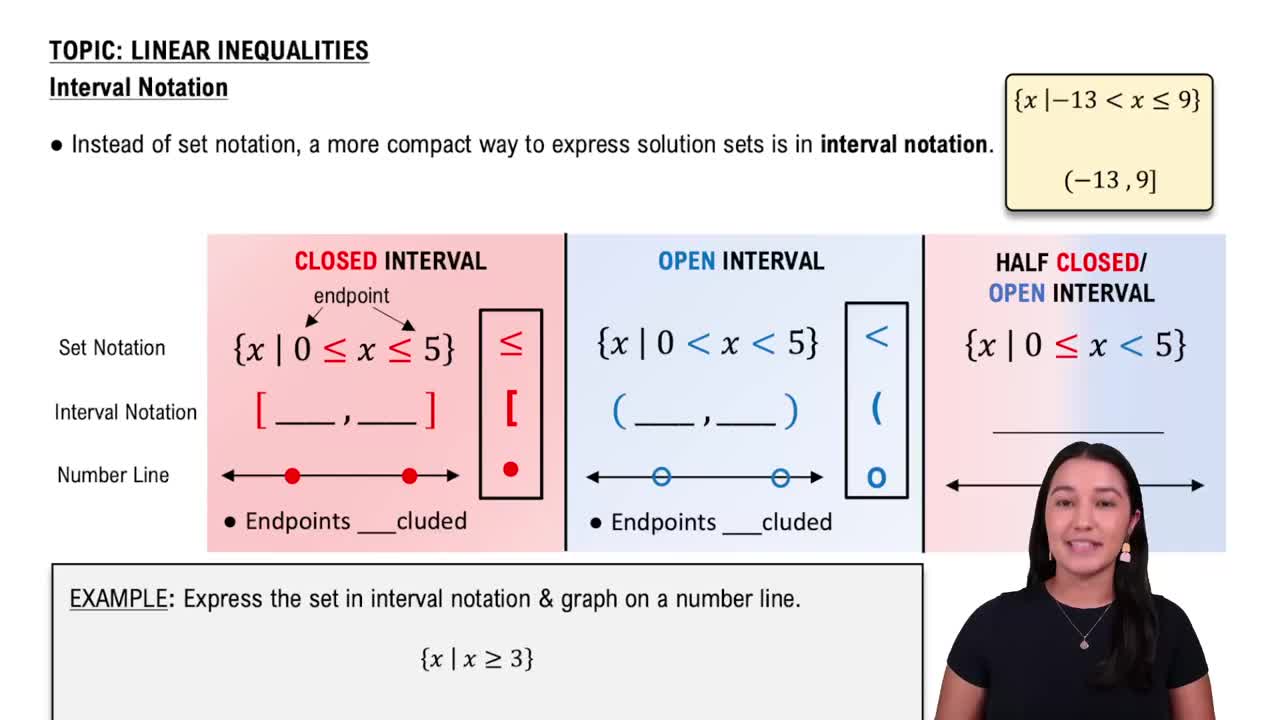
The intersection of two sets consists of all elements that are common to both sets. It is denoted by the symbol ∩. For example, if A = {1, 2, 3} and B = {2, 3, 4}, then A ∩ B = {2, 3}.
Two sets are disjoint if they have no elements in common, meaning their intersection is the empty set (∅). For instance, if A = {1, 2} and B = {3, 4}, then A and B are disjoint because A ∩ B = ∅.
The universal set U contains all elements under consideration, while subsets like M, N, Q, and R are parts of U. Understanding the relationship between subsets and the universal set helps in analyzing intersections and disjointness.