Recognize that the expression \(169^{1/2}\) represents the square root of 169.
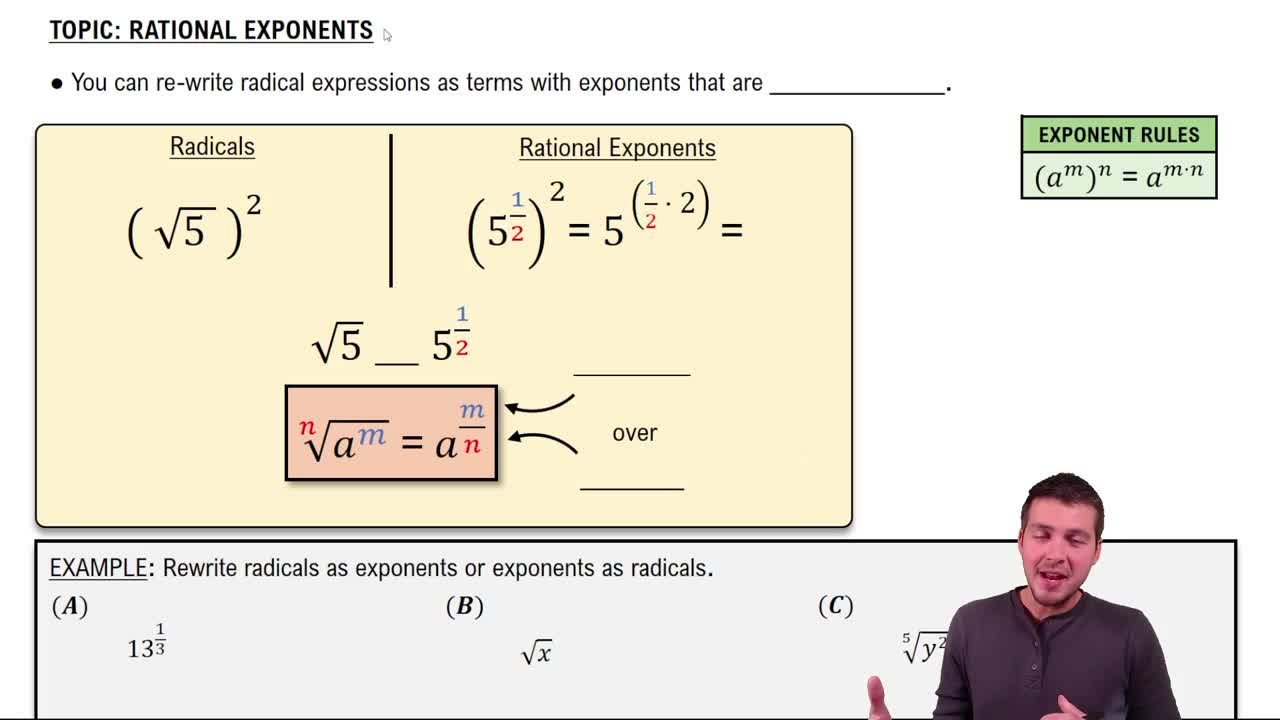
Recall that raising a number to the power of \(1/2\) is equivalent to taking the square root of that number.
Identify the perfect square that equals 169. In this case, 13 multiplied by itself (13 \times 13) equals 169.
Conclude that the square root of 169 is 13, since 13 is the number that, when squared, gives 169.
Therefore, \(169^{1/2} = \sqrt{169} = 13\).
Verified video answer for a similar problem:
This video solution was recommended by our tutors as helpful for the problem above
Video duration:
1m
Play a video:
Was this helpful?
Key Concepts
Here are the essential concepts you must grasp in order to answer the question correctly.
Exponents and Powers
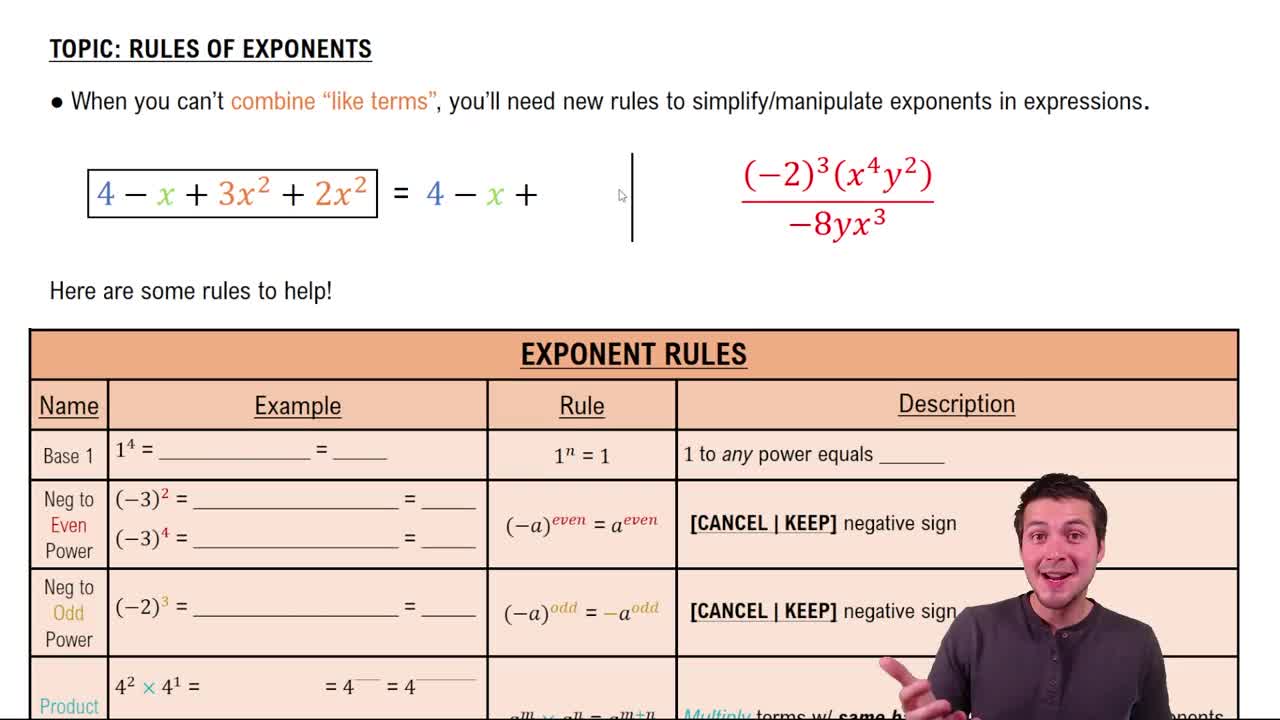
Exponents indicate how many times a base number is multiplied by itself. For example, 3^2 means 3 multiplied by itself twice (3 × 3). Understanding how to manipulate exponents is essential for evaluating expressions involving powers.
A fractional exponent like a^(m/n) represents the nth root of a raised to the mth power. Specifically, a^(1/2) means the square root of a. This concept connects roots and exponents, allowing expressions with roots to be rewritten as powers.
The square root of a number is a value that, when multiplied by itself, gives the original number. For example, the square root of 169 is 13 because 13 × 13 = 169. Recognizing perfect squares helps simplify expressions with fractional exponents.