Simplify each radical. Assume all variables represent positive real numbers. ∛250
Verified step by step guidance
1
Identify the prime factorization of 250. Start by dividing by the smallest prime number, which is 2, and continue with the next smallest primes.
Express 250 as a product of its prime factors: \(250 = 2 \times 5^3\).
Recognize that you are dealing with a cube root, \(\sqrt[3]{250}\), and look for groups of three identical factors.
Since \(5^3\) is a perfect cube, it can be taken out of the cube root as a single 5.
Simplify the expression to \(5\sqrt[3]{2}\), as 2 remains under the cube root.
Verified video answer for a similar problem:
This video solution was recommended by our tutors as helpful for the problem above
Video duration:
1m
Play a video:
Was this helpful?
Key Concepts
Here are the essential concepts you must grasp in order to answer the question correctly.
Radical Expressions
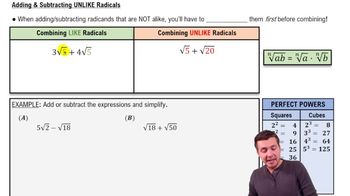
Radical expressions involve roots, such as square roots or cube roots. The expression ∛250 represents the cube root of 250, which is the number that, when multiplied by itself three times, equals 250. Understanding how to simplify these expressions is crucial for solving problems involving radicals.
Prime factorization is the process of breaking down a number into its prime factors. For example, 250 can be factored into 2 × 5². This technique is essential for simplifying radical expressions, as it allows us to identify perfect cubes or squares that can be simplified out of the radical.
Properties of exponents govern how to manipulate expressions involving powers. When simplifying radicals, these properties help in rewriting the radical in terms of exponents, such as expressing the cube root as a power of 1/3. This understanding is vital for simplifying expressions accurately and efficiently.