In Exercises 73–84, simplify each expression using the quotients-to-powers rule.
(x³/5)²
Verified step by step guidance
1
Identify the expression to simplify: \( \left( \frac{x^3}{5} \right)^2 \).
Apply the power of a quotient rule, which states \( \left( \frac{a}{b} \right)^n = \frac{a^n}{b^n} \).
Raise both the numerator and the denominator to the power of 2: \( \frac{(x^3)^2}{5^2} \).
Simplify the numerator by applying the power of a power rule: \( (x^3)^2 = x^{3 \times 2} = x^6 \).
Simplify the denominator: \( 5^2 = 25 \), resulting in the expression \( \frac{x^6}{25} \).
Verified video answer for a similar problem:
This video solution was recommended by our tutors as helpful for the problem above.
Video duration:
2m
Play a video:
0 Comments
Key Concepts
Here are the essential concepts you must grasp in order to answer the question correctly.
Quotients-to-Powers Rule
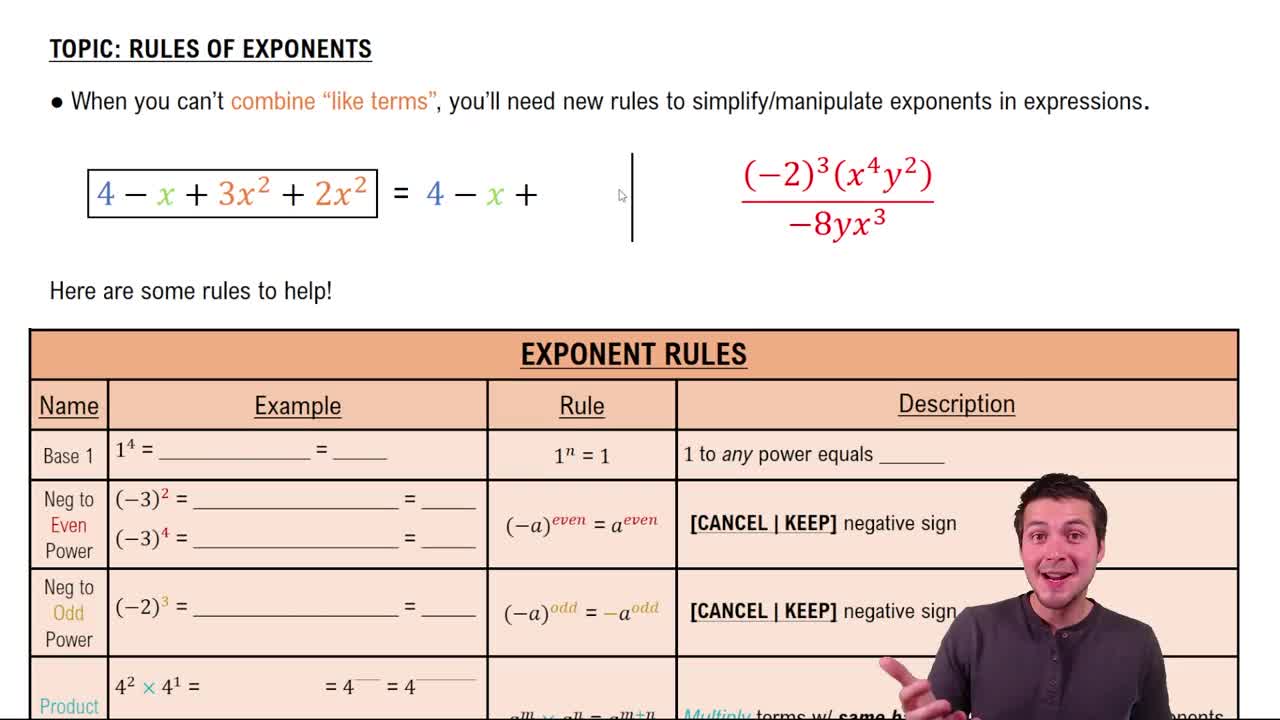
The quotients-to-powers rule states that when raising a fraction to a power, you can apply the exponent to both the numerator and the denominator separately. This means that for any expression of the form (a/b)ⁿ, it can be simplified to aⁿ/bⁿ. This rule is essential for simplifying expressions involving fractions raised to exponents.
Exponent rules are a set of mathematical principles that govern how to manipulate expressions involving powers. Key rules include the product of powers, power of a power, and power of a product. Understanding these rules is crucial for simplifying expressions correctly, especially when multiple exponents are involved.
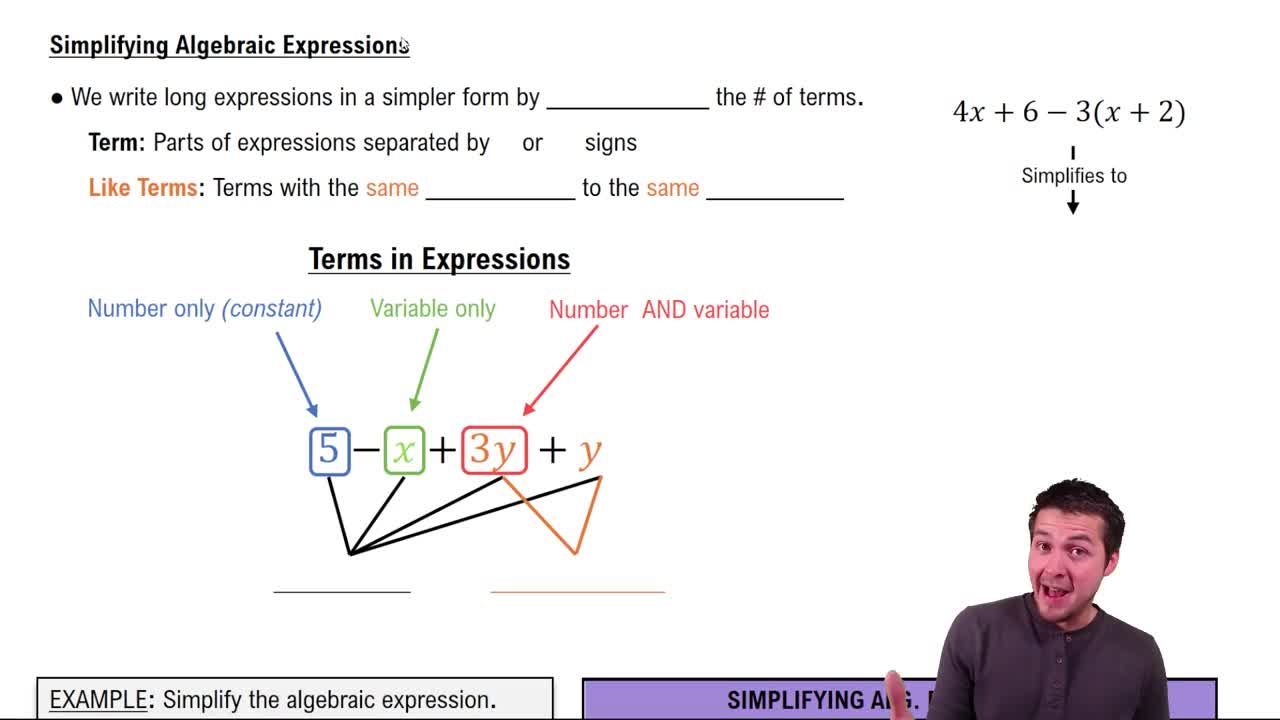
Simplifying expressions involves reducing them to their simplest form, making them easier to work with. This process often includes combining like terms, applying exponent rules, and reducing fractions. Mastery of simplification techniques is vital in algebra to solve equations and perform further calculations efficiently.

 2:44 minutes
 Verified step by step guidance
 3:49
3:49