Rewrite the equation \(x^{2/3} = 2x^{1/3}\) and recognize that both sides involve fractional exponents with the base \(x\).
Introduce a substitution to simplify the equation: let \(y = x^{1/3}\). Then, \(x^{2/3}\) becomes \(y^2\) because \((x^{1/3})^2 = x^{2/3}\).
Rewrite the original equation in terms of \(y\): \(y^2 = 2y\).
Bring all terms to one side to set the equation to zero: \(y^2 - 2y = 0\).
Factor the quadratic equation: \(y(y - 2) = 0\), then solve for \(y\) by setting each factor equal to zero, and finally substitute back \(y = x^{1/3}\) to find the values of \(x\).
Verified video answer for a similar problem:
This video solution was recommended by our tutors as helpful for the problem above
Video duration:
3m
Play a video:
Was this helpful?
Key Concepts
Here are the essential concepts you must grasp in order to answer the question correctly.
Rational Exponents
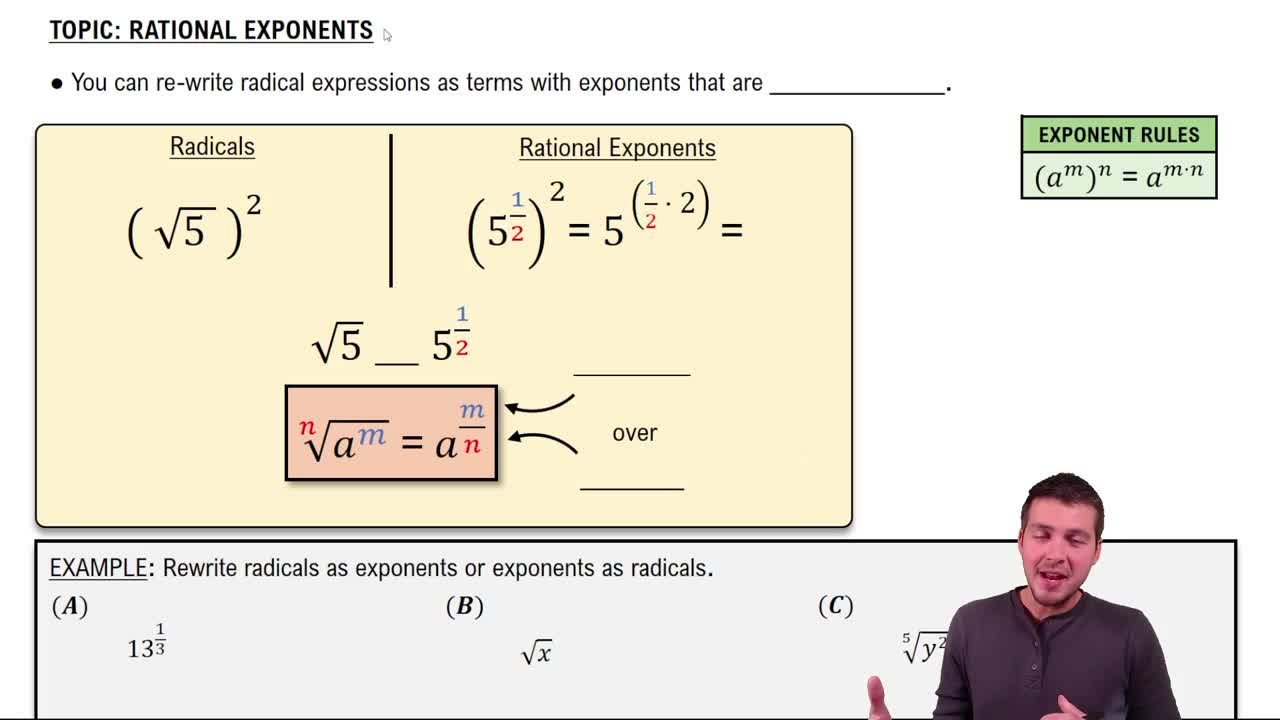
Rational exponents represent roots and powers simultaneously, where the numerator is the power and the denominator is the root. For example, x^(2/3) means the cube root of x squared. Understanding how to manipulate and simplify expressions with rational exponents is essential for solving equations like x^(2/3) = 2x^(1/3).
Substitution involves replacing a complex expression with a simpler variable to make the equation easier to solve. In this problem, letting y = x^(1/3) transforms the equation into a quadratic form, which can then be solved using standard algebraic methods. This technique simplifies handling fractional exponents.
When solving equations involving rational exponents or roots, some solutions may not satisfy the original equation due to domain restrictions. After finding potential solutions, substituting them back into the original equation ensures they are valid and not extraneous. This step is crucial for accurate problem-solving.