Start with the given equation: \( (x-3)^{\frac{2}{5}} = (4x)^{\frac{1}{5}} \).
To eliminate the fractional exponents, raise both sides of the equation to the power of 5, which is the least common denominator of the exponents. This gives: \( \left((x-3)^{\frac{2}{5}}\right)^5 = \left((4x)^{\frac{1}{5}}\right)^5 \).
Simplify the exponents by multiplying: \( (x-3)^2 = 4x \).
Rewrite the equation as a quadratic: \( (x-3)^2 = 4x \) expands to \( x^2 - 6x + 9 = 4x \).
Bring all terms to one side to set the equation to zero: \( x^2 - 6x + 9 - 4x = 0 \), which simplifies to \( x^2 - 10x + 9 = 0 \). Then solve this quadratic equation using factoring, completing the square, or the quadratic formula.
Verified video answer for a similar problem:
This video solution was recommended by our tutors as helpful for the problem above
Video duration:
3m
Play a video:
Was this helpful?
Key Concepts
Here are the essential concepts you must grasp in order to answer the question correctly.
Rational Exponents
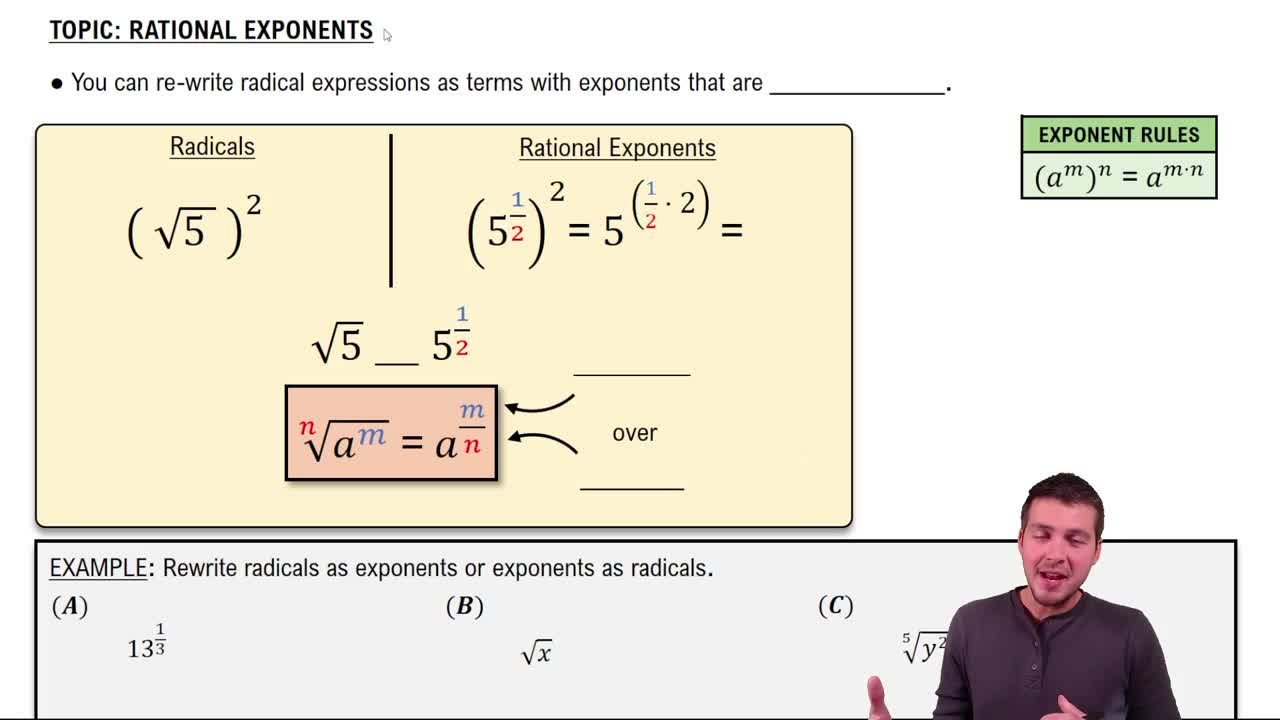
Rational exponents represent roots and powers simultaneously, where the numerator is the power and the denominator is the root. For example, x^(m/n) means the nth root of x raised to the mth power. Understanding how to manipulate these is essential for solving equations involving fractional powers.
To solve equations with exponents, it is important to isolate the terms containing the variable raised to a power. This often involves rewriting expressions with common bases or exponents and applying inverse operations like raising both sides to a reciprocal power to eliminate fractional exponents.
When solving equations involving rational exponents, raising both sides to powers can introduce extraneous solutions. It is crucial to substitute solutions back into the original equation to verify their validity and discard any that do not satisfy the equation.