Rewrite the equation \$3x^{3/4} = x^{1/2}$ to have the same base and express both sides with exponents clearly.
Recall that \(x^{1/2}\) is the same as \(x^{2/4}\), so rewrite the equation as \$3x^{3/4} = x^{2/4}$.
Divide both sides of the equation by \(x^{2/4}\) to isolate the terms with \(x\) on one side: \$3x^{3/4 - 2/4} = 1$.
Simplify the exponent subtraction: \$3x^{1/4} = 1$.
Solve for \(x^{1/4}\) by dividing both sides by 3, then raise both sides of the equation to the 4th power to solve for \(x\).
Verified video answer for a similar problem:
This video solution was recommended by our tutors as helpful for the problem above
Video duration:
3m
Play a video:
Was this helpful?
Key Concepts
Here are the essential concepts you must grasp in order to answer the question correctly.
Exponents and Rational Exponents
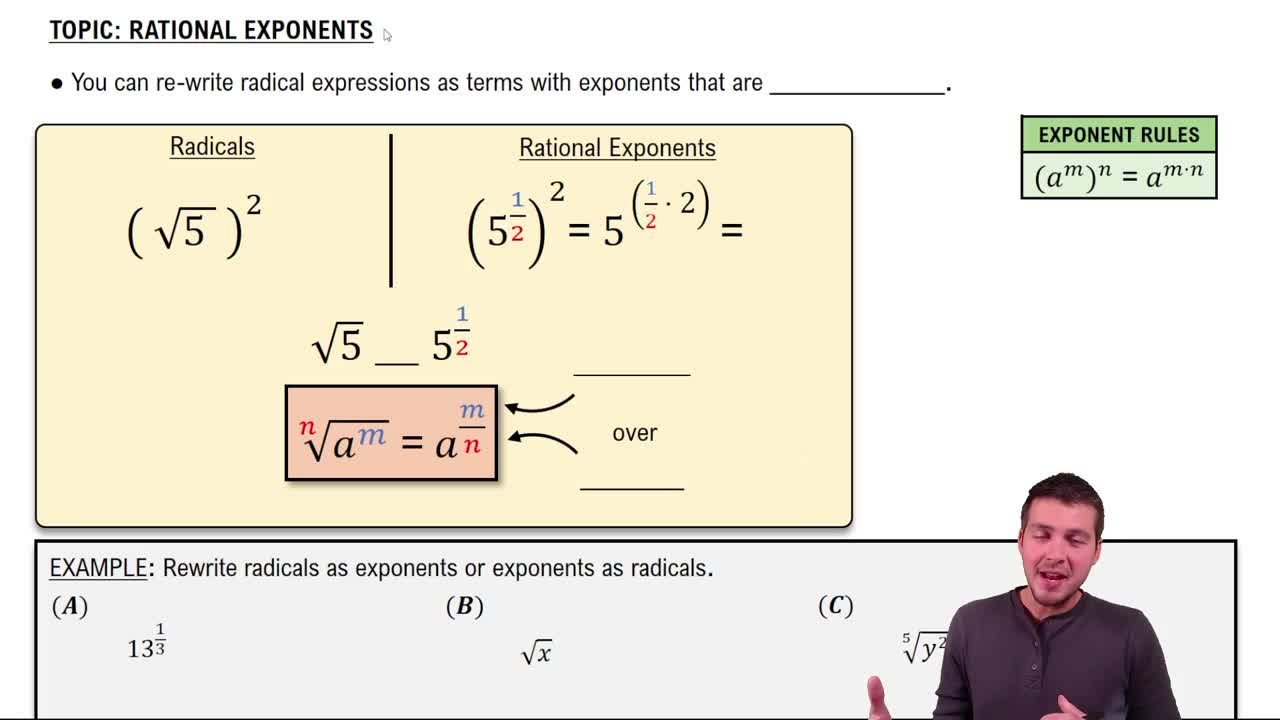
Exponents indicate how many times a base is multiplied by itself. Rational exponents, such as fractions, represent roots; for example, x^(1/2) means the square root of x, and x^(3/4) means the fourth root of x cubed. Understanding how to manipulate and interpret these is essential for solving equations involving fractional powers.
Properties like the product rule (a^m * a^n = a^(m+n)) and power rule ((a^m)^n = a^(m*n)) help simplify expressions with exponents. These rules allow rewriting and comparing terms with exponents, which is crucial when solving equations where variables have different fractional exponents.
To solve equations with exponents, isolate the variable term and use inverse operations such as raising both sides to a power that eliminates the fractional exponent. This often involves rewriting the equation to have the same base or exponent, enabling you to solve for the variable systematically.