Find the standard form of the equation of each ellipse satisfying the given conditions. Foci: (-5, 0), (5, 0); vertices: (-8, 0), (8,0)
Table of contents
- 0. Review of Algebra4h 18m
- 1. Equations & Inequalities3h 18m
- 2. Graphs of Equations1h 43m
- 3. Functions2h 17m
- 4. Polynomial Functions1h 44m
- 5. Rational Functions1h 23m
- 6. Exponential & Logarithmic Functions2h 28m
- 7. Systems of Equations & Matrices4h 5m
- 8. Conic Sections2h 23m
- 9. Sequences, Series, & Induction1h 22m
- 10. Combinatorics & Probability1h 45m
8. Conic Sections
Ellipses: Standard Form
Problem 31
Textbook Question
Find the standard form of the equation of each ellipse satisfying the given conditions. Major axis horizontal with length 8; length of minor axis = 4; center: (0, 0)
Verified step by step guidance1
Identify the center of the ellipse, which is given as (0, 0). This means the ellipse is centered at the origin.
Since the major axis is horizontal with length 8, find the value of \( a \), which is half the length of the major axis: \( a = \frac{8}{2} = 4 \).
The length of the minor axis is 4, so find the value of \( b \), which is half the length of the minor axis: \( b = \frac{4}{2} = 2 \).
Because the major axis is horizontal, the standard form of the ellipse equation centered at the origin is:
\[ \frac{x^2}{a^2} + \frac{y^2}{b^2} = 1 \]
Substitute \( a = 4 \) and \( b = 2 \) into the equation.
Write the equation explicitly with the substituted values:
\[ \frac{x^2}{4^2} + \frac{y^2}{2^2} = 1 \]
This is the standard form of the ellipse equation with the given conditions.
Verified video answer for a similar problem:This video solution was recommended by our tutors as helpful for the problem above
Video duration:
5mPlay a video:
Was this helpful?
Key Concepts
Here are the essential concepts you must grasp in order to answer the question correctly.
Standard Form of an Ellipse Equation
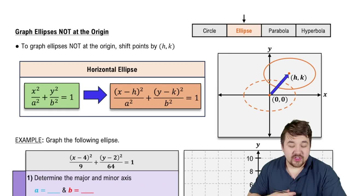
The standard form of an ellipse equation depends on the orientation of its major axis. For a horizontal major axis centered at (h, k), the equation is ((x - h)^2 / a^2) + ((y - k)^2 / b^2) = 1, where 'a' is the semi-major axis length and 'b' is the semi-minor axis length.
Recommended video:
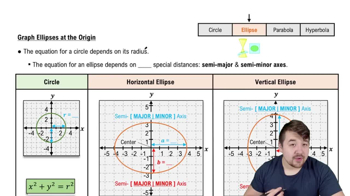
Graph Ellipses at Origin
Major and Minor Axes Lengths
The major axis is the longest diameter of the ellipse, and the minor axis is the shortest. Their lengths are 2a and 2b respectively, where 'a' > 'b'. Knowing these lengths allows you to find 'a' and 'b', which are essential for writing the ellipse equation.
Recommended video:
Graph Ellipses at Origin
Center of the Ellipse
The center of the ellipse (h, k) is the midpoint of both the major and minor axes. It shifts the ellipse from the origin if not at (0, 0). In this problem, the center is at (0, 0), simplifying the equation by removing horizontal and vertical shifts.
Recommended video:
Graph Ellipses NOT at Origin
Watch next
Master Graph Ellipses at Origin with a bite sized video explanation from Patrick
Start learningRelated Videos
Related Practice
Textbook Question