Solve: log2 (x+9) — log2 x = 1.
Table of contents
- 0. Review of Algebra4h 18m
- 1. Equations & Inequalities3h 18m
- 2. Graphs of Equations1h 43m
- 3. Functions2h 17m
- 4. Polynomial Functions1h 44m
- 5. Rational Functions1h 23m
- 6. Exponential & Logarithmic Functions2h 28m
- 7. Systems of Equations & Matrices4h 5m
- 8. Conic Sections2h 23m
- 9. Sequences, Series, & Induction1h 22m
- 10. Combinatorics & Probability1h 45m
6. Exponential & Logarithmic Functions
Properties of Logarithms
Problem 91
Textbook Question
Let u = ln a and v = ln b. Write each expression in terms of u and v without using the ln function. ln (b4 √a)
Verified step by step guidance1
Start with the given expression: \(\ln \left(b^{4\sqrt{a}}\right)\).
Recall the logarithm power rule: \(\ln(x^k) = k \ln(x)\). Apply this to rewrite the expression as \$4\sqrt{a} \cdot \ln b$.
Express \(\sqrt{a}\) in terms of \(a\): \(\sqrt{a} = a^{1/2}\). So the expression becomes \$4 a^{1/2} \cdot \ln b$.
Since \(u = \ln a\) and \(v = \ln b\), rewrite \(a^{1/2}\) using the exponential and logarithm relationship: \(a^{1/2} = e^{(1/2) \ln a} = e^{(1/2) u}\).
Substitute back into the expression to get \$4 e^{(1/2) u} \cdot v\(, which is the expression in terms of \)u\( and \)v\( without using the \)\ln$ function.
Verified video answer for a similar problem:This video solution was recommended by our tutors as helpful for the problem above
Video duration:
3mPlay a video:
Was this helpful?
Key Concepts
Here are the essential concepts you must grasp in order to answer the question correctly.
Properties of Logarithms
Logarithms have specific properties that simplify expressions, such as the power rule ln(x^r) = r ln(x) and the product rule ln(xy) = ln(x) + ln(y). These allow rewriting complex logarithmic expressions into sums and multiples of simpler logarithms.
Recommended video:
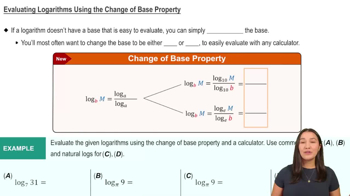
Change of Base Property
Exponent and Root Relationships
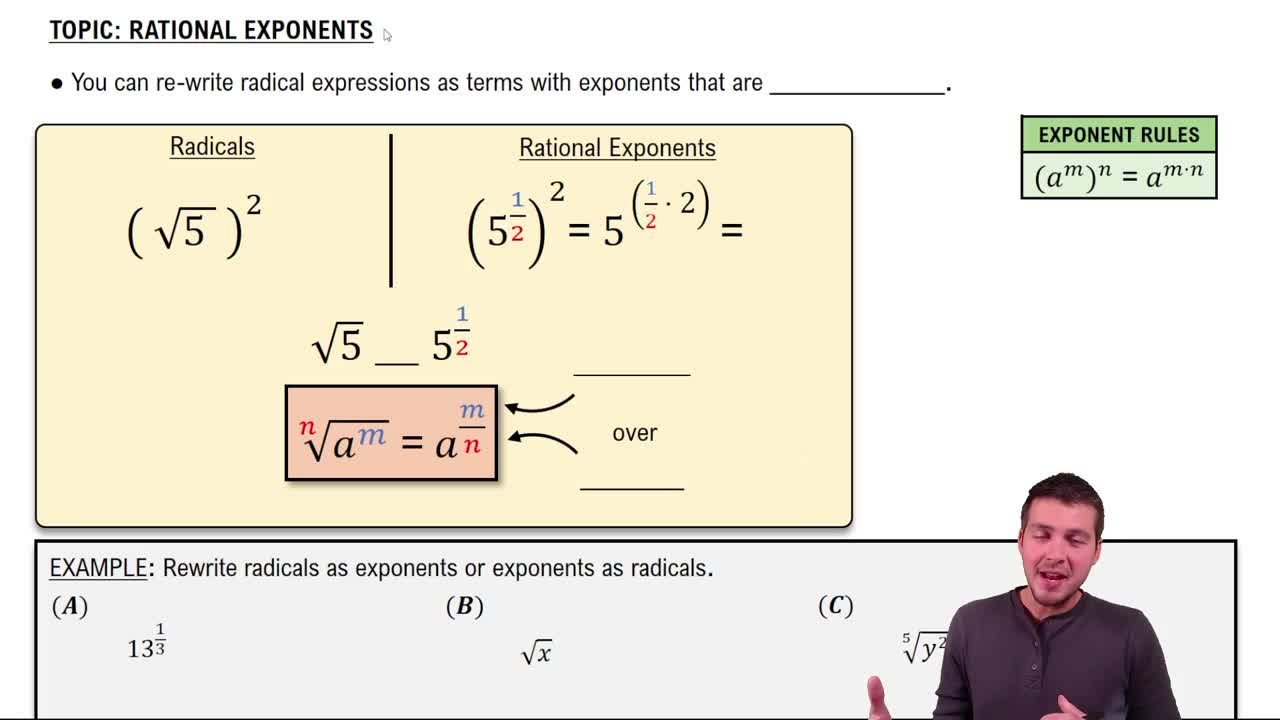
Roots can be expressed as fractional exponents, for example, the fourth root of a is a^(1/4). Understanding this allows rewriting expressions like b^4√a as b^4 * a^(1/4), facilitating the use of logarithm properties.
Recommended video:
Guided course
Rational Exponents
Substitution in Logarithmic Expressions
Given u = ln(a) and v = ln(b), substitution replaces ln(a) and ln(b) with u and v respectively. This helps express logarithmic expressions in terms of u and v without explicitly using the ln function.
Recommended video:
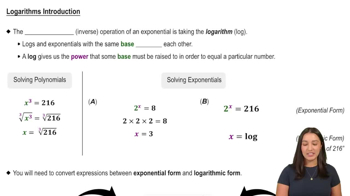
Logarithms Introduction
Watch next
Master Product, Quotient, and Power Rules of Logs with a bite sized video explanation from Patrick
Start learningRelated Videos
Related Practice
Textbook Question