In Exercises 9 - 16, find the following matrices: c. - 4A
Table of contents
- 0. Review of Algebra4h 18m
- 1. Equations & Inequalities3h 18m
- 2. Graphs of Equations1h 43m
- 3. Functions2h 17m
- 4. Polynomial Functions1h 44m
- 5. Rational Functions1h 23m
- 6. Exponential & Logarithmic Functions2h 28m
- 7. Systems of Equations & Matrices4h 5m
- 8. Conic Sections2h 23m
- 9. Sequences, Series, & Induction1h 22m
- 10. Combinatorics & Probability1h 45m
7. Systems of Equations & Matrices
Introduction to Matrices
Problem 16
Textbook Question
In Exercises 14–27, perform the indicated matrix operations given that and D are defined as follows. If an operation is not defined, state the reason. D-A
Verified step by step guidance1
Step 1: Understand the problem. The problem involves performing the matrix operation D - A, where D and A are matrices. Matrix subtraction is only defined if the two matrices have the same dimensions. Verify that matrices D and A have the same number of rows and columns.
Step 2: Write down the general rule for matrix subtraction. If D and A are matrices of the same dimensions, then the subtraction D - A is performed element by element. Mathematically, this means that for each element in the resulting matrix, (D - A)_{ij} = D_{ij} - A_{ij}, where i and j represent the row and column indices.
Step 3: Align the matrices D and A. Write out the elements of both matrices side by side, ensuring that corresponding elements are aligned. This will help you perform the subtraction element by element.
Step 4: Subtract the corresponding elements of matrices D and A. For each position (i, j), subtract the element in matrix A from the corresponding element in matrix D. Record the result in the corresponding position of the resulting matrix.
Step 5: Verify the result. Ensure that the resulting matrix has the same dimensions as the original matrices D and A, and double-check each subtraction to confirm accuracy. If the dimensions of D and A are not the same, state that the operation is not defined.
Verified video answer for a similar problem:This video solution was recommended by our tutors as helpful for the problem above
Video duration:
1mPlay a video:
Was this helpful?
Key Concepts
Here are the essential concepts you must grasp in order to answer the question correctly.
Matrix Operations
Matrix operations include addition, subtraction, and multiplication of matrices. For addition and subtraction, matrices must have the same dimensions, meaning they must have the same number of rows and columns. Understanding these operations is crucial for performing calculations involving matrices, as they follow specific rules that dictate how elements are combined.
Recommended video:
Guided course
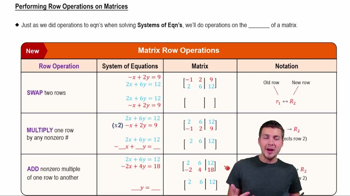
Performing Row Operations on Matrices
Matrix Dimensions
The dimensions of a matrix are defined by the number of rows and columns it contains, expressed as 'm x n' where 'm' is the number of rows and 'n' is the number of columns. When performing operations like addition or subtraction, it is essential that the matrices involved have the same dimensions; otherwise, the operation is undefined. This concept is fundamental in determining whether specific matrix operations can be executed.
Recommended video:
Guided course
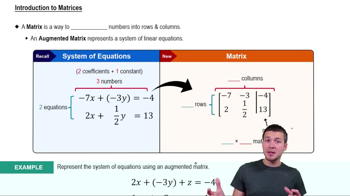
Introduction to Matrices
Defined Operations
In linear algebra, an operation is considered defined if it adheres to the rules governing the types of matrices involved. For instance, subtracting two matrices is only defined if they have the same dimensions. If the matrices do not meet the criteria for the operation, it is necessary to state that the operation is undefined, which is a critical aspect of matrix algebra.
Recommended video:
Guided course
Performing Row Operations on Matrices
Watch next
Master Introduction to Matrices with a bite sized video explanation from Patrick
Start learningRelated Videos
Related Practice
Textbook Question
615
views