Solve each rational inequality. Give the solution set in interval notation. 20/(x - 1) ≥ 1
Verified step by step guidance
1
Start by rewriting the inequality: \(\frac{20}{x - 1} \geq 1\).
Bring all terms to one side to have zero on the other side: \(\frac{20}{x - 1} - 1 \geq 0\).
Find a common denominator and combine the terms into a single rational expression: \(\frac{20 - (x - 1)}{x - 1} \geq 0\).
Simplify the numerator: \(\frac{21 - x}{x - 1} \geq 0\).
Determine the critical points by setting numerator and denominator equal to zero: \$21 - x = 0\( and \)x - 1 = 0$, then analyze the sign of the expression on intervals defined by these points to find where the inequality holds.
Verified video answer for a similar problem:
This video solution was recommended by our tutors as helpful for the problem above
Video duration:
9m
Play a video:
0 Comments
Key Concepts
Here are the essential concepts you must grasp in order to answer the question correctly.
Rational Inequalities
Rational inequalities involve expressions where one or both sides contain rational functions, which are ratios of polynomials. Solving them requires finding values of the variable that make the inequality true, often by analyzing the sign of the expression and considering restrictions from denominators.
When solving rational inequalities, it is crucial to identify values that make the denominator zero, as these are excluded from the domain. These restrictions help determine critical points that divide the number line into intervals for testing the inequality.
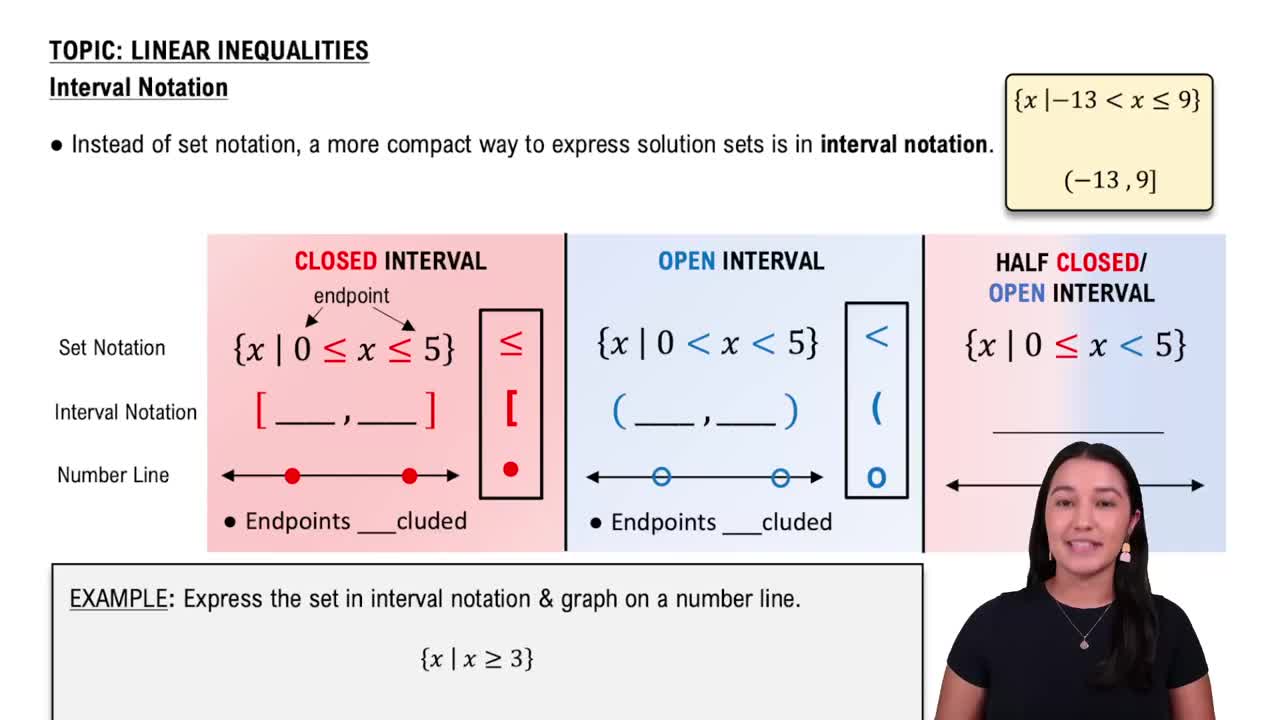
After finding critical points, the number line is divided into intervals. Each interval is tested to see if it satisfies the inequality. The solution set is then expressed in interval notation, which concisely represents all values that satisfy the inequality.

 9:15 minutes
 Verified step by step guidance
 3:21
3:21