Match each expression in Column I with its equivalent expression in Column II. Choices may be used once, more than once, or not at all. See Example 3. a. 6^0 b. -6^0 c. (-6)^0 d. -(-6)^0 A. 0 B. 1 C. -1 D. 6 E. -6
Verified step by step guidance
1
Step 1: Understand the property of exponents that any non-zero number raised to the power of 0 is 1.
Step 2: Evaluate each expression in Column I using the property from Step 1.
Step 3: For expression 'a. 6^0', apply the property: 6^0 = 1.
Step 4: For expression 'b. -6^0', note that the exponent applies only to 6, not the negative sign: -6^0 = -(6^0) = -1.
Step 5: For expression 'c. (-6)^0', apply the property to the entire expression: (-6)^0 = 1. For expression 'd. -(-6)^0', apply the property to -6 first, then apply the negative sign: -(-6)^0 = -(1) = -1.
Verified video answer for a similar problem:
This video solution was recommended by our tutors as helpful for the problem above
Video duration:
36s
Play a video:
Was this helpful?
Key Concepts
Here are the essential concepts you must grasp in order to answer the question correctly.
Exponent Rules
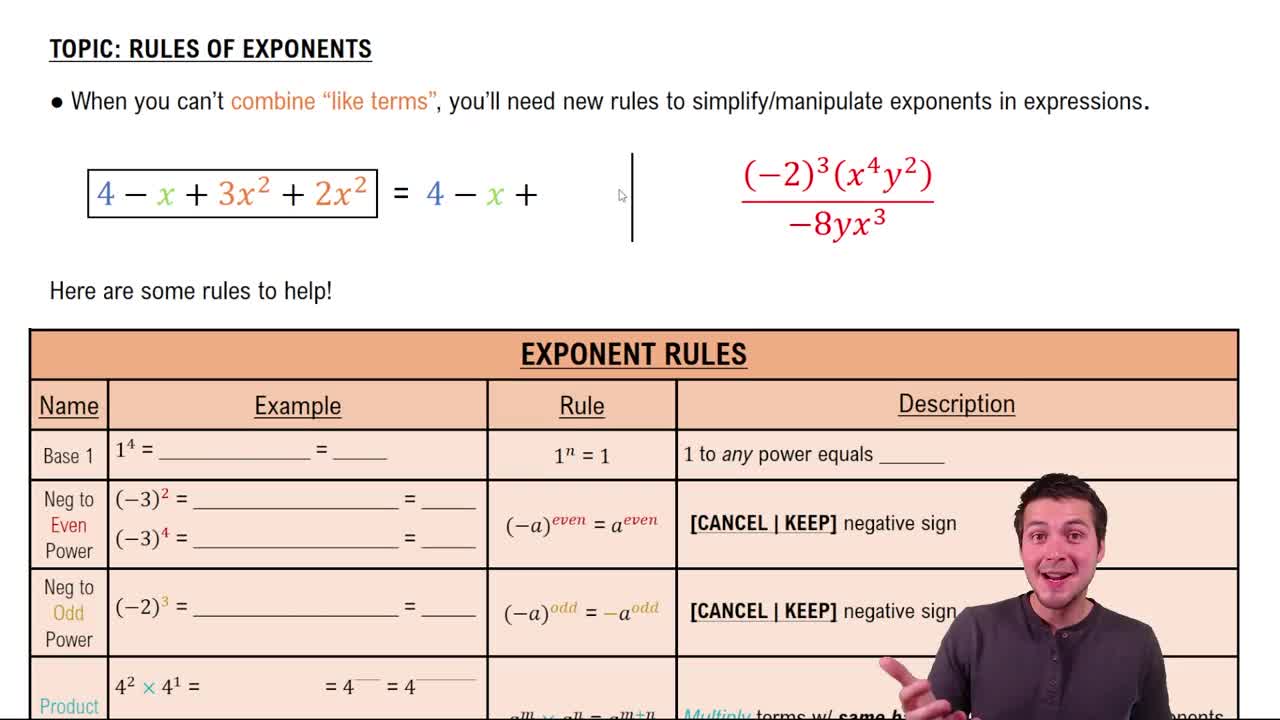
Exponent rules are mathematical principles that govern how to simplify expressions involving powers. A key rule is that any non-zero number raised to the power of zero equals one, which is crucial for evaluating expressions like 6^0 and (-6)^0.
Negative exponents indicate the reciprocal of the base raised to the corresponding positive exponent. However, in the context of zero exponents, the negative sign in expressions like -6^0 does not affect the outcome, as the exponent still evaluates to one.
The order of operations is a set of rules that dictates the sequence in which mathematical operations should be performed to ensure consistent results. In this case, understanding how to evaluate expressions correctly, especially with parentheses and negative signs, is essential for matching the expressions accurately.