In Exercises 35–52, write each expression with positive exponents only. Then simplify, if possible.3⁻²
Verified step by step guidance
1
Identify the expression with a negative exponent: \$3^{-2}$.
Recall the rule for negative exponents: \(a^{-n} = \frac{1}{a^n}\).
Apply the rule to the expression: \$3^{-2} = \frac{1}{3^2}$.
Calculate the positive exponent: \$3^2 = 3 \times 3$.
Express the simplified form: \(\frac{1}{3^2}\).
Verified video answer for a similar problem:
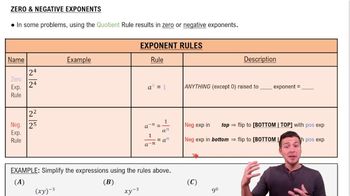
This video solution was recommended by our tutors as helpful for the problem above
Video duration:
2m
Play a video:
Was this helpful?
Key Concepts
Here are the essential concepts you must grasp in order to answer the question correctly.
Negative Exponents
A negative exponent indicates the reciprocal of the base raised to the absolute value of the exponent. For example, a⁻n = 1/aⁿ. This concept is crucial for rewriting expressions with negative exponents into forms that use only positive exponents.
The reciprocal of a number is 1 divided by that number. In the context of exponents, when converting a negative exponent, the base is placed in the denominator of a fraction. For instance, 3⁻² becomes 1/3², which simplifies the expression to a positive exponent.
Simplification involves reducing an expression to its simplest form. This can include combining like terms, applying exponent rules, and reducing fractions. In the case of 3⁻², after converting to a positive exponent, further simplification can yield a numerical value, such as 1/9.