In Exercises 1–14, write the first six terms of each arithmetic sequence.
Verified step by step guidance
1
Identify the first term of the arithmetic sequence, which is given as .
Recognize the common difference is given as , meaning each term increases by 5 from the previous term.
Use the formula for the nth term of an arithmetic sequence: to find each term.
Calculate each term from to by substituting the values into the formula: .
Write out the first six terms explicitly by evaluating the expression for each from 1 to 6.
Verified video answer for a similar problem:
This video solution was recommended by our tutors as helpful for the problem above
Video duration:
1m
Play a video:
Was this helpful?
Key Concepts
Here are the essential concepts you must grasp in order to answer the question correctly.
Arithmetic Sequence
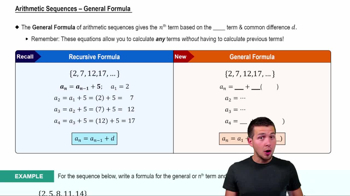
An arithmetic sequence is a list of numbers where each term after the first is found by adding a constant difference to the previous term. This constant is called the common difference, and the sequence progresses linearly.
The common difference is the fixed amount added to each term to get the next term in an arithmetic sequence. It can be positive, negative, or zero, and it determines the rate at which the sequence increases or decreases.
To find any term in an arithmetic sequence, use the formula a_n = a_1 + (n - 1)d, where a_1 is the first term, d is the common difference, and n is the term number. This formula helps generate terms without listing all previous ones.