The spinner below has 6 equal regions. Find the probability of landing on yellow for the first spin and not landing on yellow on the second spin.
Table of contents
- 0. Review of Algebra4h 18m
- 1. Equations & Inequalities3h 18m
- 2. Graphs of Equations1h 43m
- 3. Functions2h 17m
- 4. Polynomial Functions1h 44m
- 5. Rational Functions1h 23m
- 6. Exponential & Logarithmic Functions2h 28m
- 7. Systems of Equations & Matrices4h 5m
- 8. Conic Sections2h 23m
- 9. Sequences, Series, & Induction1h 22m
- 10. Combinatorics & Probability1h 45m
10. Combinatorics & Probability
Probability
Problem 21
Textbook Question
In Exercises 21–22, a fair coin is tossed two times in succession. The sample space of equally likely outcomes is {HH,HT,TH,TT}. Find the probability of getting two heads.
Verified step by step guidance1
Identify the sample space for tossing a fair coin two times. The sample space is {HH, HT, TH, TT}, where each outcome is equally likely.
Determine the event of interest, which is getting two heads. This event corresponds to the outcome {HH}.
Count the number of favorable outcomes for the event. Here, there is only 1 favorable outcome: HH.
Count the total number of possible outcomes in the sample space. There are 4 possible outcomes: HH, HT, TH, TT.
Calculate the probability of the event by dividing the number of favorable outcomes by the total number of outcomes: .
Verified video answer for a similar problem:This video solution was recommended by our tutors as helpful for the problem above
Video duration:
4mPlay a video:
Was this helpful?
Key Concepts
Here are the essential concepts you must grasp in order to answer the question correctly.
Sample Space
The sample space is the set of all possible outcomes of an experiment. For tossing a fair coin twice, the sample space includes {HH, HT, TH, TT}, representing all equally likely sequences of heads (H) and tails (T). Understanding the sample space is essential for calculating probabilities.
Recommended video:
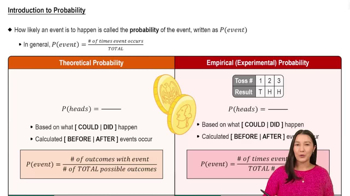
Introduction to Probability
Equally Likely Outcomes
When all outcomes in the sample space have the same chance of occurring, they are called equally likely outcomes. This assumption allows us to calculate probabilities by dividing the number of favorable outcomes by the total number of outcomes.
Recommended video:
Guided course
Adding & Subtracting Like Radicals
Probability of an Event
The probability of an event is the ratio of the number of favorable outcomes to the total number of possible outcomes. For example, the probability of getting two heads (HH) in two coin tosses is the number of outcomes with two heads divided by the total outcomes in the sample space.
Recommended video:
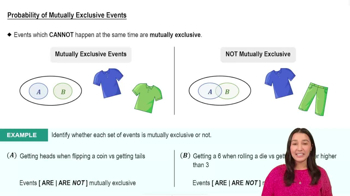
Probability of Mutually Exclusive Events
Watch next
Master Introduction to Probability with a bite sized video explanation from Patrick
Start learningRelated Videos
Related Practice
Multiple Choice
442
views