In Exercises 39-52, a. Find an equation for ƒ¯¹(x). b. Graph ƒ and ƒ¯¹(x) in the same rectangular coordinate system. c. Use interval notation to give the domain and the range of f and ƒ¯¹. ƒ(x) = x² − 4, x ≥ 0
Table of contents
- 0. Review of Algebra4h 18m
- 1. Equations & Inequalities3h 18m
- 2. Graphs of Equations1h 43m
- 3. Functions2h 17m
- 4. Polynomial Functions1h 44m
- 5. Rational Functions1h 23m
- 6. Exponential & Logarithmic Functions2h 28m
- 7. Systems of Equations & Matrices4h 5m
- 8. Conic Sections2h 23m
- 9. Sequences, Series, & Induction1h 22m
- 10. Combinatorics & Probability1h 45m
3. Functions
Function Composition
Problem 49abc
Textbook Question
In Exercises 39-52, a. Find an equation for ƒ¯¹(x). b. Graph ƒ and ƒ¯¹(x) in the same rectangular coordinate system. c. Use interval notation to give the domain and the range off and ƒ¯¹. f(x) = √(x-1)
Verified step by step guidance1
Step 1: To find the inverse function ƒ¯¹(x), start by replacing f(x) with y. This gives y = √(x - 1). Next, swap x and y to reflect the inverse relationship. This results in x = √(y - 1).
Step 2: Solve for y in terms of x to find the inverse function. Square both sides of the equation to eliminate the square root: x² = y - 1. Then, isolate y by adding 1 to both sides: y = x² + 1. Thus, the inverse function is ƒ¯¹(x) = x² + 1.
Step 3: To graph both f(x) and ƒ¯¹(x), plot f(x) = √(x - 1), which is a square root function starting at x = 1 and increasing to the right. For ƒ¯¹(x) = x² + 1, plot a parabola that opens upwards with its vertex at (0, 1). Ensure both graphs are in the same rectangular coordinate system.
Step 4: Determine the domain and range of f(x). Since f(x) = √(x - 1), the domain is [1, ∞) because the square root function is only defined for x - 1 ≥ 0. The range is [0, ∞) because the square root function outputs non-negative values.
Step 5: Determine the domain and range of ƒ¯¹(x). Since ƒ¯¹(x) = x² + 1, the domain is [0, ∞) because the input to the inverse function corresponds to the range of f(x). The range of ƒ¯¹(x) is [1, ∞) because the output of the inverse function corresponds to the domain of f(x).
Verified video answer for a similar problem:This video solution was recommended by our tutors as helpful for the problem above
Video duration:
10mPlay a video:
Was this helpful?
Key Concepts
Here are the essential concepts you must grasp in order to answer the question correctly.
Inverse Functions
An inverse function reverses the effect of the original function. For a function f(x), its inverse f¯¹(x) satisfies the condition f(f¯¹(x)) = x for all x in the domain of f¯¹. To find the inverse, one typically swaps the roles of x and y in the equation and solves for y.
Recommended video:
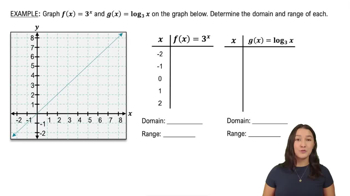
Graphing Logarithmic Functions
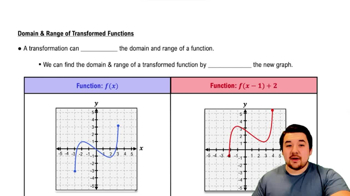
Domain and Range
The domain of a function is the set of all possible input values (x-values) that the function can accept, while the range is the set of all possible output values (y-values) that the function can produce. Understanding the domain and range is crucial for both the original function and its inverse, as they are interchanged in inverse functions.
Recommended video:
Domain & Range of Transformed Functions
Graphing Functions
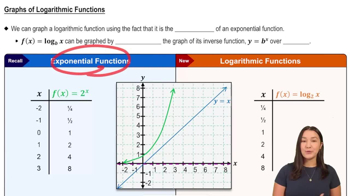
Graphing functions involves plotting points on a coordinate system to visually represent the relationship between the input and output values. When graphing both a function and its inverse, the graphs will be symmetric with respect to the line y = x, illustrating how each function undoes the other.
Recommended video:
Graphs of Logarithmic Functions
Watch next
Master Function Composition with a bite sized video explanation from Patrick
Start learningRelated Videos
Related Practice
Textbook Question
475
views