Use the Binomial Theorem to expand each expression and write the result in simplified form. (x3 +x-2)4
Table of contents
- 0. Review of Algebra4h 18m
- 1. Equations & Inequalities3h 18m
- 2. Graphs of Equations1h 43m
- 3. Functions2h 17m
- 4. Polynomial Functions1h 44m
- 5. Rational Functions1h 23m
- 6. Exponential & Logarithmic Functions2h 28m
- 7. Systems of Equations & Matrices4h 5m
- 8. Conic Sections2h 23m
- 9. Sequences, Series, & Induction1h 22m
- 10. Combinatorics & Probability1h 45m
10. Combinatorics & Probability
Combinatorics
Problem 23
Textbook Question
Use the Binomial Theorem to expand each binomial and express the result in simplified form. (c+2)5
Verified step by step guidance1
Recall the Binomial Theorem formula for expanding \((a + b)^n\):
\[ (a + b)^n = \sum_{k=0}^n \binom{n}{k} a^{n-k} b^k \]
where \(\binom{n}{k}\) is the binomial coefficient calculated as \(\frac{n!}{k!(n-k)!}\).
Identify the values in the given expression \((c + 2)^5\): here, \(a = c\), \(b = 2\), and \(n = 5\).
Write out the expansion terms using the formula:
\[ \sum_{k=0}^5 \binom{5}{k} c^{5-k} (2)^k = \binom{5}{0} c^5 (2)^0 + \binom{5}{1} c^4 (2)^1 + \binom{5}{2} c^3 (2)^2 + \binom{5}{3} c^2 (2)^3 + \binom{5}{4} c^1 (2)^4 + \binom{5}{5} c^0 (2)^5 \]
Calculate each binomial coefficient \(\binom{5}{k}\) for \(k=0\) to \$5\( and write each term explicitly with powers of \)c\( and \)2$.
Simplify each term by evaluating the powers of 2 and multiply by the binomial coefficients, then combine all terms to write the final expanded polynomial.
Verified video answer for a similar problem:This video solution was recommended by our tutors as helpful for the problem above
Video duration:
9mPlay a video:
Was this helpful?
Key Concepts
Here are the essential concepts you must grasp in order to answer the question correctly.
Binomial Theorem
The Binomial Theorem provides a formula to expand expressions of the form (a + b)^n, where n is a non-negative integer. It states that (a + b)^n equals the sum of terms involving binomial coefficients multiplied by powers of a and b. This theorem simplifies the expansion process without multiplying the binomial repeatedly.
Recommended video:
Guided course
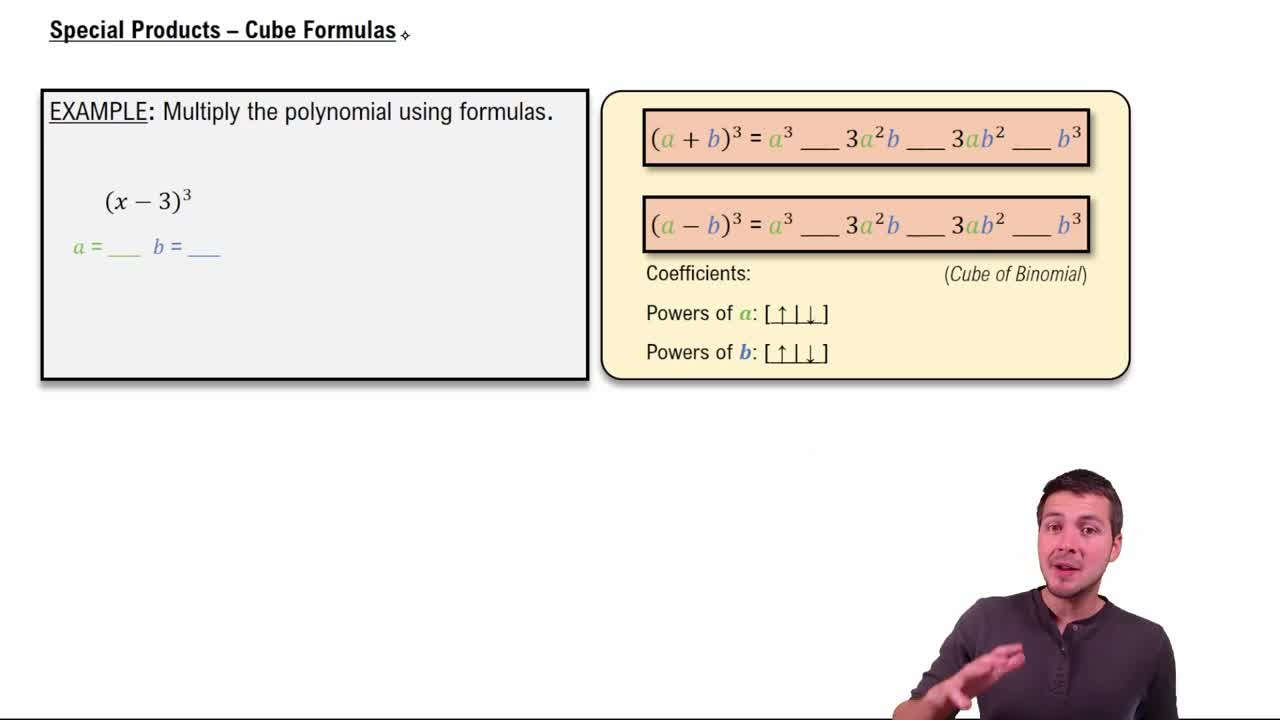
Special Products - Cube Formulas
Binomial Coefficients
Binomial coefficients, denoted as C(n, k) or "n choose k," represent the number of ways to choose k elements from a set of n elements. They appear as coefficients in the binomial expansion and can be found using Pascal's Triangle or the formula C(n, k) = n! / (k!(n-k)!). These coefficients determine the weight of each term in the expansion.
Recommended video:
Guided course
Special Products - Cube Formulas
Exponent Rules in Expansion
When expanding (a + b)^n, each term involves powers of a and b such that the exponents add up to n. Specifically, the k-th term has a raised to the power (n-k) and b raised to the power k. Understanding how to apply exponent rules ensures correct simplification of each term in the expanded expression.
Recommended video:
Guided course
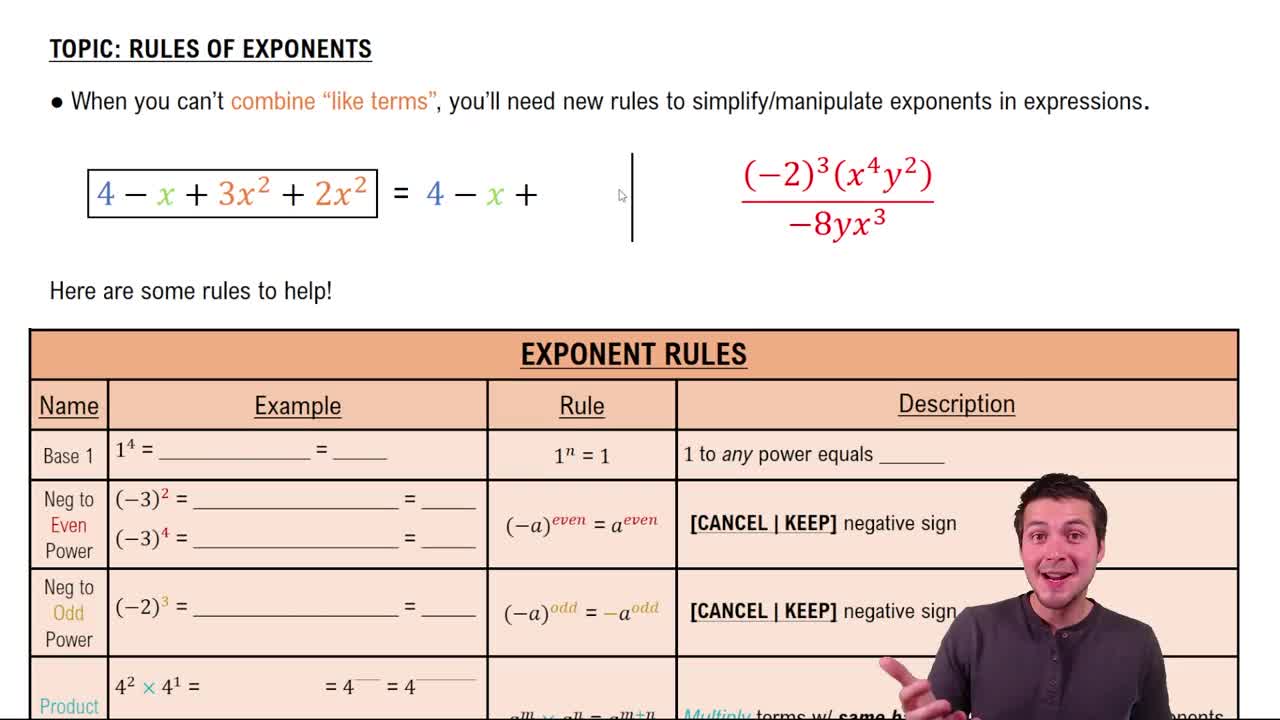
Introduction to Exponent Rules
Watch next
Master Fundamental Counting Principle with a bite sized video explanation from Patrick
Start learningRelated Videos
Related Practice
Textbook Question
544
views