Determine whether each statement is true or false. If false, correct the right side of the equation. (3x2)-1 = 3x-2
Verified step by step guidance
1
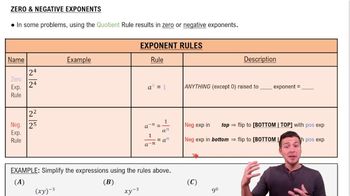
Start by examining the left side of the equation: \((3x^2)^{-1}\). Recall that a negative exponent means taking the reciprocal, so \((a)^{-1} = \frac{1}{a}\).
Rewrite the left side using this rule: \((3x^2)^{-1} = \frac{1}{3x^2}\).
Now, look at the right side of the equation: \$3x^{-2}\(. Using the negative exponent rule, \)x^{-2} = \frac{1}{x^2}\(, so \)3x^{-2} = 3 \times \frac{1}{x^2} = \frac{3}{x^2}$.
Compare the two expressions: the left side is \(\frac{1}{3x^2}\) and the right side is \(\frac{3}{x^2}\). Since these are not equal, the original statement is false.
To correct the right side so the equation holds true, write it as \(\frac{1}{3x^2}\) or equivalently \(\frac{1}{3} x^{-2}\).
Verified video answer for a similar problem:
This video solution was recommended by our tutors as helpful for the problem above
Video duration:
2m
Play a video:
Was this helpful?
Key Concepts
Here are the essential concepts you must grasp in order to answer the question correctly.
Negative Exponents
A negative exponent indicates the reciprocal of the base raised to the positive exponent. For example, x^(-n) equals 1 divided by x^n. Understanding this helps in rewriting expressions with negative powers correctly.
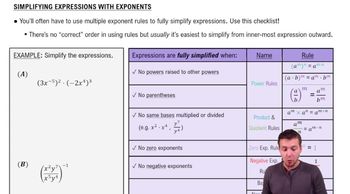
When raising a product to an exponent, apply the exponent to each factor separately: (ab)^n = a^n * b^n. This rule is essential for correctly expanding expressions like (3x^2)^-1.
Simplification involves applying exponent rules and combining like terms to rewrite expressions in a clearer or more standard form. This skill is necessary to verify or correct equations involving exponents.