Begin by graphing the absolute value function, f(x) = |x|. Then use transformations of this graph to graph the given function. g(x) = |x+3|
Table of contents
- 0. Review of Algebra4h 18m
- 1. Equations & Inequalities3h 18m
- 2. Graphs of Equations1h 43m
- 3. Functions2h 17m
- 4. Polynomial Functions1h 44m
- 5. Rational Functions1h 23m
- 6. Exponential & Logarithmic Functions2h 28m
- 7. Systems of Equations & Matrices4h 5m
- 8. Conic Sections2h 23m
- 9. Sequences, Series, & Induction1h 22m
- 10. Combinatorics & Probability1h 45m
3. Functions
Transformations
Problem 92
Textbook Question
What is the relationship between the graphs of ƒ(x)=|x| and g(x)=|-x|?
Verified step by step guidance1
Recall the definition of the absolute value function: for any real number \(x\), \(|x|\) represents the distance of \(x\) from zero on the number line, which is always non-negative.
Write down the two functions explicitly: \(f(x) = |x|\) and \(g(x) = |-x|\).
Use the property of absolute value that states \(|a| = |-a|\) for any real number \(a\). Applying this to \(g(x)\), we get \(g(x) = |-x| = |x|\).
Conclude that since \(g(x)\) simplifies to \(|x|\), the graphs of \(f(x)\) and \(g(x)\) are identical.
Therefore, the relationship between the graphs of \(f(x)\) and \(g(x)\) is that they coincide exactly; they are the same graph.
Verified video answer for a similar problem:This video solution was recommended by our tutors as helpful for the problem above
Video duration:
1mPlay a video:
Was this helpful?
Key Concepts
Here are the essential concepts you must grasp in order to answer the question correctly.
Absolute Value Function
The absolute value function, denoted |x|, outputs the non-negative value of x regardless of its sign. It creates a V-shaped graph symmetric about the y-axis, reflecting all negative inputs as positive outputs.
Recommended video:
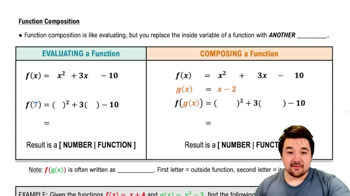
Function Composition
Function Transformation and Symmetry
Understanding how transformations affect graphs is key. Replacing x with -x reflects the graph across the y-axis. Since |x| is symmetric about the y-axis, this transformation does not change the graph's shape or position.
Recommended video:
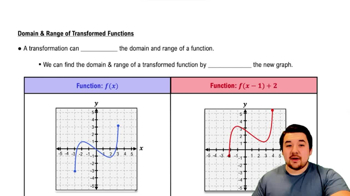
Domain & Range of Transformed Functions
Graph Comparison
Comparing graphs involves analyzing their shapes, positions, and symmetries. Since ƒ(x) = |x| and g(x) = |-x| produce identical outputs for all x, their graphs coincide, illustrating that g(x) is essentially the same function as ƒ(x).
Recommended video:
Guided course
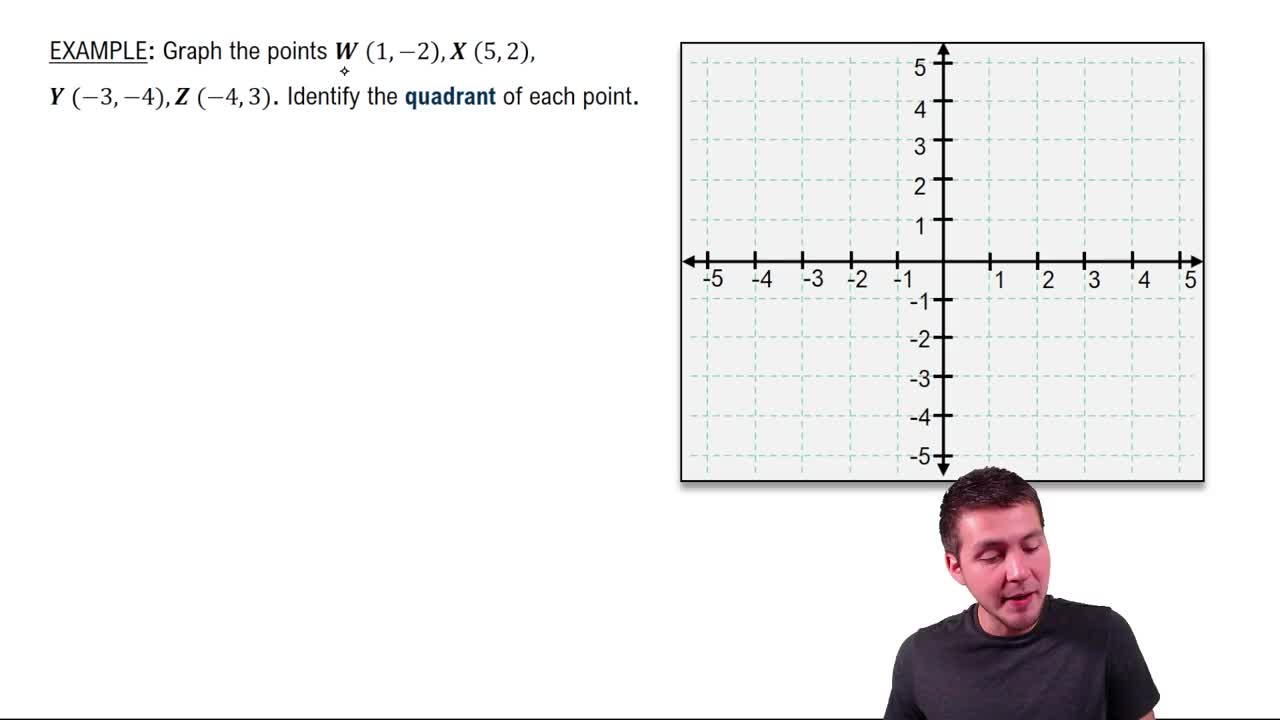
Graphs and Coordinates - Example
Watch next
Master Intro to Transformations with a bite sized video explanation from Patrick
Start learningRelated Videos
Related Practice
Textbook Question
587
views