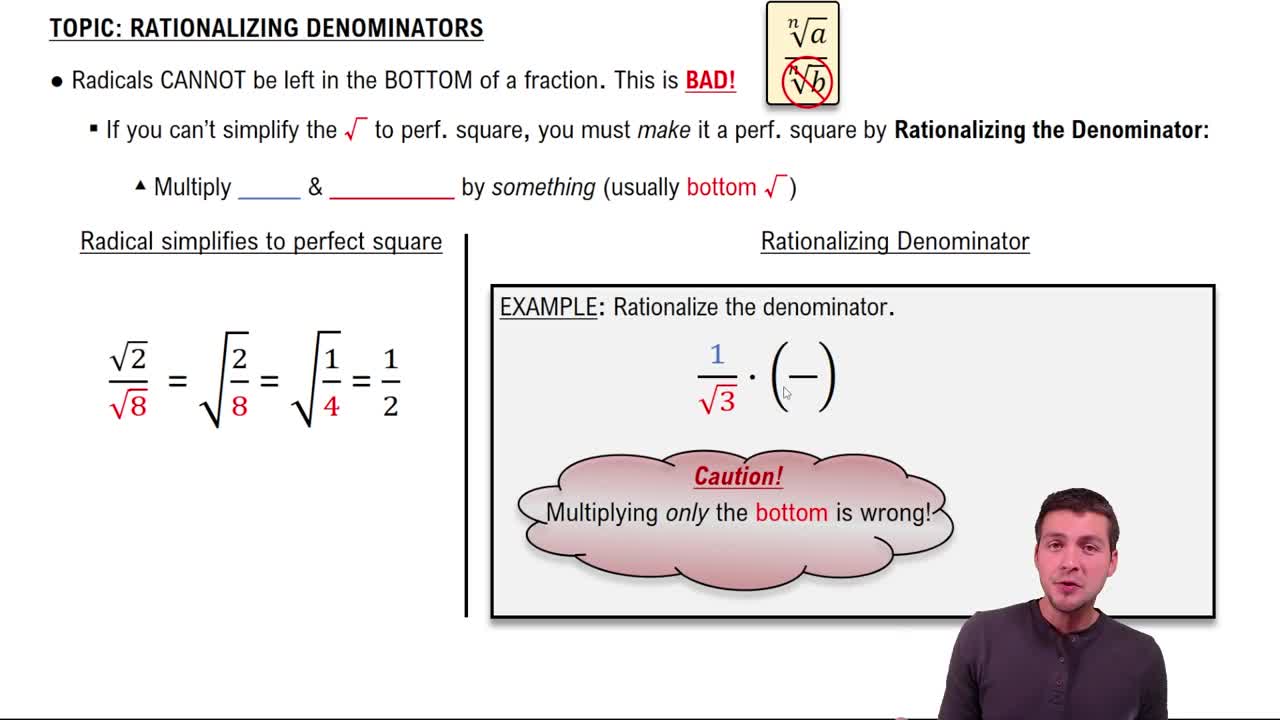
Identify the expression to rationalize: \(\frac{\sqrt{2}}{\sqrt{5}}\). The goal is to eliminate the square root from the denominator.
Multiply both the numerator and the denominator by \(\sqrt{5}\), which is the conjugate in this case, to rationalize the denominator. This gives: \(\frac{\sqrt{2}}{\sqrt{5}} \times \frac{\sqrt{5}}{\sqrt{5}}\).
Use the property of square roots that \(\sqrt{a} \times \sqrt{a} = a\) to simplify the denominator: \(\sqrt{5} \times \sqrt{5} = 5\).
Write the new expression with the rationalized denominator: \(\frac{\sqrt{10}}{5}\). This is the simplified form with no radical in the denominator.
Verified video answer for a similar problem:
This video solution was recommended by our tutors as helpful for the problem above
Video duration:
2m
Play a video:
Was this helpful?
Key Concepts
Here are the essential concepts you must grasp in order to answer the question correctly.
Rationalizing the Denominator
Rationalizing the denominator involves eliminating any radicals (square roots) from the denominator of a fraction. This is done by multiplying the numerator and denominator by a suitable expression that will remove the radical from the denominator, making the expression easier to interpret and use.
Square roots have properties such as \( \sqrt{a} \times \sqrt{b} = \sqrt{ab} \) and \( \frac{\sqrt{a}}{\sqrt{b}} = \sqrt{\frac{a}{b}} \). Understanding these properties helps simplify expressions involving radicals and is essential when rationalizing denominators.
To rationalize a denominator, multiply the fraction by a form of one that contains the radical in the denominator, such as \( \frac{\sqrt{5}}{\sqrt{5}} \). This does not change the value of the expression but helps eliminate the radical from the denominator.