Evaluate each expression or indicate that the root is not a real number. 37
Verified step by step guidance
1
First, recognize that the expression involves a division of square roots: \( \frac{\sqrt{7}}{\sqrt{3}} \).
To simplify this expression, use the property of square roots that allows you to combine them: \( \frac{\sqrt{a}}{\sqrt{b}} = \sqrt{\frac{a}{b}} \).
Apply this property to the expression: \( \sqrt{\frac{7}{3}} \).
To simplify further, you can rationalize the denominator if needed, but in this case, the expression is already simplified as a single square root.
Finally, evaluate \( \sqrt{\frac{7}{3}} \) to determine if it is a real number. Since both 7 and 3 are positive, the expression under the square root is positive, confirming that the root is a real number.
Verified video answer for a similar problem:
This video solution was recommended by our tutors as helpful for the problem above
Video duration:
2m
Play a video:
Was this helpful?
Key Concepts
Here are the essential concepts you must grasp in order to answer the question correctly.
Simplifying Radicals
Simplifying radicals involves expressing a square root in its simplest form by factoring out perfect squares. For example, √12 can be simplified to 2√3 because 12 = 4 × 3 and √4 = 2. This process helps in making expressions easier to work with and compare.
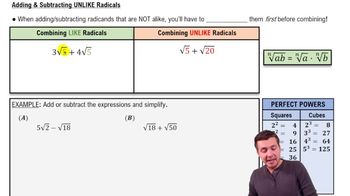
Adding & Subtracting Unlike Radicals by Simplifying
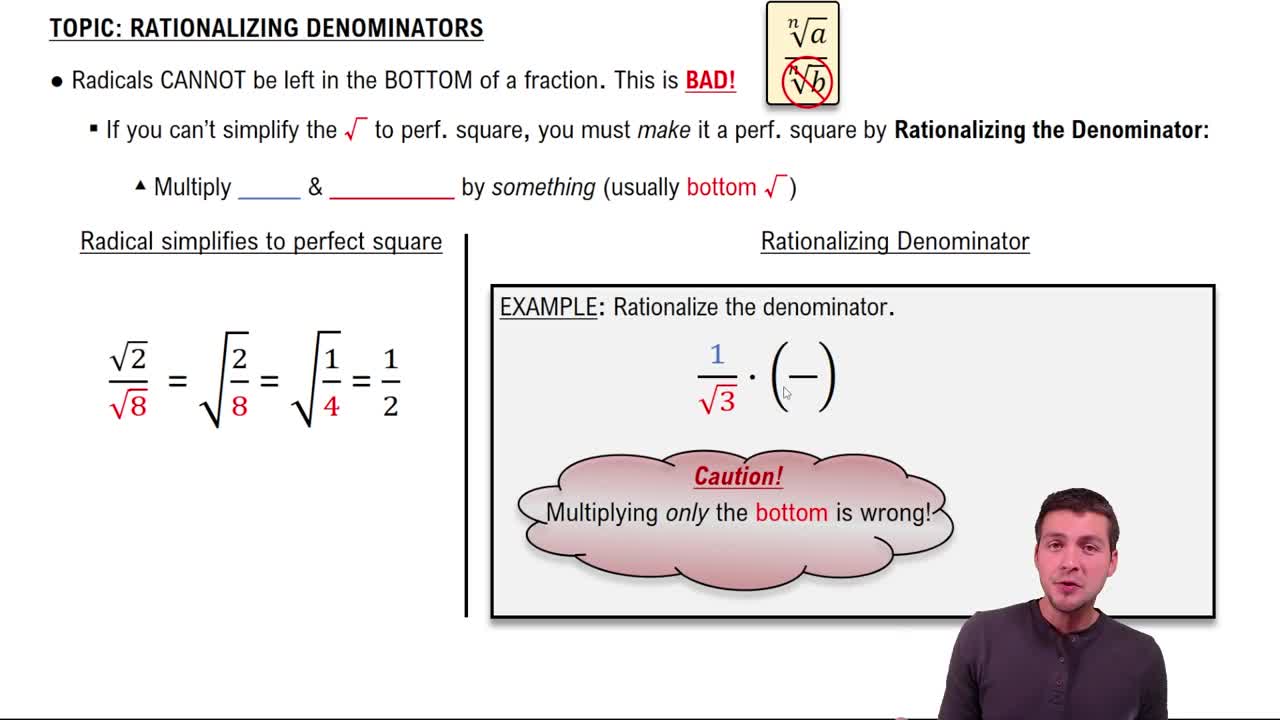
Rationalizing the Denominator
Rationalizing the denominator means eliminating any radicals from the denominator of a fraction. This is done by multiplying numerator and denominator by a suitable radical to create a rational number in the denominator. For example, to rationalize 1/√3, multiply by √3/√3 to get √3/3.
The property √a/√b = √(a/b) allows combining or separating radicals in fractions. Understanding this helps in rewriting expressions like (√7)/(√3) as √(7/3), which can then be simplified or rationalized. This property is fundamental in manipulating radical expressions.