Factor ƒ(x) into linear factors given that k is a zero. See Example 2. ƒ(x)=x^4+2x^3-7x^2-20x-12; k=-2 (multiplicity 2)
Verified step by step guidance
1
Step 1: Since k = -2 is a zero of multiplicity 2, we know that (x + 2)^2 is a factor of ƒ(x).
Step 2: Perform polynomial division to divide ƒ(x) by (x + 2)^2. This will help us find the other factors of ƒ(x).
Step 3: Set up the division, aligning terms of ƒ(x) and (x + 2)^2. Carefully subtract and bring down terms as you would in long division.
Step 4: Simplify the quotient obtained from the division. This quotient is a polynomial of degree 2, which can be factored further or solved using the quadratic formula.
Step 5: Factorize or solve the quadratic equation obtained in Step 4 to find the remaining linear factors of ƒ(x).
Verified video answer for a similar problem:
This video solution was recommended by our tutors as helpful for the problem above
Video duration:
12m
Play a video:
Was this helpful?
Key Concepts
Here are the essential concepts you must grasp in order to answer the question correctly.
Factoring Polynomials
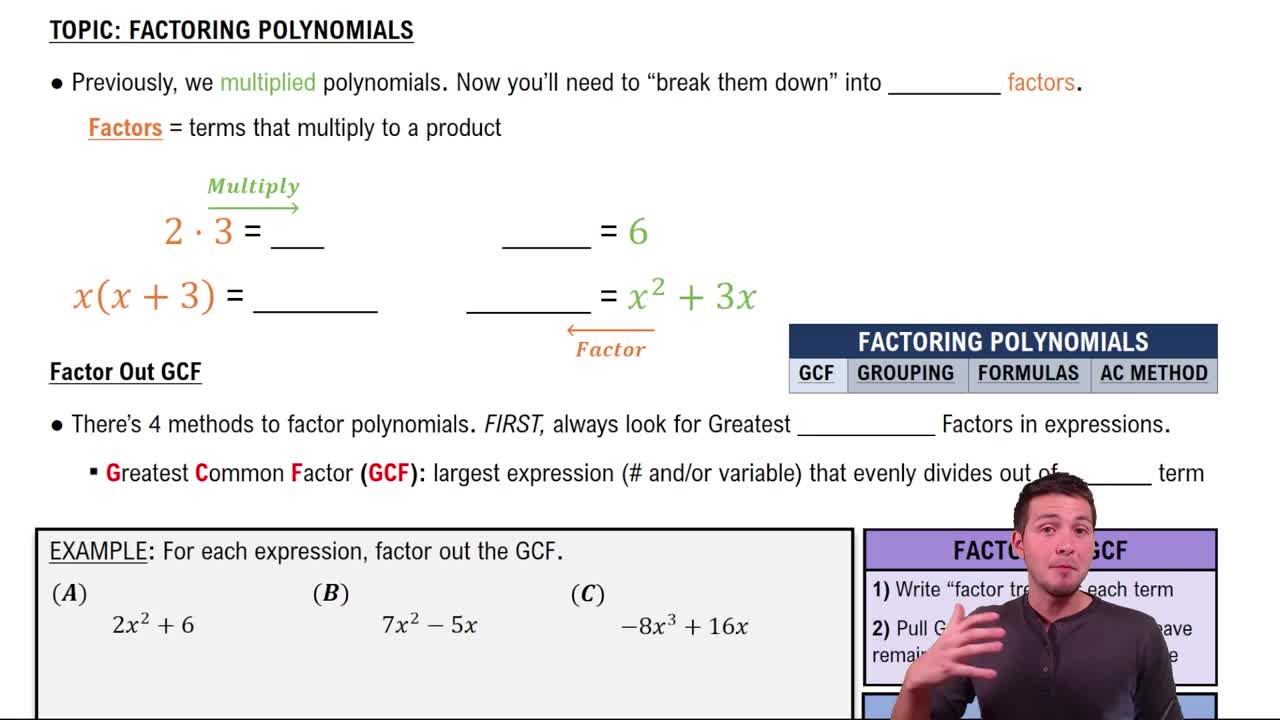
Factoring polynomials involves expressing a polynomial as a product of its simpler components, or factors. This process is essential for solving polynomial equations and can often reveal the roots or zeros of the polynomial. In this case, knowing that k = -2 is a zero helps in identifying one of the factors, which can be expressed as (x + 2)² due to its multiplicity.
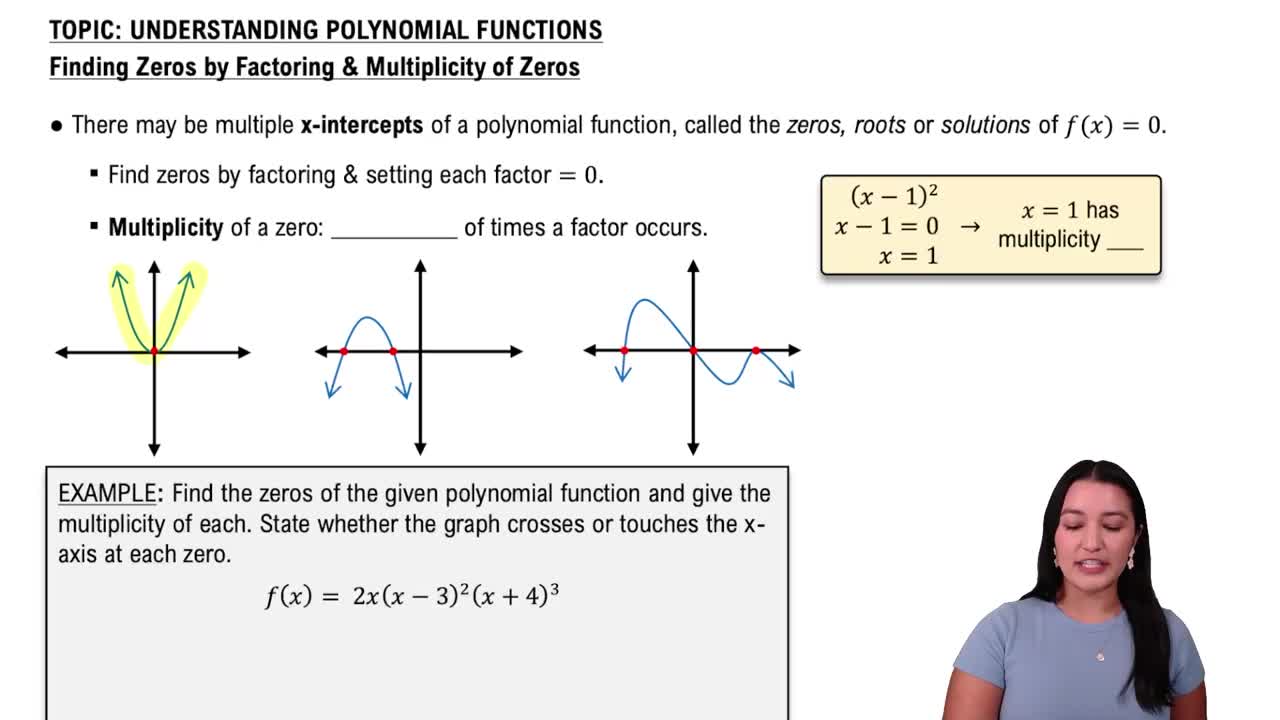
Multiplicity refers to the number of times a particular zero appears in a polynomial. A zero with a multiplicity greater than one indicates that the corresponding factor is repeated. For example, if k = -2 has a multiplicity of 2, it means that (x + 2) is a factor that appears twice in the factorization of the polynomial, affecting the shape of the graph at that zero.
The Rational Root Theorem provides a method for identifying possible rational roots of a polynomial equation. It states that any rational solution, expressed as a fraction p/q, must have p as a factor of the constant term and q as a factor of the leading coefficient. This theorem can guide the process of finding zeros, which is crucial for factoring the polynomial completely.